73 Easting: Episode 20 — Fire Support in the Storm
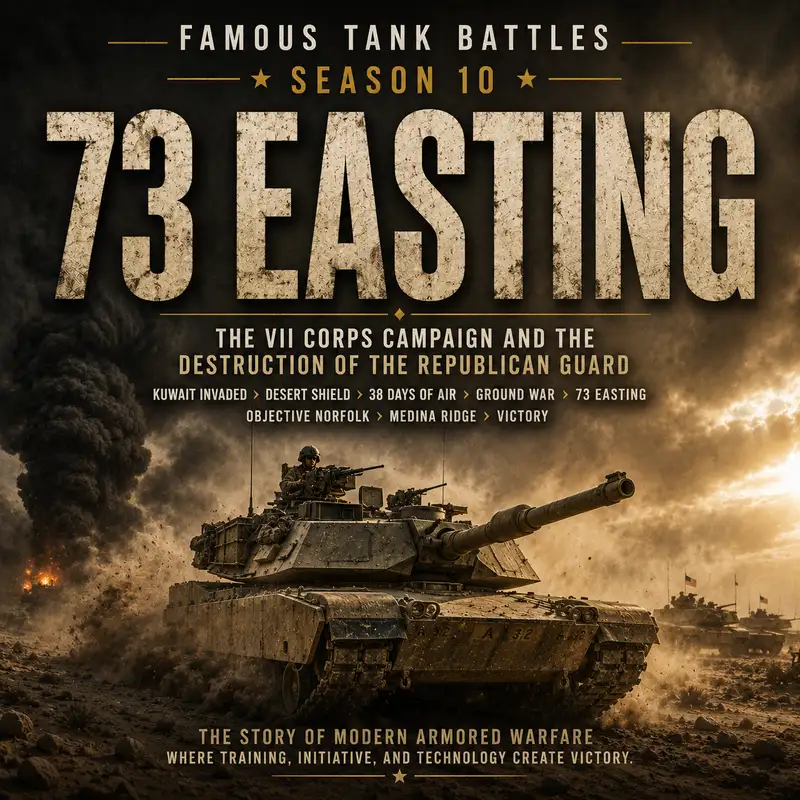
The battle at 73 Easting is often remembered through the narrow slit of a tank sight: Iraqi vehicles glowing in thermal images, Abrams crews firing through dust, Bradleys moving with scouts inside a storm. That memory is not wrong, but it is incomplete. The cavalry did not fight alone out there on the grid lines. Behind and above the troop fights stood the guns, helicopters, observers, fire direction centers, ammunition crews, radio operators, and commanders who made sure Iraqi armor and artillery could not settle into a stable defense. Fire support in the storm was not background noise. It was one of the reasons the 2d Armored Cavalry Regiment could keep moving while the Iraqi defensive system broke apart around it.
If you would like to move beyond the podcast, you can see my available books at Military Author dot me. And at Trackpads dot com, you will find magazines and galleries with hundreds of thousands of photos and videos to explore.
Artillery is sometimes hard to make vivid because the gun crews are often far from the target and the effects arrive somewhere else. But in a fast armored battle, artillery is not distant in any meaningful sense. It reaches ahead of the tanks, falls on enemy positions before crews can see them clearly, and strikes batteries or assembly areas that would otherwise threaten the advance. At 73 Easting, the regiment’s fight was moving through dust, poor visibility, and a battlefield crowded with hidden positions. The guns gave the cavalry a longer arm. They could disrupt enemy artillery, suppress defensive positions, and add shock at the moment Iraqi commanders needed calm more than anything else.
The 6th Battalion, 41st Field Artillery played a central role in this part of the battle, firing in direct support of 2d Squadron during the fighting. Its batteries sent more than seven hundred rounds into the storm, a number that matters not as a statistic for its own sake, but because it hints at the rhythm of support behind the cavalry’s movement. Each round belonged to a chain of work: observers or commanders identifying a need, fire direction teams turning that need into data, crews loading and firing, ammunition moving forward, radios carrying corrections, and leaders deciding where the next weight of fire should fall. The shells were only the visible end of an invisible system.
For the cavalry troops at the front, that system meant they did not have to solve every problem with direct fire alone. An Abrams could kill a tank it could see. A Bradley could engage a bunker, a vehicle, or an infantry position within its reach. But enemy artillery, deeper positions, and concentrations beyond immediate sight required another answer. When Iraqi guns fired or threatened to fire, counterfire and suppression could keep them from gaining the time they needed. When enemy positions appeared ahead of the troop’s movement, artillery could hammer the area, forcing defenders to keep down, move badly, or die before they could organize. This is what combined arms really means in practice: each weapon covering the limits of another.
The dust storm made all of this harder. Fire support depends on information, and information in a shamal becomes partial, delayed, and blurred. Observers may not see far. Crews may not know exactly what lies beyond the next rise. Commanders hear reports that must be sorted quickly from radio traffic already strained by movement and combat. The danger is obvious: fire too slowly, and the enemy recovers; fire too carelessly, and friendly units moving fast through poor visibility may be endangered. The American advantage was not that the storm vanished for them. It was that training, procedures, radios, maps, and discipline allowed them to use artillery even when the battlefield refused to become clear.
Attack helicopters added another dimension to the fight. They were not floating tanks, and they did not replace the armored troops moving on the ground. Their value lay in reach, angle, and the ability to strike threats that might be difficult for the cavalry to engage directly. During the battle, helicopters struck Iraqi batteries and helped prevent enemy artillery from becoming a steady hand on the American advance. This mattered because Iraqi artillery was one of the weapons that could have slowed the regiment, forced halts, damaged vehicles, and created the confusion defenders needed. If the Iraqis could not stabilize their guns, they could not easily stabilize the battle.
Helicopters in that environment faced their own dangers and limits. Dust can be as hostile to aircraft as it is to tank crews, and low visibility complicates navigation, target identification, and coordination with friendly forces. The helicopter crews had to work inside the same uncertain battlefield, where American vehicles were moving, Iraqi vehicles were burning or shifting, and the line between opportunity and hazard could change quickly. Their attacks were effective because they were tied to the larger fight rather than thrown into it casually. Aviation became part of the regiment’s pressure, striking enemy artillery and armor so that the ground troops could maintain the initiative. The sky and ground were not separate wars. They were two layers of the same fight.
This is where 73 Easting becomes much richer than a story of first-shot tank kills. The American cavalry’s famous speed came from more than engines. It came from a web of support that kept Iraqi reactions broken. A defender under direct fire may still recover if his artillery can answer, if reserves can move, if commanders can identify the attacker’s axis, and if protected positions can hold long enough to restore order. Fire support attacked those possibilities. Artillery and helicopters did not merely destroy things; they stole time. They made it harder for Iraqi crews, observers, and commanders to connect their local fights into a coherent defense. In armored warfare, stealing time is often as decisive as destroying vehicles.
For the Iraqi soldiers under that fire, the experience must have been disorienting and terrifying. Many had already lived through weeks of coalition air attack, and now the ground fight brought direct tank fire, Bradley fire, artillery, and helicopter strikes into the same storm. A position that seemed concealed could be hit by tank fire. A battery that tried to support the defense could be struck before it shaped the battle. Movement could invite attention from ground or air. Remaining in place could mean being destroyed in a revetment or bunker. The Iraqi defense suffered not just because American weapons were powerful, but because those weapons arrived in overlapping forms that denied safe choices.
The American troops were not immune to fear, confusion, or danger simply because they had better fire support. In fact, the more powerful the supporting fires became, the more important control became. Fast-moving friendly armor, poor visibility, and heavy supporting fire are a dangerous combination if coordination breaks down. Soldiers had to know where they were, where neighboring units were, where fires were falling, and when to shift or cease fire as the cavalry advanced. A successful fire support system is therefore not simply a matter of having many guns. It is a matter of timing, restraint, trust, and shared understanding. Fire that lands in the right place at the wrong time can become disaster.
The fire supporters also depended on logistics as surely as tank crews depended on fuel. More than seven hundred artillery rounds did not appear by wish or courage. They had to be transported, stored, handled, loaded, and replenished by soldiers whose work rarely becomes famous. Gun tubes, vehicles, radios, ammunition carriers, and maintenance teams all had to keep functioning in desert conditions that punished machinery. The battle at the front consumed resources at speed, and the support system had to feed that consumption without slowing the armored movement. This is another reason modern armored warfare is never only a tank story. Every visible act of combat rests on a supply chain strong enough to keep violence sustained.
Fire support also connected 73 Easting to the larger evolution of armored warfare. In the First World War, tanks often moved with artillery plans that were rigid and difficult to adjust once the attack began. In the Second World War, the best armored forces learned to integrate artillery, aircraft, engineers, reconnaissance, and tanks more fluidly, but communication and visibility still imposed harsh limits. By 1991, the coordination was faster, the reach was longer, and the expectation of combined arms was built into the force. The tank remained the battlefield’s central image, but the battle was won by a system that could see, shoot, shift, and support at a tempo the Iraqi defense could not match.
Fire Support in the Storm matters because it restores the hidden weight behind the famous cavalry fight. Iron, Eagle, and Ghost did not win by courage and machines alone, even though courage and machines were essential. They fought inside a network of artillery and aviation that kept enemy armor and artillery from turning scattered resistance into a stable line. The guns and helicopters widened the regiment’s reach, broke Iraqi attempts to recover, and gave the cavalry the confidence to keep moving through uncertainty. At 73 Easting, modern armored warfare revealed itself not as a duel between tanks, but as a storm of coordinated arms. The dust hid much of that system from view, but it was there, firing, flying, calculating, loading, correcting, and making movement possible.