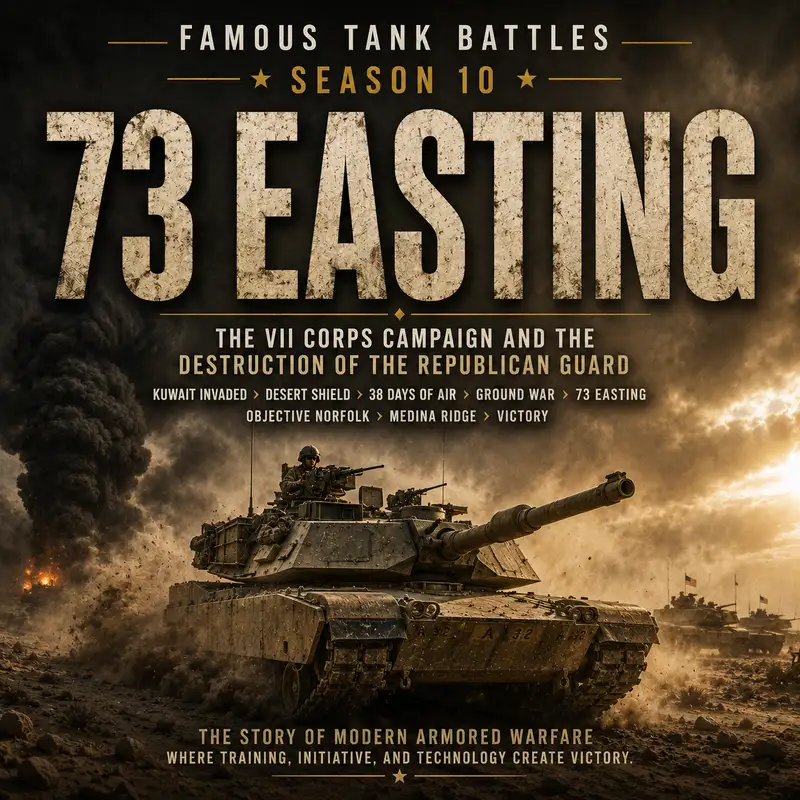
73 Easting: Episode 6 — The Corps Cavalry
The first Americans to meet the Republican Guard in the great armored fight were not supposed to be the whole fist. They were the fingers reaching ahead of it, feeling through dust, distance, and uncertainty for the shape of the enemy. That was the role of the 2d Armored Cavalry Regiment, the corps cavalry for VII Corps, a formation built to move in front of heavier divisions and keep them from blundering blind into danger. Cavalry in this setting did not mean horsemen or romantic raiders from another century. It meant armored scouts, tanks, Bradleys, artillery, engineers, helicopters, and radios, all organized to find, screen, warn, delay, and, if necessary, fight. At 73 Easting, that last phrase would become the hinge of the whole story.
If you would like to move beyond the podcast, you can see my available books at Military Author dot me. And at Trackpads dot com, you will find magazines and galleries with hundreds of thousands of photos and videos to explore.
The 2d Armored Cavalry Regiment carried an old name into a very modern war. Its lineage reached back through earlier American conflicts, but in 1991 it was a Cold War armored cavalry unit stationed in Germany and trained for the grim possibility of fighting Soviet forces in Europe. Its soldiers were accustomed to thinking of themselves as the eyes and shield of a corps. They were expected to move ahead of the main body, make contact with the enemy, identify strengths and weaknesses, and give the larger force time to deploy. That sounds neat in a manual, but on a battlefield it is a dangerous calling. The cavalry is out front by design, close enough to find trouble before anyone else, and often too far forward to feel entirely safe.
A corps cavalry regiment was not a light patrol with binoculars. It was a powerful combined-arms formation in its own right, with squadrons that included tanks, armored cavalry troops, artillery support, air cavalry, and the command systems needed to operate across a wide front. Its Bradleys carried scouts who could observe, fight, and report from armored vehicles, while its Abrams tanks gave the regiment real striking power when reconnaissance became combat. This mattered because modern reconnaissance is rarely a matter of simply looking and leaving. An enemy worth finding is also an enemy trying to hide, deceive, delay, or kill the scouts who discover him. The cavalry needed enough force to survive contact and enough discipline not to become so absorbed in battle that it forgot its larger purpose.
For VII Corps commander Frederick Franks, the regiment was essential because the corps was too large and too valuable to move blindly. Behind the cavalry came heavy divisions whose strength depended on timing and direction. If the corps turned east too soon, it might miss key Iraqi formations. If it turned too late, the Republican Guard might escape or reposition. If it collided unexpectedly with a strong defense, the result could be confusion across miles of moving vehicles. The cavalry’s job was to reduce that uncertainty. It had to find the enemy, maintain contact, define the battlefield, and pass information quickly enough for commanders behind it to make decisions while the campaign was still moving.
The commander of the regiment, Colonel Don Holder, had to balance caution and aggression in a way that cavalry leaders have always understood. A timid screen sees too little and gives the main body a false sense of safety. A reckless screen charges too far, loses coherence, and risks being destroyed before it can provide useful warning. Holder’s regiment needed to move boldly, but not blindly; fight hard, but not squander itself; report clearly, but not slow the advance with indecision. That balance became even more difficult because the Gulf battlefield was enormous. A cavalry regiment that might once have screened roads, villages, and wooded approaches in Germany now had to cover desert space where distance could stretch command and visibility could vanish in dust.
The regiment’s position in front of the 1st Infantry Division gave its mission particular importance. The division, despite its old infantry name, was a mechanized heavy formation with tanks, Bradleys, artillery, engineers, and the mass needed to break into the deeper Iraqi defense. But a heavy division takes room to deploy and time to bring its full power to bear. It cannot simply sprint forward through an unknown enemy screen without risking surprise, congestion, and friendly confusion. The 2d Armored Cavalry Regiment moved ahead like a moving guardrail, keeping the division oriented and protected while also forcing the Iraqis to reveal themselves. When the cavalry found real resistance, the information it sent back would shape how the heavier force followed.
This was reconnaissance in the mature age of armored warfare, and it was far removed from the image of a lone scout peering over a hill. The regiment searched with vehicles, sensors, patrols, aircraft, maps, radios, and disciplined movement. It listened as well as looked, gathering reports from subordinate troops and building a picture from fragments. A burning vehicle, a minefield, an artillery impact, a bunker, a line of revetments, or a sudden burst of fire could all mean something larger. The challenge was to interpret those signs quickly without imagining certainty where none existed. In fast armored war, information is never perfect. The side that wins is often the side that can act intelligently while the picture is still incomplete.
The Iraqi army waiting ahead was not a faceless mass. Its forward security zones, defensive positions, tanks in prepared emplacements, infantry bunkers, artillery, and minefields were part of a system designed to slow and damage an attacker before the main formations were forced into decisive battle. Elements of Iraqi armored and mechanized divisions stood between VII Corps and the Republican Guard formations that mattered most. Some Iraqi units were poorly led or demoralized after weeks of bombing, but others still had weapons that could kill and positions that could surprise. The cavalry could not assume that airpower had emptied the battlefield. It had to approach as though every rise, every wadi, every cluster of vehicles might conceal a fight.
The desert weather deepened the uncertainty. Dust and wind could narrow the world until a huge battlefield became a gray room. Vehicles threw up their own clouds, artillery and movement stirred the ground, and a shamal, the regional windstorm that could fill the air with sand, made vision unreliable. Yet the Americans possessed a powerful advantage in thermal sights, which allowed crews to detect heat signatures through darkness and some battlefield obscuration. That advantage was real, but it was not magic. A thermal image still had to be interpreted by a tired human being in a moving vehicle, under pressure, while radio traffic crackled and the unit tried to keep its formation. Technology helped the cavalry see, but training taught it what seeing meant.
The regiment’s culture mattered as much as its equipment. Armored cavalry lived close to initiative because its troops operated forward, often at the edge of what higher headquarters could fully control. Junior leaders had to understand the commander’s intent, not merely wait for instructions. They needed to know when to push, when to halt, when to report, when to bypass, and when to fight through. In a rigid army, a forward unit might freeze when the situation changed faster than orders could arrive. In the American system at its best, disciplined initiative allowed leaders to act within the purpose of the mission. The coming battle at 73 Easting would show how much that habit mattered when control measures, enemy contact, and opportunity all collided.
There was a paradox in the cavalry’s mission. It was meant to protect the corps from surprise, but in doing so it accepted surprise onto itself. The first sudden contact, the first ambush, the first unexpected minefield, the first glimpse of a hidden tank line would fall on the regiment, not on the divisions behind it. That is why armored cavalry had to be more than brave. It had to be composed. A frightened unit might fire wildly, miss what mattered, or report confusion as fact. A well-trained cavalry unit could absorb the shock of contact and turn it into knowledge. It could tell the corps not just that the enemy was present, but where he was, how he was arranged, and whether he could be beaten in motion.
As VII Corps pushed deeper into Iraq and began the great turn east, the 2d Armored Cavalry Regiment moved into the space between plan and reality. On the map, the western envelopment looked clean, almost graceful: sweep wide, turn east, find the Republican Guard, and destroy it. On the ground, that elegance became dust, intervals, fuel, radio calls, vehicle breakdowns, uncertain sightings, and the pressure of keeping the corps moving without outrunning understanding. The cavalry was the formation that translated the broad arrow into contact. Its scouts and tank crews would be the first to learn whether the Iraqi defense was collapsing, withdrawing, or waiting. Their reports would help decide whether VII Corps was still maneuvering toward battle or already in it.
By the time the regiment approached the grid lines that would make 73 Easting famous, it had become something more than a screen in the narrow sense. This was one of the revelations of Desert Storm: armored cavalry began as a security force, but the speed and violence of the campaign could turn it into a main battle force almost without warning. When the enemy appeared, the cavalry could not always step aside and let someone else do the fighting. It had to engage, survive, and keep moving long enough for the rest of the corps to arrive. That blurred line between reconnaissance and battle is the key to understanding why 73 Easting was so dramatic. The unit sent to find the fight became, for a time, the unit fighting it.
The Corps Cavalry matters because it reminds us that armored warfare is not only about the largest formations or the heaviest tanks. It is about who sees first, understands first, and acts first. The 2d Armored Cavalry Regiment stood at the front of VII Corps not as a decorative spearpoint, but as the living instrument that connected movement to knowledge. Its mission demanded machines, but also judgment; firepower, but also restraint; speed, but also discipline. In earlier eras, tanks had often been thrown forward in hope that shock alone would decide the day. In the desert of 1991, shock still mattered, but it had to be guided by reconnaissance and command initiative. Before 73 Easting became a battle, it was a cavalry problem: ride ahead of the army, find the enemy in the storm, and hold the door open for the blow behind you.