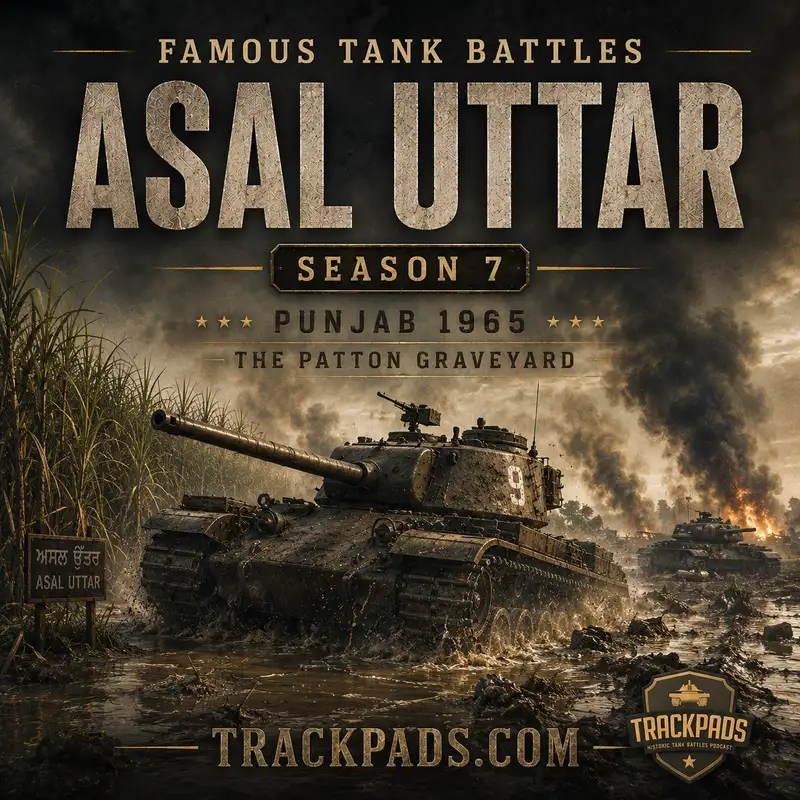
Asal Uttar: Episode 15 — 3rd Cavalry
3rd Cavalry entered the Asal Uttar battle as the armored reserve that could turn a strained defense into a killing zone. The regiment’s Centurion tanks brought heavier striking power than the older Shermans of Deccan Horse, and their arrival mattered because the Indian defensive box needed more than courage and obstacles. It needed mobile, protected firepower placed where Pakistan’s thrust would become vulnerable. This episode is about reserve armor used at the right moment and in the right setting. Reinforcements in war do not matter merely because they arrive. They matter when they arrive into a plan, when commanders know where to send them, and when their presence turns delay into destruction.
If you would like to move beyond the podcast, you can see my available books at Military Author dot me. And at Trackpads dot com, you will find magazines and galleries with hundreds of thousands of photos and videos to explore.
3rd Cavalry was equipped with Centurions, British-designed tanks that had earned a reputation as solid, hard-fighting machines. By 1965, the Centurion was not a new concept, but it remained a respected battle tank because it combined protection, firepower, and a stable fighting platform. Against Pakistani Pattons, it gave Indian crews a weapon that could engage with confidence if the tactical conditions were right. That last phrase is essential. The Centurion was not a magic answer. No tank is. Its value at Asal Uttar came from the way it was committed into a battlefield already shaped by mines, flooding, infantry positions, and the earlier resistance of Deccan Horse. The tank was powerful, but the situation made it decisive.
The regiment was part of India’s armored resources in the sector under the broader control of commanders trying to stabilize the Khem Karan front. Brigadier Thomas K. Theogaraj, commanding 2 Independent Armoured Brigade, and Lieutenant Colonel Salim Caleb of 3rd Cavalry were among the leaders associated with the armored response. Their task was not simply to rush tanks toward danger. It was to fit armored strength into the defensive box around Asal Uttar. That required judgment. Send the Centurions too early or too far forward, and they might be drawn into confused fighting on unfavorable ground. Hold them too far back, and the Pakistani thrust might break through before their firepower mattered. Reserve command is the art of timing under uncertainty.
The ground into which 3rd Cavalry moved was already becoming hostile to Pakistan’s armored plan. Fields were wet or uncertain, crops concealed positions, and routes were being narrowed by obstacles and defensive fire. Pakistani tanks advancing through this zone could still be dangerous, but they were less free than a fast armored thrust needed to be. This was the moment when Centurions could be used most effectively. A defending tank positioned with care does not need to chase the attacker across the field. It can wait where the attacker is likely to appear, use concealment, fire at exposed vehicles, and shift only when the situation demands it. The reserve became a hammer because the anvil had already been prepared.
The arrival and use of 3rd Cavalry also illustrates why the word reserve should never be confused with inactivity. A reserve is not an afterthought. It is the commander’s ability to influence the battle once the enemy’s main effort becomes clearer. Before contact, every possible enemy route is a guess. After contact, the pattern begins to emerge. The first engagements by Deccan Horse and the resistance of infantry positions helped show where Pakistani armor was pressing, slowing, or concentrating. That information gave the reserve meaning. 3rd Cavalry could be committed not into empty uncertainty, but into a developing plan. In armored warfare, the best reserve is not simply fresh. It is fresh at the moment when the enemy has begun to lose balance.
The Centurion crews still faced a frightening fight. Even from prepared positions, they were engaging enemy tanks that were dangerous and often numerous. A tank battle is not a calm exchange of calculated shots. It is noise, smoke, impact, broken visibility, and quick decisions made inside steel compartments. Crews had to identify targets, avoid firing at friendly movement, use cover, and maintain awareness of flanks and routes. The commander in the turret had to read the battlefield while exposed to danger or limited by the need to stay under armor. The gunner had to convert a brief target into an accurate shot. The driver had to move the tank without giving away advantage or entering bad ground. The machine only worked because the crew worked.
3rd Cavalry’s effect came partly from its ability to bring heavier anti-tank fire into a defensive pattern. Pakistani armor that had already been slowed by mines, flooding, and concealed resistance now faced Centurions able to engage from positions chosen for fields of fire. This changed the cost of every Pakistani push. A column attempting to move through a likely route could be hit from the front or flank. A vehicle halted by ground or obstacle could become a target. A commander trying to push through hesitation had to worry that more Indian armor was waiting beyond the next field. The battle was becoming a layered trap, not a single line of resistance. 3rd Cavalry supplied one of the strongest layers.
The phrase killing zone can sound cold, so it should be used carefully. It does not mean an easy or clean victory. It means a space where the defender has arranged fire, terrain, and timing so that the attacker suffers heavily if he continues forward. At Asal Uttar, the killing zone was not created by Centurions alone. It was created by the interaction of infantry, artillery, mines, water, concealed Shermans, local strongpoints, and command decisions. 3rd Cavalry’s role was to add decisive armored weight to that system. When Pakistani tanks entered the defended zone, they were not merely facing one kind of weapon. They were facing a battlefield that forced them into the reach of several weapons at once.
The psychological effect of Centurion fire was significant. Pakistani crews had already encountered resistance; now they faced a defending tank force that could meet them with greater confidence. The sight of tanks hit in a supposedly exploitable sector can change the mental tempo of an offensive. Commanders become more cautious, reports grow more urgent, and crews begin to suspect danger in every patch of cover. The attacker may still try to press on, but the feeling of inevitability has gone. On the Indian side, the presence of 3rd Cavalry could strengthen the confidence of infantry and other arms. Soldiers holding villages and field positions knew that heavier friendly armor was now part of the fight. That mattered when the pressure of enemy tanks came close.
The commitment of 3rd Cavalry also shows how reserves can fail if the surrounding system is broken. Had Indian infantry collapsed, the Centurions might have been forced into isolated duels without secure flanks. Had the minefields and flooded areas not slowed the attack, the regiment might have had to chase fast-moving targets rather than fire into predictable approaches. Had communications failed completely, the reserve might have arrived too late or in the wrong place. The success of 3rd Cavalry therefore should not be separated from the wider defensive design. Its Centurions were formidable, but they became most formidable because they entered a battle where the enemy’s movement had already been constrained. This is combined arms in its clearest defensive form.
In the longer story of armored warfare, 3rd Cavalry represents a mature lesson about how tanks defend. Early ideas about tanks often emphasized attack, breakthrough, and exploitation, and those roles remain central to armored doctrine. But tanks can be equally important in defense when used as mobile anti-tank firepower, placed behind obstacles, and committed against an enemy whose route has been predicted. A defending tank unit does not have to be passive. It can counterattack locally, shift to threatened sectors, and deliver fire where infantry alone would be overwhelmed. At Asal Uttar, 3rd Cavalry helped demonstrate that armored defense was not merely a shield. Properly timed, it could become the decisive counterstroke inside the enemy’s failed offensive.
The regiment’s contribution should be understood without turning the battle into a single-regiment legend. Deccan Horse had already helped blunt the first blow. Infantry around the defensive box held the ground that made tank fire useful. Engineers had altered the terrain. Artillery had disrupted movement and concentration. Commanders had accepted the risk of withdrawal and the discipline of defense in depth. Into that system, 3rd Cavalry brought the Centurions that made Pakistan’s continued advance increasingly costly. Its importance was not isolated heroism, but integration. It showed that reinforcements are most powerful when they do not simply plug a hole, but complete a pattern. At Asal Uttar, 3rd Cavalry helped turn a thin defensive line into a dangerous armored trap.
By the time 3rd Cavalry’s role became fully felt, Pakistan’s drive toward the Beas line was no longer moving through the kind of battle its planners had hoped for. The thrust had entered ground that slowed it, revealed it, and punished it. The Indian defense had survived long enough for its armored reserve to matter. That is the central lesson of this episode. A reserve is time made visible. It is the force that can appear because earlier decisions bought the hours needed to use it. 3rd Cavalry’s Centurions did not merely add tanks to the battlefield; they added decision at the moment when the attacker’s momentum was beginning to fail. In the story of Asal Uttar, that made them indispensable.