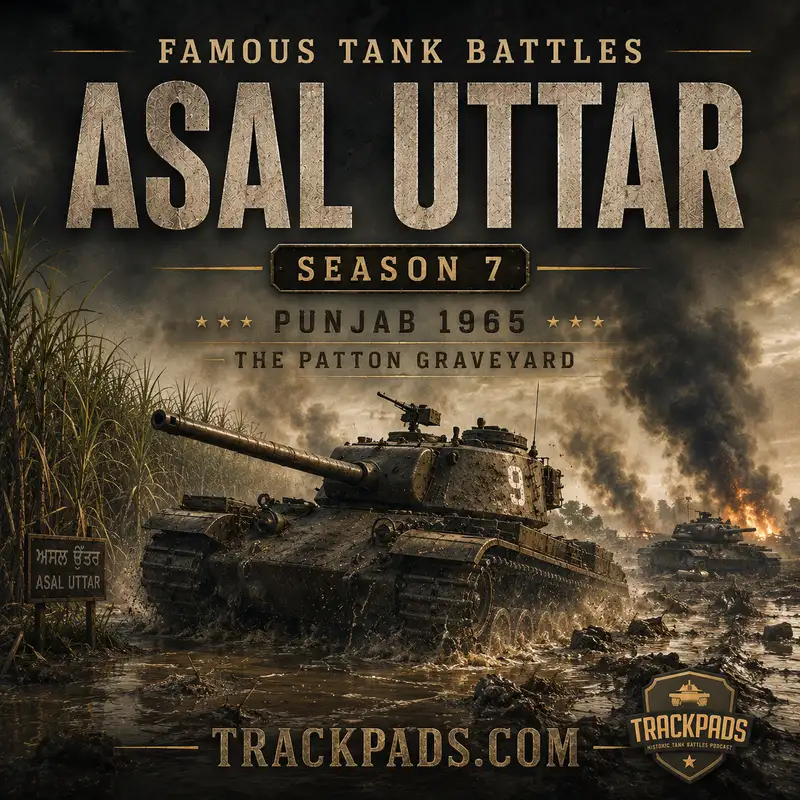
Asal Uttar: Episode 19 — 10 September: The Break Fails
On 10 September 1965, the Pakistani drive in the Khem Karan sector reached the point where offensive possibility collapsed. The phrase “the break fails” is useful because it focuses attention on what mattered most. Pakistan did not need merely to fight bravely or seize pieces of ground; it needed to break through the Indian defensive system and open the road toward Bhikhiwind, Harike, and the Beas crossings. By the morning of the 10th, that prospect was fading fast. The battle did not end in one clean cinematic moment. It ended through the accumulation of delay, loss, confusion, defensive fire, poor ground, and the growing realization that the armored thrust could no longer become operational decision.
If you would like to move beyond the podcast, you can see my available books at Military Author dot me. And at Trackpads dot com, you will find magazines and galleries with hundreds of thousands of photos and videos to explore.
The conditions facing Pakistan were now very different from the confidence of the original plan. The thrust had entered the Asal Uttar defensive zone and had suffered heavily. Tanks had been knocked out, disabled, bogged down, or abandoned. Some routes were blocked or dangerous, and ground that looked usable from a distance had proved treacherous under tracks. Infantry, engineers, and recovery elements faced the hard task of working under fire in a battlefield already shaped by Indian resistance. A commander can still order an attack under such conditions, but the character of the attack has changed. It is no longer a fast exploitation. It becomes an effort to force movement through a field of accumulating problems.
The Indian defense was also exhausted, strained, and far from invulnerable. Men had been fighting under pressure for days, and the defensive box had been built quickly rather than perfectly. Ammunition had to be supplied, casualties evacuated, guns kept firing, tanks repaired or repositioned, and infantry kept steady in exposed positions. Yet the defense now possessed something it had lacked during the earlier withdrawal: proof that its design worked. Pakistani armor had been slowed and hurt. Indian tanks, anti-tank weapons, artillery, mines, and village positions had operated as a system. That mattered psychologically as well as tactically. A tired defender who believes the enemy can be stopped is very different from a tired defender who thinks collapse is inevitable.
The Pakistani problem on 10 September was how to restore tempo in a battlefield designed to deny tempo. To break through, armor had to find a route that was passable, weakly defended, and capable of supporting follow-on movement. It also needed infantry close enough to clear positions, engineers close enough to handle mines and obstacles, and supply close enough to sustain the push. Each requirement made the problem harder. Moving slowly allowed Indian fire to concentrate. Moving quickly risked entering mines, soft ground, or concealed fire. Bypassing resistance could expose flanks. Attacking each defended position consumed the time that exploitation required. The plan’s boldness remained visible, but its practical foundation was breaking away.
Indian commanders had to resist the temptation to leave the defensive system too soon. When an attacker begins to falter, a defender may feel the urge to counterattack broadly, chase retreating units, or move armor into the open. Sometimes that is exactly the right decision. At Asal Uttar, the key was to preserve the conditions that were already destroying the offensive. Indian armor was most effective when Pakistani tanks were slowed, exposed, or channeled. Infantry positions were most valuable when they continued to anchor the box. Artillery was most useful when it struck concentrations and routes. The defense had to keep its shape long enough for the attack to exhaust itself. Patience was not passivity; it was control.
The fighting on the final day remained dangerous and local. Pakistani elements still tried to push, probe, recover vehicles, and find ways through or around the Indian positions. Indian tanks engaged from prepared or concealed locations, while infantry and anti-tank teams held the close ground that made those engagements possible. Artillery continued to punish concentrations and likely approaches. In many places, the battlefield’s earlier wreckage added to the difficulty. Disabled tanks, churned fields, blocked tracks, and uncertain mine locations made movement increasingly awkward. What had begun as a planned armored thrust now resembled a struggle inside a narrowing space, where every attempt to solve one problem created another.
The terrain completed much of the work that Indian preparation had begun. Flooded or softened ground made heavy vehicles cautious and sometimes immobile. Mines made every route suspect. Sugarcane and village edges hid defenders and shortened the time available for reaction. Roads promised movement but invited fire. Even wrecked tanks could become obstacles that forced following vehicles to slow or shift direction. The effect was cumulative. No single field, mine, gun, or village explains the whole battle. The failure came because all of them acted together against a formation that needed speed and coherence. The armored thrust was not simply defeated by being hit. It was defeated by being made unable to move in the way its mission required.
This is the military concept of culmination, even if soldiers on the ground would not have used that word in the middle of the fight. An offensive culminates when it can still possess weapons, men, and courage, but can no longer advance effectively toward its purpose. It may still fire, resist, regroup, or hold ground, but the forward energy has gone. By 10 September, Pakistan’s drive toward the Beas line had reached that point. The tanks were not all destroyed, and the soldiers were not without bravery. But the offensive system had lost the ability to turn armored strength into operational movement. That distinction is crucial. Asal Uttar was not a contest over whether tanks could fight. It was a contest over whether they could break through.
The outcome also shows why local ground can have strategic meaning. Khem Karan itself had been lost by India during the earlier movement, and the battlefield situation in the wider sector remained complex. But the larger Pakistani aim had failed. The road to Bhikhiwind, Harike, and the Beas crossings had not opened. India had prevented a dangerous armored penetration from becoming a deeper rupture in Punjab. That is why Asal Uttar stands out among armored battles of the post-1945 period. It was not merely a successful defense of one village area. It was the defeat of a plan that might have reshaped the war if it had preserved momentum for only a little longer.
The material losses gave the battle its enduring visual force. Many Pakistani tanks, especially Pattons, were left destroyed, disabled, or captured in and around the battlefield, while Indian forces also suffered losses in men and equipment. Exact figures have been debated, and responsible history should avoid false precision when accounts vary. What matters is that the scale of Pakistani armored loss was large enough to shape memory, morale, and later interpretation. The Patton had been a symbol of modern armored confidence. At Asal Uttar, that symbol was transformed into evidence that technology without favorable conditions can fail dramatically. The wreckage did not explain the battle by itself, but it made the lesson impossible to ignore.
For the soldiers who survived 10 September, the end of the offensive did not mean the end of fear or hardship. Crews still had to escape burning or disabled vehicles. Infantry still had to hold positions in a damaged landscape. Medical teams still had to move wounded men. Engineers and recovery parties still faced mines, unexploded ammunition, and uncertain ground. Civilians still faced the loss of homes, fields, and safety. The battle’s finality at the operational level did not make the battlefield clean. Victory and defeat both left wreckage behind. A serious account must hold together the defensive achievement and the human cost, because the same events produced both.
In the longer evolution of armored warfare, 10 September at Asal Uttar reminds us that tanks are most powerful when they are part of a functioning system moving at a tempo the enemy cannot match. That was the promise of armored warfare from the breakthrough dreams after Cambrai to the mechanized operations of later decades. But the same history also teaches that armored tempo is fragile. Terrain can slow it, mines can channel it, artillery can disrupt it, infantry can anchor resistance, and well-placed tanks can strike when movement becomes predictable. At Asal Uttar, India did not defeat armor by denying that tanks mattered. India defeated armor by understanding what tanks needed and then taking those conditions away.
By the end of 10 September, the door to the Beas had effectively slammed shut. Not because one weapon delivered a miracle, and not because one commander alone solved the battle, but because a chain of defensive choices had met a chain of offensive difficulties. The withdrawal to Asal Uttar, the mining and flooding, the defensive box, the infantry at Chima, the anti-tank courage of Abdul Hamid and others, the early resistance of Deccan Horse, the Centurions of 3rd Cavalry, and the discipline of artillery and engineers all formed one answer. Pakistan’s break failed because the battlefield had been turned against it. Asal Uttar became a decisive defensive victory by proving that armored ambition, however bold, cannot survive without movement, coordination, and time.