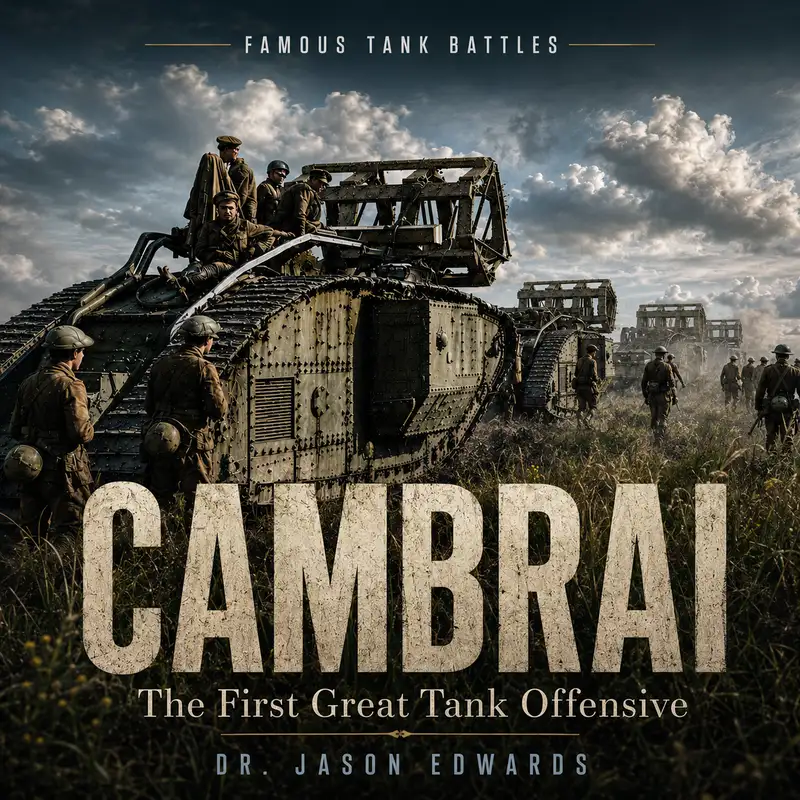
Cambrai: Episode 11 — Havrincourt Falls
On a battlefield like Cambrai, a village was never just a village. What looked on a staff map like a small dot with a short French name could decide where tanks could pass, where infantry could reform, where artillery observers could see, where machine guns could anchor a defense, and where roads could carry the next wave forward or trap it in a bottleneck. That is why Havrincourt matters so much. Its capture on the opening day was not important because of its size, and not because it was somehow grander than the other places around it. It mattered because it was one of the local hinges on which a much larger operation turned. When Havrincourt fell, the British left-center advance gained room to breathe, and when neighboring places held or failed elsewhere, the shape of the whole battle changed with them.
This podcast is accompanied by a companion book that expands the story of the Battle of Cambrai, with additional historical context, maps, and dozens of enhanced colorized photographs from the battle. Your purchase helps support our mission to keep these podcasts free. You can find the book at Military Author dot me or at track pads dot com
This is one of the easiest truths to lose when listening to a battle without a map. Modern audiences often hear village names and assume they are simply markers used to describe movement. In First World War fighting, especially in the transition toward more mobile combined-arms battle, those names often meant something more concrete. A village usually sat on a road, near a junction, beside a bridge, along a sunken lane, or on ground that mattered for observation and command. Even when shellfire had smashed houses into rubble, the place still carried military value. Cellars could shelter defenders. Brick ruins could hide machine guns. Orchard lines, garden walls, and streets could become improvised defensive belts. The villages around Cambrai were therefore not background scenery. They were part of the battle system itself, and that is why the British opening success and later frustrations can only be understood through them.
Havrincourt lay in exactly that kind of dangerous geography. Before the attack, the village sat within the Hindenburg defensive system and near the approaches that mattered to the British Fourth Corps, especially the Sixty-Second Division, whose attack would help drive the left side of the British advance beyond the first trench belts and toward Graincourt, Anneux, and the rising ground around Bourlon. Nearby Havrincourt Wood had already played a role in the preparations, serving as part of the hidden space from which men and machines moved toward the assault line. So Havrincourt was not just a target that happened to be in the way. It was a local anchor in the German line and a gateway for what came next. If it remained in German hands, the British advance through that sector would be constricted and exposed. If it fell quickly enough, a road opened toward deeper possibilities.
When the attack began on the morning of the twentieth of November, Nineteen Seventeen, the assault on Havrincourt formed part of the wider shock delivered across the front by tanks, infantry, and artillery working together with unusual precision. The predicted barrage struck without a long registration prelude, smoke complicated German observation, and tanks moved forward to crush wire and help the infantry through the first trench systems. In the Havrincourt sector, the Sixty-Second Division drove into and through ground that had been fortified, shelled, and fought over so heavily that the village was less a peaceful settlement than a broken node inside a defensive grid. Still, the capture was no mere walkover. Havrincourt had to be fought for, cleared, and passed through. When British infantry moved up into the captured trenches near the village that day, they were standing inside one of the places where the new battle method had genuinely worked.
The importance of that success became clearer almost immediately. Once Havrincourt was taken, the British did not stop there and admire the result. The real value of such a place lay in what it allowed the attack to do next. From the ruins of Havrincourt, the advance pressed on toward Graincourt and farther toward Anneux, under the long shadow of Bourlon Ridge and Bourlon Wood beyond. By nightfall, the Sixty-Second Division had covered close to five miles from its start point, an astonishing distance by the standards of recent Western Front fighting. That was not because Havrincourt itself was the ultimate prize. It was because taking it removed one obstacle in a chain, and in modern battle chains matter more than single points. The village fell, and the larger question of the day shifted instantly from whether the line could be broken to whether the British could keep moving fast enough once it was.
What happened to the right of Havrincourt helps explain why one village could never be read in isolation. The Sixth Division pushed through Ribécourt and on through Marcoing, while farther right the Twentieth Division fought through La Vacquerie and reached Masnières, where the canal crossing became a matter of urgent importance. These names, like Havrincourt, were not just labels to help historians organize the narrative later. They were pieces of the operational puzzle in real time. Ribécourt and Marcoing mattered because they lay on the route toward the canal and beyond it. If they were taken and the crossings secured, the attack could threaten deeper German positions and potentially enable cavalry to pass through. So when British troops seized those places, they were not simply occupying more ground. They were testing whether the opening shock could become true exploitation.
Masnières is perhaps the clearest example of how a tiny map point could decide a very large outcome. The village itself was important because it sat beside one of the canal crossings the British needed if the breakthrough was to widen and deepen. The assault got there. The bridge was there. The opportunity seemed real. And then the weight of the first tank to cross, Flying Fox, broke the bridge, abruptly turning promise into delay. That single collapse did not ruin the entire battle by itself, but it shows how the whole campaign could pivot on a bridge in a village most listeners had probably never heard of before this series. Infantry could still work across a lock gate, and a few mounted men got over later in limited fashion, but the clean exploitation that planners hoped for did not happen. Small place, large consequence. That was Cambrai in miniature.
Now place that beside Flesquières, and the logic becomes even clearer. Flesquières did not fall in step with the British gains on either side, and that failure imposed a heavy price on the wider attack. The village sat on stronger ground and inside a more stubborn local defense, supported by artillery fire that proved deadly to tanks. Because Flesquières held out while places around it gave way more quickly, a dangerous salient appeared in the British line of advance. That exposed the flanks of neighboring formations and complicated the movement of men and machines on both sides of the gap. In other words, the British could say with pride that Havrincourt had fallen and that the advance near it had gone deep, but they could not ignore the fact that another village nearby had refused to fit into the same success story. A battle on this scale is not won by adding local victories like coins in a jar. It is won when the local victories connect.
That is why Graincourt and Anneux matter so much in the story that follows Havrincourt. Once the Sixty-Second Division had fought through Havrincourt, the advance toward Graincourt kept the left-center thrust alive and carried the British line toward the approaches below Bourlon Ridge. By the end of the day, Anneux lay within sight, and beyond it the high ground around Bourlon Wood loomed as the next great problem. The map points were getting smaller in one sense and larger in another. Graincourt was not the end of the battle. Anneux was not Cambrai itself. But each name marked another step in the transformation of the operation. What began as a clean penetration of a defensive line was becoming a struggle over who would control the routes, ridges, and villages that determined whether that penetration could grow into something decisive or harden into a salient.
There is a wider lesson here about armored warfare that reaches far beyond Cambrai. Tanks tempt the imagination toward pictures of sweeping movement over open country, but real armored battle is often governed by stubbornly local things. Villages, bridges, road forks, embankments, woods, and ridgelines channel movement, delay reserves, and define what can be exploited and what cannot. At Cambrai, the British did not discover that local terrain no longer mattered because tanks had arrived. They discovered almost the opposite. Tanks made movement possible in new ways, but that only made the control of local nodes more important. Once armor and infantry got through the first obstacle belt, the entire battle turned on whether specific places could be cleared, crossed, held, and supplied before the defender recovered. Havrincourt mattered because it was one of those nodes, and because its fall helped show how much of modern battle would still depend on geography at the closest scale.
The German side understood this as well, even in the first shock of the attack. A forward defense can afford to lose some trench frontage if the next line of villages, roads, crossings, and high ground still allows command and artillery to restore coherence. That is one reason the British opening success, impressive as it was, did not automatically become final collapse for the Germans. Havrincourt had fallen. Ribécourt and Marcoing had been taken in the center. La Vacquerie and Masnières had been reached on the right. Yet the Germans still had surviving anchors in the system, above all around Flesquières and then beyond toward Bourlon Ridge. That meant the British had created a breach without yet dissolving the entire structure behind it. When one village fell and another held, the difference was not merely local. It decided which roads stayed open, where artillery could still dominate, and how quickly reserves could be gathered for the reply.
By the end of the battle, that logic became even clearer. Much of the spectacular British gain from the first days would be clawed back in the German counterstroke, but not all of it. Among the ground the British ultimately retained were positions around Havrincourt, Ribécourt, and Flesquières. That result says something important about the battlefield. These were not meaningless scraps of ruined countryside accidentally left behind after larger ambitions failed. They were the kinds of places that had structured the battle from the start. They had mattered in the opening assault because they were gateways, anchors, and pivots, and they still mattered after the counterattack because they remained tied to the underlying geography of control. In other words, even when the grander hopes of Cambrai faded, the battle was still being measured in villages, roads, crossings, and local pieces of terrain that had proven their weight in blood and time.
So when Havrincourt falls, what really falls with it is the illusion that big battles are decided only by big places. Cambrai was aimed at something vast: rupture of the Hindenburg Line, threat to Cambrai itself, and the possibility of a wider operational unhinging. Yet the path toward those larger goals ran through broken villages whose names could be missed in a casual glance at the map. Havrincourt mattered because it was one of the doors the British had to force open if the new style of combined-arms attack was going to move beyond the first trench system. Its fall helped carry the advance forward, but the neighboring villages and crossings determined how far that success could spread and where it would begin to stiffen into resistance. That is the enduring lesson here. In armored warfare, the grand movement is real, but it is often decided one village at a time.