Cambrai: Episode 14 — Masnières: The Broken Bridge
On the opening day at Cambrai, few moments reveal the battle’s promise and its limits more clearly than what happened at Masnières. In the morning, the British attack on the right and center had moved with a speed that seemed to belong to a different war. Tanks had crossed the wire, infantry had broken through the Hindenburg defenses, and the line in front of them no longer looked like an iron wall. Then the advance reached the Saint-Quentin Canal, and one damaged bridge became the point where possibility began to narrow. That is why Masnières matters so much. It was the place where a breakthrough was no longer just a question of getting through trenches. It became a question of crossings, routes, timing, and whether the forces behind the first wave could actually pass through the opening that had been made.
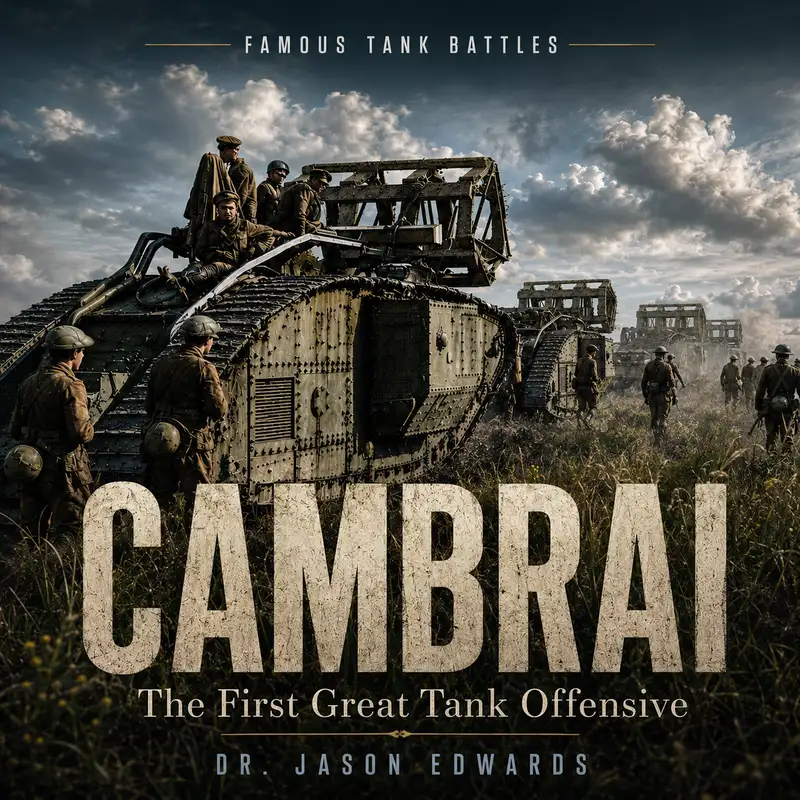
This podcast is accompanied by a companion book that expands the story of the Battle of Cambrai, with additional historical context, maps, and dozens of enhanced colorized photographs from the battle. Your purchase helps support our mission to keep these podcasts free. You can find the book at Military Author dot me or at track pads dot com
The canal was not simply another blue line on a map. It was a major obstacle running across the eastern side of the battlefield, one that could either help define British success or stop it from growing. In the planning for Cambrai, this mattered enormously because the opening attack was not meant to end with the first trench system falling. Tanks and infantry would crack the front, but deeper exploitation would depend on roads, bridges, and the movement of cavalry and reserves through the gap. That meant the canal crossings near places like Marcoing and Masnières were loaded with importance long before the first British soldier reached them. A bridge there was not just a convenience. It was the kind of narrow piece of infrastructure on which an entire day’s momentum could turn.
The attack on this side of the battlefield initially justified that concern in the best possible way. British formations on the right advanced rapidly through the first German positions, and the Twentieth Division fought its way through La Vacquerie and on toward the canal line. This was precisely the kind of movement the planners had hoped for. The predicted artillery barrage had preserved surprise, tanks had helped smash the obstacle belt, and German defenders in the forward zone were still trying to recover from the shock of the opening blow. For a few hours, it looked as if the British had managed to do something that had eluded them in earlier offensives. They had not simply damaged the front. They had reached the line beyond it quickly enough that real exploitation no longer seemed fanciful.
That is why the bridge at Masnières carried such heavy expectations. It appeared to offer one of the routes by which success on the front edge could become movement into the German rear. The British wanted not just captured trenches but a widening breach, and the cavalry waiting behind the attack needed usable crossings if they were to pass through in strength. In theory, the canal line could be crossed, the mounted troops could press on, and the Germans might be denied the time needed to reorganize. This was the battlefield logic of breakthrough in late Nineteen Seventeen. It was never enough to create a hole. The hole had to become a passage, and the passage had to remain open long enough for more than the first attackers to get through it.
At Masnières, that hope seemed almost within reach. The advance got to the bridge before the Germans had completely ruined the opportunity, but the structure had already been weakened. Then came the moment that later memory fixed so sharply on one image: a British tank, generally identified as Flying Fox, tried to cross and the bridge gave way beneath it. The tank crashed into the canal, the bridge was wrecked, and a crossing that might have carried the momentum of the day instead became a blockage. The symbolism is almost too perfect, but it was also real. The machine that represented the attack’s modern promise helped destroy the very route that promise depended upon. In one instant, the British had not lost the battle, but they had lost one of the cleanest ways to turn breach into exploitation.
It is important, though, not to let the drama of that collapse oversimplify the battlefield. The broken bridge did not mean the canal became absolutely impassable, and it did not mean every opportunity vanished on the spot. Infantry could still cross more slowly at a nearby lock gate, and some British troops did just that. The village and its approaches remained contested, and fighting continued around the crossing rather than ending in immediate paralysis. That matters because Masnières is often remembered as if one broken span single-handedly doomed the whole attack. The real story is harsher and more useful. The bridge collapse did not end possibility. It reduced it, slowed it, and turned what had looked like a broadening opening into a much narrower and more awkward problem.
That narrowing affected every arm of the operation. Tanks could not simply roll over the canal where they pleased. Cavalry could not pass in the kind of mass the original design required. Infantry who crossed piecemeal or by awkward alternative routes could establish a foothold, but they could not instantly produce the kind of deep, widening pressure that turns a shaken defense into a broken one. In other words, the collapse changed the scale of what British success could become in the hours that followed. An intact bridge might not have guaranteed a decisive exploitation, but a destroyed one made decisive exploitation much harder. On a battlefield built around surprise and tempo, that loss of speed was not a minor inconvenience. It gave the Germans the exact resource they needed most: time.
What followed shows why small events matter so much in operational warfare. British infantry and supporting troops did manage to get across in places and fight on, and the Newfoundlanders, among others, would later battle hard around the lock and on the approaches beyond the canal. There was courage there, and there was still local success. But bravery on the far bank could not cancel the fact that the crossing problem had changed the character of the advance. Instead of a strong flow through a key route, the British now had a bottleneck. Instead of a broad and confident exploitation, they had disconnected local efforts pushing over or around obstacles under fire. That is a very different military condition. Once success becomes fragmented, the defender’s chances of recovery rise sharply.
The cavalry problem makes that even clearer. The original British vision depended in part on mounted troops being able to pass through quickly enough to exploit the chaos created by the opening assault. That was already a difficult idea in a battlefield full of wire, shell holes, ruined roads, and uncertain reports. The collapse at Masnières made it harder still. Cavalry could not cross there in sufficient strength, and although small mounted elements got over the canal elsewhere, they did so too thinly and too late to transform the situation. This is one reason the broken bridge has remained so famous. It became the visible sign of a larger truth. The British had created a breach, but the forces meant to deepen that breach were being fed through a battlefield whose routes and command arrangements were far more fragile than the plan had hoped.
Communications and command delays magnified the damage. Even with the bridge intact, exploitation would have depended on fast decisions, clear understanding of where the front had opened, and the ability to move follow-on forces without confusion. Cambrai offered none of those things in abundance. Headquarters sat too far back, messages moved slowly, and the cavalry command structure proved cumbersome at exactly the moment when speed of judgment mattered most. So the bridge collapse should not be treated as a magical explanation for every lost opportunity. It mattered deeply, but it mattered inside a larger pattern of hesitation, congestion, and uncertainty. Masnières did not reveal one point of failure. It revealed how several kinds of friction can pile on top of each other until a promising opening shrinks into something much more limited.
The Germans, for their part, did not need to restore the whole battlefield at once. They only needed to prevent the British from pouring fresh force across the canal in the time available. Once the crossing at Masnières became obstructed and the movement through the breach slowed, German resistance had a better chance to harden on the far side. Machine guns, local strongpoints, and reorganized defenders could now confront British troops who were arriving in narrower streams rather than in overwhelming flow. This is the point at which a breakthrough begins to lose its expansive quality. The attacker is still ahead, still dangerous, still capable of hard fighting, but the battlefield has stopped widening for him. The initial shock is no longer carrying him forward on its own. Now he must push against an enemy who is recovering minute by minute.
Masnières therefore stands as one of the clearest examples of the gap between breaking in and breaking through. The British opening assault had shown that tanks, artillery science, and infantry cooperation could crack a formidable defensive system. But what happened at the canal showed that this was only the first part of the problem. A breach on the front edge of battle is a physical achievement. A breakthrough into the enemy’s depth is a logistical and operational one. It depends on crossings, traffic control, reserves, command flexibility, and the simple ability to move more force through the opening faster than the defender can repair his position. At Masnières, that second problem came into view with unusual clarity. The attack had succeeded brilliantly enough to reach the canal, yet not cleanly enough to master what the canal required.
That is why the broken bridge remains so important in the history of armored warfare. It was not merely a mishap, and it was not merely an anecdote about a tank that was too heavy for its crossing. It was a revealing moment in the birth of modern combined-arms battle. Tanks could break wire and help rupture trenches, but they could not abolish geography. Surprise could create opportunity, but it could not guarantee the routes beyond it. The British had found a way to open the front faster than before, but at Masnières they discovered how quickly a modern offensive could be reduced from flowing movement to constricted effort once one key crossing failed. In that sense, the broken bridge was not just a physical collapse. It was the instant when the scale of British opportunity visibly contracted.
By the end of the day, the battle had not been lost at Masnières, and it would be wrong to force the whole outcome into that single scene. Yet it would be equally wrong to dismiss it as a small episode inside a much larger story. In battle, there are moments when one object on one road at one village reveals the whole logic of the campaign. Masnières was one of those moments. The canal crossing showed that the British had indeed learned how to begin a new kind of offensive, but not yet how to sustain it once its leading edge ran into narrow infrastructure, delayed exploitation, and recovering enemy resistance. Opportunity did not disappear when the bridge fell, but it did change shape. It became narrower, slower, and more fragile, and the rest of the battle would unfold inside those new limits.