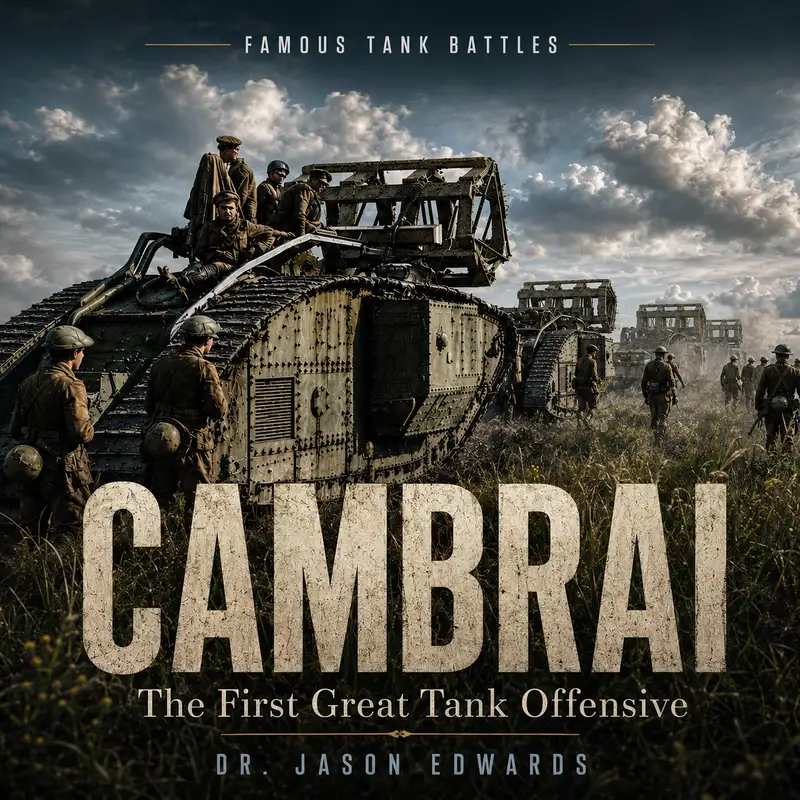
Cambrai: Episode 15 — Why the Cavalry Couldn’t Finish It
On the first day at Cambrai, once the wire had been crushed, the trench systems penetrated, and villages like Ribécourt and Marcoing taken, a very old military hope came rushing back into view. If the front had really been broken, then perhaps fast-moving troops could ride through the gap, scatter the enemy’s rear areas, seize crossings, and turn a local rupture into a wider collapse. That was the role British cavalry were expected to play. Yet by the end of the day, the mounted arm had not finished the battle, had not transformed the breach into a rout, and had not delivered the sweeping exploitation that some planners imagined. To understand why, it is not enough to say that cavalry were obsolete. The harder truth is that they were being asked to perform an old function in a battlefield that had changed faster than the function itself.
This podcast is accompanied by a companion book that expands the story of the Battle of Cambrai, with additional historical context, maps, and dozens of enhanced colorized photographs from the battle. Your purchase helps support our mission to keep these podcasts free. You can find the book at Military Author dot me or at track pads dot com
That does not mean the cavalry idea was foolish on its face. British commanders still needed some force that could move more rapidly than marching infantry once a breach appeared, and the tank, for all its promise, was not yet a deep exploitation machine. Early tanks were too slow, too fragile, too mechanically unreliable, and too demanding of maintenance to dash far into the enemy rear and keep going without pause. Trucks and motor transport existed, but they could not simply flow cross-country over a shattered battlefield and replace mounted troops in every role. So cavalry remained, in British thinking, the available mobile reserve that might pass through once tanks and infantry had done the harder work of opening the line. In that sense, Cambrai was not simply a contest between old and new. It was an awkward handoff between them.
The original British logic depended on sequence. Tanks and artillery would create surprise, infantry would force the trench systems, engineers and follow-on troops would help open the routes, and then cavalry would move through the gap before the Germans could recover. This sounded plausible because the opening blow at Cambrai really did create movement on a scale rare for the Western Front. In the center and right, British units reached places like Ribécourt, Marcoing, and the canal approaches with remarkable speed. For a few hours, the battlefield offered exactly the kind of opening cavalry planners had spent years hoping to see again. But that possibility depended on something very fragile. The cavalry could only exploit if the breach stayed wide enough, safe enough, and physically passable long enough for mounted formations to get through in strength.
That last condition was the beginning of the problem. Cavalry are fast in open country, but they are not magically fast in traffic. At Cambrai, they were held behind the infantry and tank assault, which meant they were already dependent on the first wave not only winning, but winning in a way that left the routes usable. The moment the front opened, those routes were crowded with wounded men, prisoners, supply movement, guns trying to come forward, staff officers searching for information, and the confusion that every successful attack creates. A breach in battle is rarely a clean gate waiting for the reserve to pass through. It is usually a torn opening full of rubble, smoke, uncertainty, and people moving for different reasons at once. Cavalry entering that kind of space could lose precious time before they even reached the point where their speed was supposed to matter.
The canal line made everything worse. Whatever hopes existed for mounted exploitation were tied closely to crossings at Marcoing and Masnières, because cavalry could not simply leap the Saint-Quentin Canal and continue the pursuit. When the bridge at Masnières collapsed under the weight of a tank, it did more than destroy one crossing. It narrowed the whole idea of exploitation on that side of the battlefield. Cavalry could no longer pass there in sufficient strength, and alternative routes were slower, more awkward, and more vulnerable to German fire. A squadron of the Fort Garry Horse did manage to cross later by a temporary bridge and achieve a dramatic local success against a German battery, but that kind of brave, isolated action was not the same thing as a sustained mounted exploitation by a massed force. The route had become too constricted for that.
Even where the route existed, time was already slipping away. Mounted exploitation depends on an enemy still being disorganized when the cavalry arrives, and that is an unforgiving requirement. At Cambrai, the opening British success did stun the Germans, but it did not erase them. Surviving artillery batteries, machine-gun posts, and local commanders began rebuilding resistance surprisingly quickly, especially once the first shock had passed and once places like Flesquières continued to hold long enough to distort the British line of advance. That meant the cavalry were not riding into empty rear areas. They were pushing toward villages, crossings, and roads where German defenders were already trying to re-form. By the time mounted troops reached toward places like Noyelles and the canal approaches, the battlefield was already becoming less a wide-open opportunity and more a series of defended obstacles.
Communications deepened the problem. Modern listeners often imagine that once a gap appeared, commanders could instantly recognize it, redirect formations, and feed reserves through with perfect timing. Nothing about Cambrai worked that way. Information moved slowly and unevenly, often carried by runners or officers over ground still under shellfire. Higher headquarters could not always tell exactly where the best opportunity lay, whether bridges were intact, whether tanks had crossed, or whether neighboring sectors had kept pace. Cavalry formations were therefore not simply delayed by physical obstacles. They were also delayed by uncertainty. In at least some cases, mounted troops moved under assumptions that no longer matched the reality ahead, discovering too late that the route they expected to use was blocked, broken, or swept by enemy fire. Speed in war means little when the information guiding it is already out of date.
The nature of the ground also mattered more than cavalry advocates liked to admit. Mounted men could move impressively across favorable terrain, but Cambrai was not a racecourse. The battlefield still contained uncut wire in places, shell holes, trenches, sunken roads, embankments, and villages whose approaches were often covered by machine guns or artillery. The cavalry did not fail because horses had somehow become ridiculous overnight. They failed because the landscape through which they were asked to finish the battle had not become a proper space for mounted exploitation merely because the first German line had been broken. The old cavalry dream assumed that once the crust of the front was cracked, open maneuver country would begin. At Cambrai, what began instead was a new layer of constrained fighting in which bridges, roads, and defended villages mattered as much as raw movement.
There was also a more basic issue of firepower. Cavalry could ride quickly, but they could not ride through modern defensive fire as if the previous three years of war had not happened. German machine guns and field artillery did not vanish once British tanks appeared. They remained the dominant killers on the battlefield wherever they were still organized enough to act. That meant cavalry could exploit only under very narrow conditions: where surprise still suppressed the defenders, where crossings remained open, where local resistance had not yet solidified, and where the mounted force could pass through in enough strength to overwhelm what it met. Those conditions were present only in fragments, and fragments are not enough to sustain a cavalry exploitation across miles of contested ground. Heroism could win a battery, scatter a detachment, or seize a village edge. It could not by itself create the broad operational vacuum cavalry needed.
This is why the mounted arm at Cambrai should be judged with some fairness. It did not fail because the horsemen lacked courage or because their commanders simply forgot how to be aggressive. It failed because the battle offered only a brief and damaged window for the kind of operation cavalry were supposed to perform. The British had achieved a rupture, but not a clean one. Flesquières remained a problem. The canal crossings were compromised. The roads were congested. The artillery and infantry that might have supported deeper mounted action could not keep up with enough coherence. Under those conditions, cavalry could harass, probe, and exploit fleeting local chances, but it could not impose decisive collapse on an enemy that still retained guns, villages, and pieces of defensive structure to rally around.
There is also an irony here that matters historically. The cavalry’s inability to finish the battle does not mean cavalry were useless in the campaign as a whole. Some of the same mounted formations that could not produce decisive exploitation on the twentieth of November were still available later, including during the German counterattack at the end of the month, when mobile troops were valuable for emergency response and local stabilization. In other words, the failure to exploit may actually have spared them from being shattered in a desperate mounted adventure beyond the canal. That does not turn frustration into success, but it does remind us that military value is often situational. The old arm had not yet disappeared, but its best use was becoming narrower, more conditional, and less central to the kind of decisive movement commanders still wanted from it.
Cambrai therefore marks a revealing point in the longer evolution of mobile warfare. The British had discovered a way to begin a modern combined-arms breach with tanks, artillery science, and infantry coordination. What they had not yet discovered was the right force to carry that success far enough and fast enough once the breach appeared. Cavalry were too vulnerable, too dependent on crossings, and too constrained by modern firepower to serve as the perfect answer. Tanks, meanwhile, were not yet mature enough to become the answer in their place. The result was a gap between opening and exploitation, between the new way of starting success and the still unsolved problem of finishing it. Later mechanized warfare would close that gap with more reliable armored vehicles, better communications, stronger motorization, and doctrine built around deep follow-through. At Cambrai, that future was visible only in outline.
So the cavalry could not finish it because the battlefield they inherited was neither the old open country of mounted exploitation nor the fully mechanized battlefield of a later age. It was a transitional battlefield, one in which the British had learned how to crack the front but not yet how to pour sustained mobile force through the crack before the defender recovered. Horses met trenches, bridges, machine guns, field artillery, and broken communications, and courage alone could not reconcile those worlds. The mounted arm did what it could in fragments and moments, but the conditions required for decisive exploitation never came together cleanly enough. That is the real lesson. The old arm did not simply meet the new war and vanish. It met the new war, found that the breach it was meant to exploit was too narrow and too late, and revealed that a different kind of mobility would one day be needed to finish what Cambrai had begun.