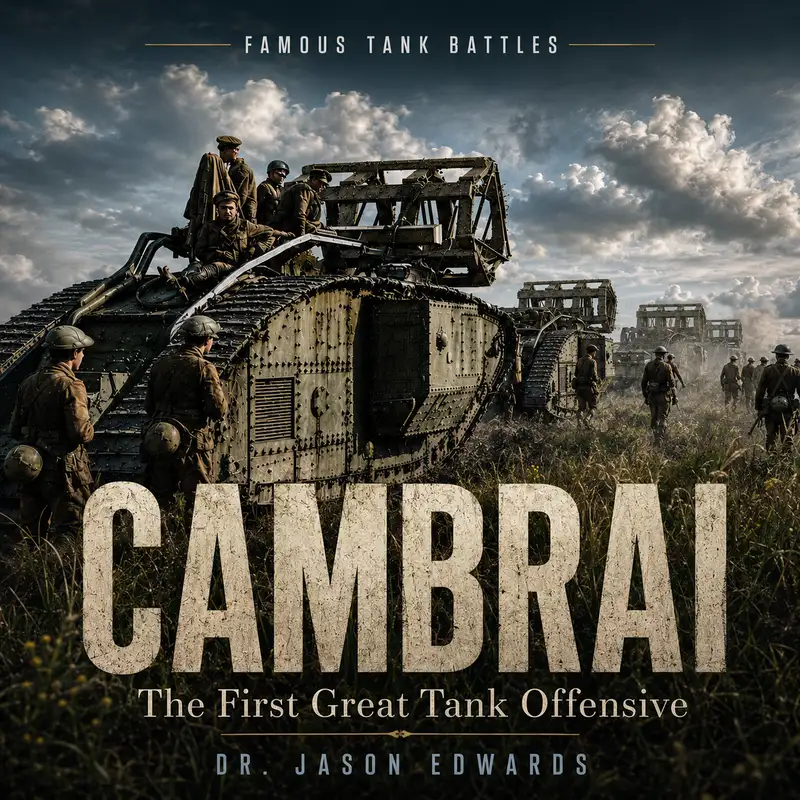
Cambrai: Episode 18 — Bourlon Ridge
After the first shock of Cambrai, when the British had broken into the Hindenburg Line and advanced farther in a single day than many thought possible on the Western Front, the battle began to contract around one stubborn piece of ground. That piece of ground was Bourlon Ridge. To a listener hearing the name without a map, it might sound like one more village-and-wood objective among many, but it became the hinge of the whole operation. Once the eastern opportunities across the canal began to fade, the ridge on the northern shoulder of the British salient took on a value out of all proportion to its size. It was not glamorous ground, and it was not the final destination the public imagined when they heard the name Cambrai, but it was the place from which the gains already won could either be secured or slowly made vulnerable.
This podcast is accompanied by a companion book that expands the story of the Battle of Cambrai, with additional historical context, maps, and dozens of enhanced colorized photographs from the battle. Your purchase helps support our mission to keep these podcasts free. You can find the book at Military Author dot me or at track pads dot com
The importance of Bourlon Ridge begins with the shape of the battlefield itself. The British attack had driven eastward and north-eastward into the German line, creating a bulge or salient rather than a clean, straight new front. On the northern side of that bulge, Bourlon Wood and the ridge around it formed the dominant feature. This was not mountain terrain. In northern France, a comparatively modest rise could matter enormously, especially in a war where observation, artillery direction, and tactical command depended so heavily on who could see farther and more clearly. A force on the ridge could look down into the approaches below, watch movement around Anneux and Graincourt, and exert pressure on the roads and tracks by which the British would have to feed, reinforce, and organize their new positions. A patch of high ground became decisive because the rest of the battlefield around it was low enough to make that height count.
This had been part of the logic from the beginning, even before the fighting forced the issue. In the original conception of the operation, securing Bourlon to the north was tied directly to the idea of local exploitation after the breakthrough. The capture of Cambrai itself was never the simple main prize of the battle in the way later memory sometimes suggests. What mattered more was whether the British, after breaking in, could secure the key flank positions that would let them use the breach rather than merely admire it. Bourlon was one of those positions. If the British held the ridge, they would be better placed to exploit locally between Bourlon and the river lines beyond, and better able to protect the exposed shoulder of their advance. Even before the battle began, then, Bourlon was more than another name in the order of battle. It was part of the geometry of success.
The opening day made that geometry much harder to ignore. The British had done something remarkable on the twentieth of November, but they had not done it evenly. The delay at Flesquières had distorted the center-left of the advance, and the canal problems near Masnières had narrowed the eastern opportunity. At the same time, the Germans still held the dominating height around Bourlon, and from there they were able to interfere with British movement toward Anneux and Graincourt. This was the kind of battlefield reality commanders notice very quickly. A map may show a broad advance, but if the enemy still sits on one shoulder of that advance and can see into it, then the whole achievement begins to look more fragile than it did at first light. By the end of the first day, it was already apparent that Bourlon was no longer simply an attractive objective. It was becoming a necessity.
That necessity grew from practical military reasons, not from symbolism. High ground mattered because it gave artillery observers a better view and gave artillery a better chance to punish roads, assembly areas, and forming-up lines. High ground mattered because infantry trying to move up a slope toward a wood could be watched, shelled, and machine-gunned in a way that troops moving on flatter or more concealed approaches might avoid. High ground mattered because if the Germans kept it, they could continue using local railways and communications routes with more confidence while the British, below them, struggled to organize their own expanding salient under hostile observation. In that sense, Bourlon Ridge was not just a tactical prize. It was an operational switch point. It influenced not only who could stand there, but who could move, supply, and see across a broad section of the battle.
And yet the very features that made the ridge so valuable also made it difficult to take. Bourlon was not an open bare slope waiting to be rushed by tanks alone. It was a combination of ridge, village, and wood, and that combination created a cruel battlefield. Woods break up movement, complicate artillery support, reduce visibility, and disrupt the neat timing on which a combined-arms attack depends. Tanks can be valuable near woods, but they are less free there than on open ground, and infantry moving into wooded fighting lose many of the advantages of broad-front momentum. Add to that the sunken lanes, defended village edges, and German forces now recovering from the first day’s surprise, and the result was obvious. Bourlon was important because it commanded the battlefield. Bourlon was hard because it was not the kind of ground on which the methods of the twentieth of November could simply be repeated without change.
The fighting on the twenty-first of November revealed that difficulty with painful clarity. British troops pushed forward toward Fontaine-notre-Dame, Anneux, and the approaches to the ridge, but the fire coming from the direction of Bourlon checked them badly. The Fifty-First Division, with some tank support, tried to move on Fontaine and was held up. The Sixty-Second Division fought hard around Anneux but could not break cleanly beyond the sunken lane facing the wood. To the north, forces that were meant to continue the advance beyond Moeuvres waited for a signal that Bourlon had been secured, because without that success the whole northern continuation of the offensive would remain dangerously exposed. The signal never came. This is one of the clearest ways to understand the ridge’s importance: it did not merely resist attack in its own immediate sector. Its continued German possession paralyzed wider British intentions around it.
By the evening of the twenty-first, British leaders had therefore reached a harsh conclusion. The hoped-for larger exploitation south and east of Cambrai was fading, while the British now sat in an exposed position below Bourlon. If they stopped without taking the ridge, they would be left holding a salient whose northern shoulder remained under enemy observation and enemy pressure. If they pressed on, they would have to throw more tired troops into a difficult fight over ground that favored the defense. This was not a choice between good and bad. It was a choice between two bad conditions, one of which at least offered the possibility of securing the battlefield they had already paid so heavily to create. That is why the attack on Bourlon followed. The British were no longer only attacking to enlarge success. They were attacking to prevent success from becoming strategically misshapen.
The attack of the twenty-third of November showed just how costly that would be. The Fortieth Division was brought up to relieve the worn Sixty-Second and take on the wood and village, while other formations attacked on the flanks and tanks were again brought in to help. The ground, however, was now very different from the opening day’s wide-front surprise assault. Men had to move down slopes, cross the sunken lane, and climb into the wooded ridge under shellfire. Fighting in the wood became close, confused, and vicious. Parts of the British force did succeed in getting through the undergrowth and onto sections of the ridge, and troops entered Bourlon Village, but the battle there never developed into a clean sweeping capture. It became a series of contested holds, counterattacks, withdrawals, and renewed efforts, all on ground where the advantages of surprise had largely burned away.
This is the moment when Cambrai’s character changed most clearly. What had begun as a fast, startling rupture of trench warfare now became a brutal contest for a feature of landscape. The ridge drew in battalions, then divisions, and then more reserves, because neither side could comfortably leave it to the other. The British needed it to secure the salient and deny the Germans observation. The Germans needed it because as long as they contested it, the British position remained incomplete and vulnerable. Bourlon Village changed hands, parts of the wood were taken and lost, and the shoulders of the ridge near Fontaine-notre-Dame and west of the wood remained especially dangerous because as long as the enemy held them, British troops lower down were still exposed to observation and fire. A patch of high ground became the center of gravity because it forced both armies to keep paying for it.
That cost was not only in casualties, though those were severe. It was also in time, energy, and operational freedom. Every day spent fighting for Bourlon was a day in which the British offensive moved farther away from the original hope of rapid exploitation and closer to a familiar pattern of attritional struggle. Roads broke up under the traffic of reliefs and support. Tanks were used again, but now in conditions less favorable than the open opening-day ground. Infantry who had already fought hard were asked to hold or assault positions in woods and villages where the battle became intimate, exhausting, and confused. Most importantly, the struggle for Bourlon gave the Germans exactly what they needed most after the first shock: time to bring in reinforcements, organize counterattacks, and prepare the larger response that would come at the end of the month. The ridge was not just commanding terrain. It was a clock, and every hour spent there was an hour the Germans used elsewhere.
This is why Bourlon Ridge became key to the whole campaign rather than simply important to one stage of the battle. It shaped the meaning of the British advance after the twentieth of November. If the ridge could be fully taken and held, the salient might become defensible and perhaps useful for future action. If it remained contested, then the British would be left with ground that looked impressive on a map but remained exposed in reality. That exposure mattered directly when the Germans later launched their major counterattack, because the British position at Cambrai had by then been deepened and complicated by the effort to hold the Bourlon area without fully mastering all the surrounding high ground. In that sense, the ridge did not merely influence the offensive phase. It helped define the vulnerability of the whole British posture that followed.
There is also a deeper lesson here about armored warfare and modern battle more generally. Cambrai is often remembered as a triumph of innovation, and rightly so, but Bourlon Ridge reminds us that no innovation abolishes terrain. Tanks, predicted fire, surprise, and well-drilled infantry could break open a fortified front, but they could not make commanding ground irrelevant once the battle moved past the first shock. The British could innovate their way through the wire and trenches, yet still find themselves drawn into an old and very recognizable struggle for high ground, observation, and tactical security. That is not a contradiction. It is the normal condition of war. New methods change what is possible, but they do not remove the permanent military value of terrain that dominates roads, lines of sight, and the shape of a salient.