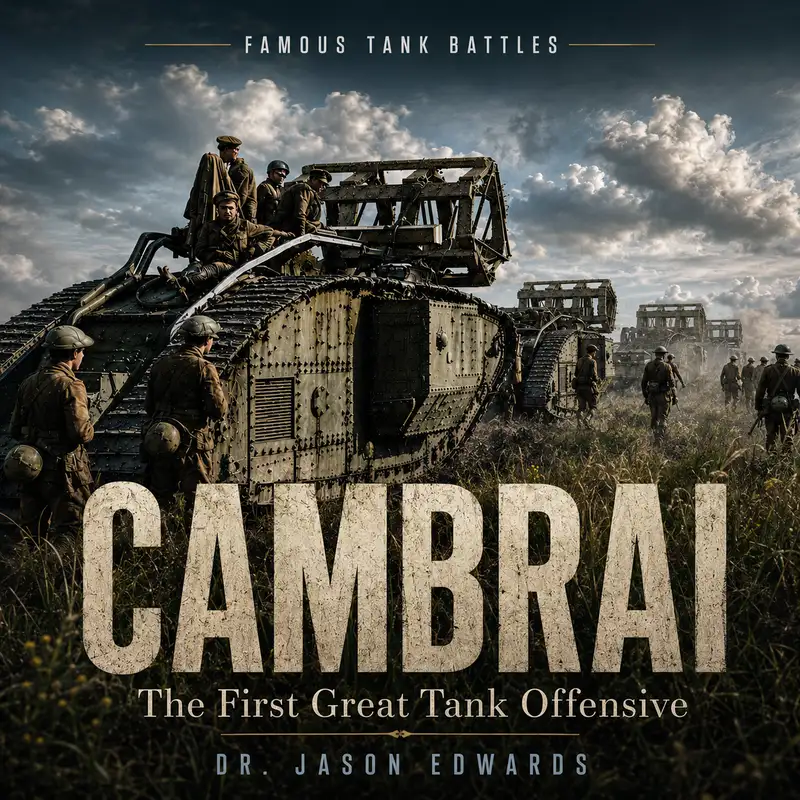
Cambrai: Episode 5 — The Tank Corps Grows Up
When the tanks moved toward the German lines at Cambrai in late November Nineteen Seventeen, the most important change was not simply that there were more of them. The deeper change was that the British Army had begun to build an institution around them, with its own habits, specialists, training systems, maintenance burdens, and ideas about how tanks should fit into a larger battle. At the Somme a year earlier, the tank had appeared as a startling new machine, half experiment and half hope, impressive enough to capture the imagination but too immature to shape an entire operation. By Cambrai, the tank was still far from perfect, but it had ceased to be a battlefield curiosity. It was becoming a planned instrument, something commanders were trying to use deliberately as part of an all-arms method for breaking a fortified front.
This podcast is accompanied by a companion book that expands the story of the Battle of Cambrai, with additional historical context, maps, and dozens of enhanced colorized photographs from the battle. Your purchase helps support our mission to keep these podcasts free. You can find the book at Military Author dot me or at track pads dot com
That transformation had not been smooth, and it had not been inevitable. The British had first pursued tanks in secrecy because the Western Front seemed to demand some machine that could cross trenches, crush wire, and protect advancing troops from machine-gun fire. The early answer was awkward, noisy, and mechanically fragile, but it addressed a real tactical problem that infantry and artillery alone had struggled to solve. What became the Tank Corps began within the British Army as a small and unusual body of men working on something most officers had never seen and many were not yet convinced would matter. In those early months, tanks were still surrounded by a strange mixture of excitement, skepticism, improvisation, and official caution. That is often how military change begins, not with certainty, but with a few institutions trying to make an uncertain idea useful before the rest of the army fully trusts it.
The tank’s first combat appearances did not instantly settle the argument. On the Somme in Nineteen Sixteen, some machines reached the battlefield and showed flashes of promise, especially when crossing obstacles and unsettling defenders who had never faced such a weapon before. But many broke down, lost direction, or failed to have the wider effect enthusiasts had imagined. That result was disappointing if one expected a miracle, but highly instructive if one was willing to learn from it. The early tank was teaching the British Army that invention by itself was not enough. A weapon could be ingenious and still fail if it lacked reliable mechanics, trained crews, disciplined tactics, and a staff system that understood what it could actually do. In that sense, the tank was not yet a mature battlefield instrument because the organization around it had not matured either.
What followed was a year of institutional growth under pressure. British commanders and tank officers had to create a new arm while the war was still being fought, which meant learning in public and under fire rather than in peacetime laboratories. The branch gained a clearer identity, stronger leadership, and more coherent internal culture, helped by figures such as Hugh Elles, who understood that the tank needed not just technical attention but organizational seriousness. The name itself mattered when the branch became the Tank Corps in Nineteen Seventeen, because names in armies often reflect status. A corps suggests permanence, doctrine, and a claim to a real battlefield role. By the time Cambrai approached, the tank no longer sat at the edge of military thinking as an odd experiment. It had a headquarters, a growing body of experience, and officers who were trying to turn scattered lessons into a practical theory of action.
Training was one of the clearest signs that the Tank Corps was growing up. Early tank crews had to do far more than simply drive and fire weapons. They needed to navigate over broken ground, maintain internal discipline in terrible physical conditions, coordinate with neighboring tanks, understand infantry movement, and keep functioning inside a machine that was loud, hot, cramped, and often filled with fumes. Crew work inside an early tank was punishing and complex, because success depended on several men performing different tasks in a moving steel box with limited visibility and constant mechanical stress. That made training central, not optional. A tank could not become a planned battlefield instrument until its crew behaved less like a collection of brave individuals and more like a practiced team. The British were beginning to understand that the fighting value of a tank depended as much on human coordination as on armor plate and engines.
Maintenance may have mattered even more than training, because early tanks lived under a permanent threat from their own machinery. Engines failed, tracks were damaged, gearboxes strained, and simple movement over rough ground could turn a promising attack into a trail of disabled vehicles if the support system behind the tanks was weak. The Tank Corps had to build a culture that respected mechanics, fitters, workshops, spare parts, and recovery arrangements as much as battlefield dash. This is one of the great themes of armored warfare that begins clearly at Cambrai and never disappears. Tanks are always seductive to talk about in terms of speed, shock, and breakthrough, but they survive in battle only if somebody fuels them, repairs them, retrieves them, and gets them back into action fast enough to matter. A corps that takes maintenance seriously is beginning to think like a true armored arm rather than a machine enthusiasts’ club.
The Tank Corps also had to learn where the tank belonged in relation to infantry and artillery. At first, many officers naturally thought in very simple terms. Tanks would go forward, infantry would follow, and the enemy’s trench line would somehow crack open. Experience quickly proved that this was not enough. Tanks could flatten wire and overrun some positions, but they could not by themselves clear every trench, secure every village, or hold ground once they had passed on. Infantry remained essential for dealing with dugouts, machine-gun nests, and the complicated work of occupation and consolidation. Artillery remained essential because German guns, if left active, could smash advancing troops and isolate tanks from support. The Tank Corps grew up when it stopped imagining tanks as a replacement for older arms and began treating them as part of a combined team whose members each solved different parts of the same battlefield problem.
That shift in thinking changed planning before Cambrai. Tanks were no longer being sprinkled into battle as scattered novelties, sent forward in small numbers in the hope that their mere presence would produce results. Instead, the British prepared to mass them, assign them specific tasks, and integrate them with a larger operational design. Some tanks would lead infantry through the wire and trench systems. Some would help deal with strongpoints. Some would carry materials such as fascines, great bundles intended to fill trenches and help other vehicles cross obstacles that might otherwise stop the advance cold. This was a mark of institutional maturity. A corps that plans different battlefield functions for its vehicles is thinking less like an inventor and more like a professional arm of service. At Cambrai, the tank was being used as part of a deliberate system of tasks, timings, and responsibilities.
The machines themselves had improved enough to support this wider ambition, though not enough to remove danger or uncertainty. By Cambrai the British were using the Mark Four, a more developed version of the earlier tanks, still slow and still vulnerable, but better suited to organized use than the very earliest models. The point is not that the technology had suddenly become flawless. It had not. The point is that the Tank Corps had begun to understand the machine it possessed and plan within its limits. Crews and commanders knew that tanks could be useful against wire and trenches, that they could create shock at the point of contact, and that they could help restore momentum in the opening phase of an assault. They also knew that tanks remained vulnerable to breakdown, artillery, bad navigation, and battlefield friction. Maturity in war often begins when an institution stops dreaming about perfection and starts planning intelligently for imperfection.
That new maturity showed itself in how the Tank Corps thought about time and space. Early armored warfare could not rely on instant radio control or continuous battlefield awareness, so many of the most important decisions had to be made before the battle began. Routes had to be studied, start lines organized, objectives tied to infantry schedules, artillery support timed with care, and assembly areas concealed from enemy observation. This kind of planning does not sound dramatic, but it was exactly what transformed the tank from novelty to instrument. A novelty surprises by appearing. An instrument works because it has been tuned for a purpose. At Cambrai, the Tank Corps was trying to tune itself to the battlefield in advance, accepting that once the attack began, confusion and disruption would make improvisation difficult. That is one reason Cambrai matters so much. It was not merely a larger tank attack. It was a more consciously designed one.
The opening of the battle justified much of that effort. When the British attack began, tanks helped tear open parts of the German defensive belt in a way that felt different from many earlier Western Front assaults. Their presence was no longer symbolic. They were there in mass, assigned to tasks, moving in concert with infantry and supported by carefully prepared artillery methods that preserved surprise. Wire that might once have stopped a battalion could be crushed. Trenches that had once imposed long delays could be crossed more quickly. Defenders were forced to react not to a handful of mechanical oddities, but to a coordinated assault in which the tanks had a defined place. In that moment, the Tank Corps appeared to vindicate its own growth. It had not solved every problem of breakthrough, but it had shown that tanks could be integrated into battle planning in a serious, purposeful, and operationally meaningful way.
And yet the phrase “grows up” must be used carefully, because adulthood in war is never absolute. The Tank Corps at Cambrai was more professional, more organized, and more useful than it had been a year earlier, but it was not yet the fully developed armored force that later generations might imagine. Mechanical breakdowns still reduced strength, communications still limited flexibility, and early success still proved easier than sustained exploitation. The corps had learned how to help crack the front, but the larger British system had not yet mastered how to turn that crack into deep and decisive operational collapse. In that sense, Cambrai was both a coming of age and a reminder of youth. The Tank Corps had reached the point where it could shape a major battle, but not yet the point where it could dominate one from beginning to end.
The battle is often remembered for the sight of tanks advancing in large numbers, but the more important development was institutional. Between the Somme and Cambrai, the British had begun to create the habits that make armored warfare possible: specialized training, realistic maintenance, thoughtful planning, tactical integration, and leadership willing to treat tanks as one arm within a wider system rather than as magical devices. Those habits were still incomplete, but they were real. Once they existed, tanks could influence operations not simply by appearing on the battlefield, but by being prepared for it. The Tank Corps grew up when it learned that battlefield effect comes from organized competence more than from novelty, and that lesson would echo through every later generation of armored warfare.
So when we say the Tank Corps grew up, we do not mean that it had become modern in the fully developed sense familiar from later mechanized war. We mean that by late Nineteen Seventeen it had crossed an important threshold. It had moved from experiment to institution, from scattered proof of concept to planned battlefield instrument, and from imaginative possibility to practical force. Cambrai gave that growth its clearest public test, and the test mattered because it showed what tanks could become when doctrine, crews, maintenance, and planning started to mature together. The machine itself still had limits, and the army using it still had much to learn, but a genuine turning point had been reached. The tank was no longer simply something new. It was becoming something the British Army knew how to use.