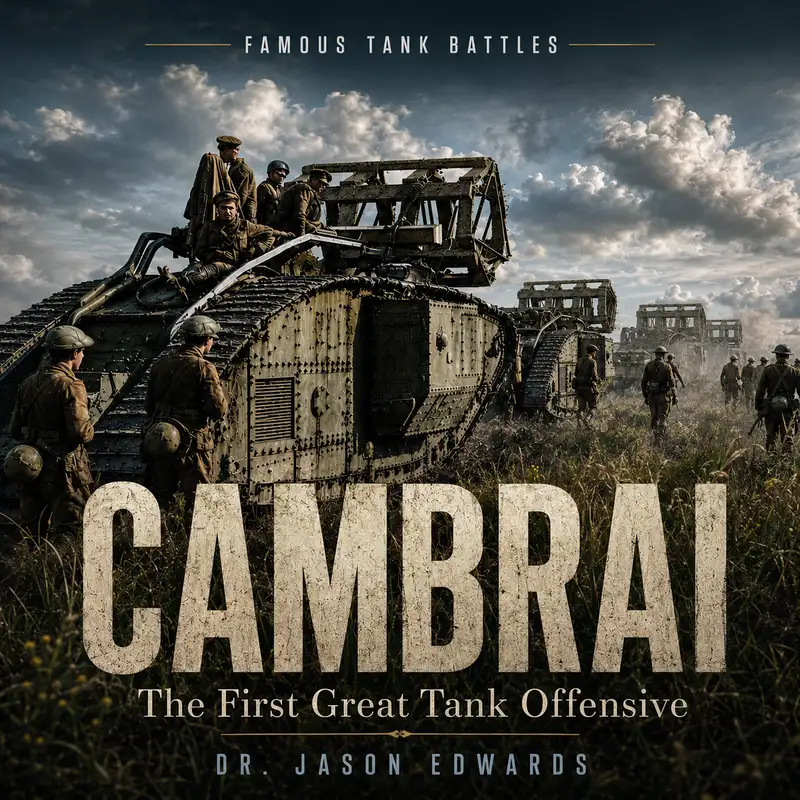
Cambrai: Episode 8 — Commanders and Doubters
Cambrai was a battle of machines, trenches, wire, mud, chalk, guns, and exhausted men, but it was also a battle of arguments. Before the first tank moved forward on the twentieth of November, Nineteen Seventeen, British commanders had already spent months debating what tanks actually were, what they could realistically do, and whether they represented the future of warfare or simply another expensive wartime experiment. Those arguments mattered because Cambrai was not fought by a single shared idea. It was fought by men who agreed on the need for something new after the failures of earlier offensives, yet disagreed sharply on how far that novelty could be trusted. That is why this episode matters. To understand Cambrai, you have to understand not only the battlefield, but the minds of the men who were shaping it, restraining it, and sometimes misunderstanding it at the same time.
This podcast is accompanied by a companion book that expands the story of the Battle of Cambrai, with additional historical context, maps, and dozens of enhanced colorized photographs from the battle. Your purchase helps support our mission to keep these podcasts free. You can find the book at Military Author dot me or at track pads dot com
It is tempting to divide those men into believers and doubters as if the lines were simple. They were not. The British Army in late Nineteen Seventeen was full of officers who were trying to learn under terrible pressure, and many of the so-called doubters had perfectly good reasons for caution. Tanks had already appeared on the Somme in Nineteen Sixteen and had already disappointed some of the grand hopes attached to them. At Arras and Passchendaele they had shown both usefulness and fragility, especially when ground conditions turned against them. Engines failed, tracks broke, crews became exhausted, and field artillery could still kill tanks if it caught them in the open. So the argument before Cambrai was never simply between genius and stupidity, or progress and reaction. It was an argument about risk, timing, terrain, and whether a weapon that was clearly interesting had yet become dependable enough to shape a major offensive.
John Frederick Charles Fuller stood near the center of that argument, though not in the simple way people often imagine. Later generations remembered him as one of the great thinkers of armored warfare, a man whose imagination reached beyond the battlefield of his own time. Yet there is an instructive irony in his story, because when he first entered the tank world he was not a natural believer at all. He had not come to the new weapon as a lifelong devotee of machines. He arrived, looked closely, and then began to see possibilities others had not yet organized clearly. Fuller’s gift was not merely enthusiasm. It was conceptual boldness. He thought in operational terms. He saw that tanks needed suitable ground, concentration, surprise, and support, and he pushed toward a battlefield design in which they would be used in mass rather than dribbled forward in small, disappointing packets. In that sense, Fuller was less the prophet of tanks as symbols than the planner of tanks as systems.
Hugh Elles was different. If Fuller was the intellectual advocate, Elles was the practical champion and builder of belief. As commander of the Tank Corps in France, he was not just inventing plans on paper. He was helping create an institution, and that required a different kind of leadership. He had to inspire crews, protect the Tank Corps from dismissal, argue for its battlefield value inside a skeptical army, and at the same time accept every mechanical and logistical weakness the machines still possessed. That made him a more grounded believer than the caricature of the starry-eyed innovator. He knew the defects because his men lived inside them. Yet he continued to press for massed use on suitable ground because he believed the failures at places like Passchendaele had proved less about the uselessness of tanks than about the folly of using them under the wrong conditions. When he rode into battle himself at Cambrai, leading from the front in Hilda, he was making a public argument as much as a personal gesture.
Julian Byng, commanding the Third Army, occupied another important place between advocacy and caution. He was not a tank visionary in the Fuller mold, and he was not the institutional father of the Tank Corps in the way Elles was. What he brought was something just as important: a senior field commander’s willingness to take the idea seriously enough to build a real operation around it. That required imagination, but it also required restraint. Byng had to think about infantry, artillery, cavalry, engineers, reserves, and the broader front, not merely about the wishes of the Tank Corps. He accepted the combined promise of Fuller’s tank plan and Tudor’s artillery ideas, and in doing so he became the commander who turned separate innovations into a battlefield design. Yet he also changed the plan. What had begun more as a large raid with limited aims was reshaped by Byng into an operation intended to seize and hold ground. That was a crucial decision, and it reveals him as neither pure believer nor doubter, but as a pragmatist trying to convert innovation into military result.
Douglas Haig stood even farther back from the immediate mechanics of the plan, but his role was decisive because nothing of this scale happened without his approval. Haig has often been treated in very simple ways by later memory, either as a stubborn butcher chained to attrition or as a misunderstood commander navigating impossible conditions. Cambrai resists both easy versions. Haig was under immense strategic pressure after the attritional disappointments of Nineteen Seventeen, and he remained fundamentally a commander thinking in terms of armies, fronts, and the wearing down of German strength. He did not hand the war over to tank enthusiasts and let them redefine strategy on their own terms. Yet he was not blind to innovation either. He approved the Cambrai attack once the case for it hardened, particularly when Passchendaele had shown how badly conventional offensives could bog down. His caution was real, but so was his willingness to gamble on a new method when the old one had become intolerably costly.
That matters because the so-called skeptics were not necessarily men who hated the future. Many were officers who had seen enough battle to distrust promises of easy transformation. Tanks were slow. They were noisy. They were mechanically vulnerable. They had limited endurance. They could terrify defenders and still be helpless against well-served field guns. They could smash wire and yet become separated from the infantry they were meant to help. In other words, the skeptics had evidence. They had watched new weapons arrive before. They had seen the battlefield punish optimism. So when some senior officers preferred familiar methods or hesitated to build a major offensive around tanks, their caution was not always intellectual laziness. Sometimes it was simply the hard-earned instinct of men who knew that battle has a cruel way of exposing the gap between promising theory and survivable practice.
The deepest argument among commanders was not whether tanks were impressive. Almost everyone who saw them understood that they were impressive. The real argument was what tanks were for. Fuller and other tank advocates leaned toward a vision of concentrated use, surprise, shock, and rapid exploitation, something closer to a sharp operational incision than another piece of attritional grinding. Byng and the larger command structure, however, had to think about what happened after the incision. If the line opened, who would move through it, and with what objective? Should the tank attack be treated as a great raid, a limited blow with a controlled finish, or as the beginning of a breakthrough that might unhinge the German position more deeply? This disagreement was not academic. It shaped the entire battle. The very meaning of Cambrai changed depending on whether tanks were seen as instruments for a contained success or as the spearhead of something much larger.
Cavalry sat awkwardly inside that argument, and their presence says much about the transitional nature of command thinking in Nineteen Seventeen. Even some officers who believed in tanks still imagined that horse cavalry might exploit the opening once the armored and infantry assault had cracked the defensive crust. This was not as absurd as it sounds to modern ears, because commanders were still searching for any force that could move quickly into the enemy rear before the front re-formed. But it also shows that even believers in mechanized change were not yet thinking in fully mechanized terms. Tanks could open the door, but many commanders still expected older arms to race through it. That is one reason Cambrai feels so historically alive. You can hear the British Army arguing with itself in real time, half stepping toward the future and half reaching back toward older habits of exploitation and pursuit.
There was also an argument on the battlefield itself over how closely infantry should work with tanks. In theory the relationship was clear. Tanks would crush wire, help cross trenches, and suppress positions; infantry would follow close enough to protect the tanks from enemy guns, clear strongpoints, and hold what had been taken. In practice, that cooperation depended on trust, rehearsal, and a willingness to adapt local methods to an unfamiliar machine. Not every infantry commander was equally convinced. One of the recurring controversies of Cambrai centers on the conduct of the Fifty-First Highland Division at Flesquières, where local methods of tank-infantry cooperation did not align cleanly with what tank officers preferred. Later critics treated this as proof that some commanders had not really believed in close cooperation with tanks, while defenders argued that the battlefield there was uniquely difficult and heavily prepared. What matters most is that the dispute existed at all. It reveals how incomplete agreement still was, even on the morning of the attack.
The opening day gave the believers their strongest evidence. The British attack achieved a level of surprise and penetration that stood out sharply against earlier Western Front offensives. Tanks moving in mass, supported by carefully prepared artillery and followed by infantry, helped break into the Hindenburg Line in a way that seemed to justify months of advocacy from Elles, Fuller, and others. For several hours, it looked as if the doubters had been answered. The ground was suitable, the planning was coherent, and the tanks were being used not as scattered curiosities but as a concentrated battlefield instrument. Yet the same day also fed the doubts. At Flesquières and elsewhere, tanks were knocked out by artillery, delayed by local resistance, or lost to breakdowns. Belief and skepticism were therefore both strengthened at once. The attack worked impressively enough to change military history, but not cleanly enough to silence every objection.
After the first day, the argument changed shape. The question was no longer whether tanks could help rupture a fortified front. Cambrai had shown that they could. The question became whether the British command had really understood how to use success once it appeared. Tank advocates could reasonably complain that the opportunity had not been exploited with enough speed, coherence, or fresh strength. Some critics pointed to the lack of adequate reserves, the muddled role of cavalry, and the contradictions between raid thinking and breakthrough thinking. Others responded that this criticism asked too much of a still immature weapon and too much of a battlefield whose canal crossings, communications failures, and defensive depth imposed severe limits on every arm alike. In other words, even the post-battle debate was not simply about tanks. It was about command judgment. The tanks had opened a possibility, but the larger system had not fully agreed what to do with that possibility once it existed.
The battle of Cambrai was not won or lost by machine design alone, and it was not shaped by a single visionary mind dragging a backward army into the future. It emerged from a contested conversation among men with different responsibilities, different temperaments, and different definitions of what success would look like. Fuller supplied conceptual aggression. Elles supplied institutional belief and personal example. Byng supplied operational adoption and command weight. Haig supplied conditional approval from a higher level that still thought in wider strategic terms. Around them stood many others, some supportive, some cautious, some skeptical, and some simply unconvinced that the tank had yet earned the trust being asked of it. Cambrai matters because it did not end that argument. It changed it. After Cambrai, tanks no longer had to be defended as mere novelties. They had to be argued over as serious instruments of war.
In the long history of armored warfare, that is a turning point of its own. Great military changes do not happen only when a weapon appears or when a battle is won. They happen when institutions begin to reorganize themselves around a new possibility, even while still debating it. Cambrai did exactly that. The commanders and doubters were all, in their different ways, participating in the birth of modern armored warfare. Some pushed too far. Some held back too hard. Some understood one part of the problem better than another. But together they revealed the real truth of military innovation: new weapons become historically important not when everyone believes in them, but when enough influential people disagree seriously about how they should be used. At Cambrai, the tank ceased to be an experiment at the edge of war and became a contested center of military thought. That may be the most important victory it won there.