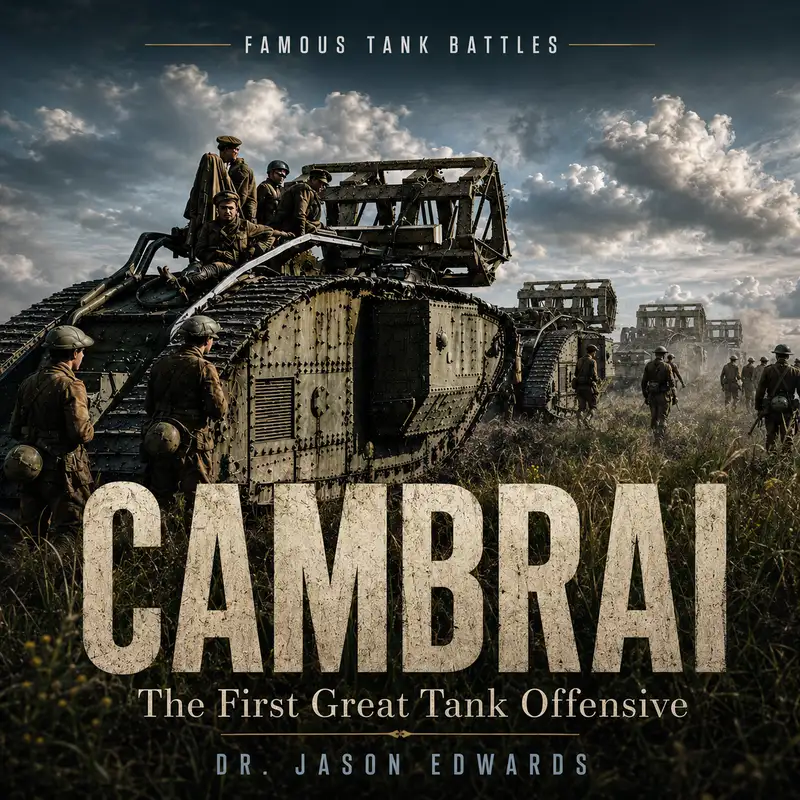
Cambrai: Episode 9 — Zero Hour: 20 November 1917
Before dawn on the twentieth of November, Nineteen Seventeen, the battlefield west of Cambrai held an unusual kind of tension. Armies on the Western Front were accustomed to warning. They expected the preliminary thunder of registration fire, the long battering that told defenders an attack was coming, and the dreadful waiting that followed while both sides prepared for the slaughter to begin. At Cambrai, the British were trying to replace that familiar pattern with something more abrupt and more dangerous. Zero hour would not be the climax of several days of noise. It would be the moment when silence broke into motion, when guns, tanks, infantry, smoke, and timing were meant to strike together so suddenly that the German line would be forced into confusion before it fully understood what was happening.
This podcast is accompanied by a companion book that expands the story of the Battle of Cambrai, with additional historical context, maps, and dozens of enhanced colorized photographs from the battle. Your purchase helps support our mission to keep these podcasts free. You can find the book at Military Author dot me or at track pads dot com
That was the real novelty of the opening attack. Tanks were the most visible symbol of the operation, but the deeper transformation lay in how everything was supposed to begin at once. The British did not want another assault where the artillery destroyed the ground, warned the enemy, and robbed the infantry of momentum before the first wave even crossed no man’s land. They wanted the opposite. They wanted guns that arrived without public rehearsal, smoke that concealed the shape of the assault, tanks already close enough to move immediately, and infantry trained to follow those machines through the gaps they created. Zero hour therefore represented a change in battlefield philosophy. The plan assumed that surprise was not a decorative advantage. It was the condition that made the whole attack worth attempting.
In the hours before the assault, the scale of the undertaking was already remarkable. By about five in the morning, British tanks were assembled in a long broken line across the front, waiting in darkness near the points from which they would lead the advance. They were not standing in some neat parade order. They were dispersed according to sector, route, and assigned infantry formations, each crew trying to hold discipline inside a machine that was loud, hot, cramped, and always vulnerable to mechanical trouble. Then, roughly ten minutes before zero hour, many of the tanks began to creep forward into their final positions. This was a delicate phase of the battle, because even at the last moment surprise could still be lost. Engines could fail, crews could lose direction, or enemy observation could expose movement too soon, but the attack held together long enough for the opening design to survive.
At six twenty in the morning, the British artillery opened. Around a thousand guns fired according to a carefully prepared plan that relied on predicted fire rather than the old method of lengthy public registration. The effect was immediate because the shells were not announcing an offensive that would begin later. They were opening the offensive itself. Forward positions, rear points, and enemy artillery zones were struck at the very moment tanks and infantry began to move, while smoke shells added concealment to force and confusion to surprise. Then the creeping barrage came on, a moving curtain of shells placed ahead of the assault to suppress defenders as the attack advanced. This combination mattered because it gave the British their best chance of restoring tempo to a battlefield that usually killed tempo in its first minutes. Firepower and movement were not being asked to take turns. They were being made to cooperate from the beginning.
That cooperation shaped the role of the infantry as much as the role of the tanks. British infantry were not simply told to run after the machines and hope for the best. They had trained to follow closely through lanes crushed in the wire and to move in smaller grouped formations rather than in exposed, rigid lines. Behind the tanks they advanced in ordered columns sometimes described as worms, a practical answer to the problem of how to cross broken ground without losing all cohesion. The tanks would help crush barbed wire, cross trenches, and suppress strongpoints at the moment of contact, but infantry still had to do the intimate work of battle. They had to enter trench systems, clear dugouts, deal with machine-gun nests, secure villages, and hold whatever had been taken. The opening assault worked because each arm carried part of the burden instead of pretending one weapon could solve the whole front by itself.
Across the attack frontage, the first light of dawn revealed a battlefield changing faster than many Western Front commanders had thought possible. From right to left, British divisions began pressing into the Hindenburg Line with tanks moving before them or among them, artillery lifting and shifting on schedule, and local German defenders trying to understand the scale of what was hitting them. On the British right, progress toward Bonavis and Lateau Wood suggested that the attack had struck hard and quickly. In the center and left center, formations pushed toward places such as La Vacquerie, Marcoing, and the approaches to the Saint-Quentin Canal, each success opening new questions about crossings, reserves, and exploitation. Farther left, the advance through Havrincourt and beyond showed how effective the combination of surprise and mass could be on suitable ground. The action was not tidy, but it was much faster than the standard rhythm of trench assault that soldiers had come to dread.
For the Germans in the forward defenses, the psychological effect was almost as important as the physical one. They had not been given the long, unmistakable warning that earlier offensives usually provided. Instead, they found themselves under an intense barrage while tanks loomed forward through mist and smoke, crushing obstacles that defenders normally counted on to slow any assault. Rockets and distress signals went up along parts of the line as local commanders tried to summon artillery and alert reserves, but the first British blow had already landed. In some sectors the reply from German guns was initially weak or delayed, and that delay mattered enormously. A defending system on the Western Front depended on time. If the first line could hold long enough, guns, reserves, and deeper positions could restore the battle. At Cambrai, zero hour was designed to steal that time, and for several crucial hours it did.
Mist and smoke added to the confusion, but they did not turn the battlefield into a romantic blur. They mattered because they complicated enemy observation at exactly the moment the British needed concealment most. Tanks advancing in the open were never invisible. They were large, noisy, and vulnerable once enemy gunners could see them clearly. Yet under the cover of dawn light, drifting smoke, and a barrage that forced defenders to keep their heads down, the tanks reached the obstacle belts with a degree of protection earlier offensives had often failed to achieve. This is one reason the opening day at Cambrai remains so important in military history. It showed that armor could be made more effective not simply by improving the machine itself, but by improving the battlefield conditions in which the machine was introduced. Zero hour was therefore as much about shaping the enemy’s perception as about smashing his positions.
For a time, the results were extraordinary by the standards of the war. In many sectors, wire that might have stopped infantry for hours was crushed quickly, and trench lines that might once have consumed whole battalions in repeated frontal effort were penetrated with surprising speed. The British did not suddenly make friction disappear. Tanks still broke down, crews still became disoriented, and some strongpoints still fought stubbornly. But the opening assault showed that a fortified trench system could be cracked open on a broad front if the attack began with surprise, concentrated armor, disciplined infantry movement, and artillery planned for immediate effect rather than prolonged warning. This was not yet the fluid armored warfare of a later age. It was something more transitional and in some ways more revealing: a modern combined-arms opening attack emerging inside the landscape of the First World War.
Even in those first hours, however, the weaknesses of the system began to show. The battle did not advance at the same pace everywhere, and one of the clearest examples came around Flesquières, where German resistance and effective artillery fire checked progress and knocked out tanks in a sector that would later attract lasting controversy. Elsewhere, the very speed of the opening success created new pressures. Assault troops moved beyond the first trench systems and toward canal crossings and villages whose seizure now mattered more than the initial penetration itself. Communications remained uncertain, as they so often did in First World War battle, and commanders had to judge success through incomplete reports carried across a landscape still under shellfire. Zero hour had worked brilliantly in creating an opening, but it could not settle the harder question of how to expand that opening before delay, resistance, and geography began to close around it.
The canal crossings soon revealed how unforgiving battlefield momentum could be. Success on the morning front did not automatically mean a clean path into the enemy rear, because the Saint-Quentin Canal and its limited crossing points imposed a harsh physical limit on exploitation. At Masnières, a bridge that might have helped sustain the advance collapsed under the weight of a tank, and that single event carried consequences larger than the loss of one vehicle. A breakthrough is only as real as the routes available behind it. If cavalry, infantry, supply, and follow-on forces cannot pass through in strength, the initial breach begins to narrow in value even while the first line is still falling. So the opening hours at Cambrai contained both triumph and warning. The British had shown how to begin differently, but the battlefield was already asking whether they could continue differently as well.
By midday and into the afternoon, the attack had already entered its second phase, the phase where the opening surprise had to contend with the enemy’s surviving strength. German defenders who had been stunned at dawn were reorganizing where they could, and artillery that had been caught off balance was beginning to answer more effectively in some sectors. Meanwhile, the British faced the familiar burdens of any advance: tanks running into mechanical trouble, infantry becoming tired and scattered, and the challenge of moving support, guns, and reserves through ground that was now contested and confused. Yet none of that erased what zero hour had accomplished. In less than half a day, the British had forced their way deep into one of the most formidable defensive systems on the Western Front. The opening attack did not finish the battle, but it changed what commanders on both sides believed was possible at the start of one.
What remains so striking about that morning is the degree to which it captured modern armored warfare in an unfinished state. Tanks did not win alone, and the battle did not become a clean mechanized exploitation. Instead, the dawn attack revealed a more complicated truth that would echo through later wars. Firepower had to support movement without destroying its conditions. Armor had to cooperate with infantry rather than run free of it. Smoke, timing, route discipline, and surprise were not supporting details but central parts of battlefield design. And even the most brilliant opening could still be limited by communications, obstacles, reserves, and the enemy’s capacity to recover. On the twentieth of November, Nineteen Seventeen, zero hour at Cambrai showed that the age of combined-arms armored assault had begun to take visible shape. It also showed how much remained to be learned before that shape could become mastery.