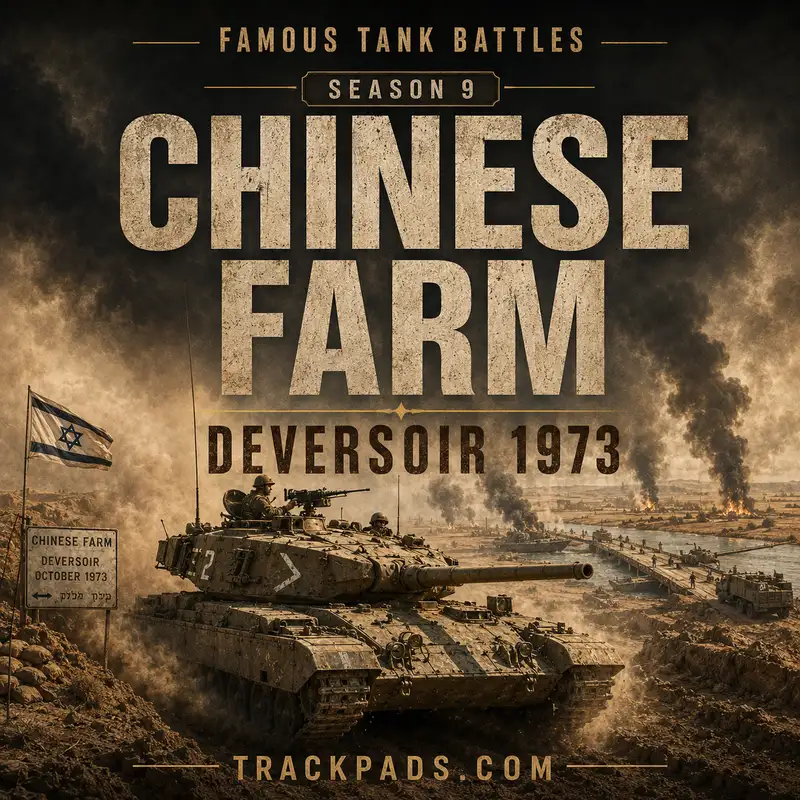
Chinese Farm: Episode 12 — Operation Stouthearted
Operation Stouthearted Men began as a plan drawn across a narrow possibility. Israel had found the seam near Deversoir, the weak place between the Egyptian Second and Third Armies, but a seam is not yet a road, and a road is not yet a crossing. The Israeli army had been hurt badly in the opening days of the war, then steadied itself on 14 October when Egyptian armor moved east and suffered a major defeat. Now the question was whether Israel could do more than stop Egypt. Could it reverse the direction of the war, reach the Suez Canal, put troops across to the west bank, and threaten the Egyptian rear? The answer depended on a sequence so fragile that one broken link could leave men trapped in the dark.
If you would like to move beyond the podcast, you can see my available books at Military Author dot me. And at Trackpads dot com, you will find magazines and galleries with hundreds of thousands of photos and videos to explore.
The operation’s Hebrew name, often translated as Stouthearted Men or Valiant Men, captured the spirit Israeli commanders wanted from the force, but bravery was only one ingredient. The plan demanded precision from an army still recovering from confusion. First, Israeli units had to secure the approaches to the canal near Deversoir. Then they had to open and protect the routes that would carry bridging equipment forward. At the same time, an initial force had to cross the canal in small craft and establish a foothold on the west bank before Egypt understood the scale of the danger. After that, heavier bridges had to arrive, tanks had to cross, and the lodgment had to expand north and south. It was simple only when spoken quickly. On the ground, every step was exposed to friction, enemy fire, darkness, delay, and misunderstanding.
The Israeli commanders understood that they were not merely planning a local raid. A successful crossing would change the entire problem facing Egypt. Since 6 October, Egyptian troops had looked east from their bridgeheads, preparing to stop Israeli armor coming from Sinai. Their missile batteries, artillery positions, supply routes, and command arrangements were built around sustaining the armies east of the canal. If Israeli forces suddenly appeared on the west bank, behind the Egyptian crossing system, then the Egyptian army would have to turn around mentally and physically. Air-defense sites could be threatened from the rear. Supply lines could be cut. The Egyptian Third Army in the south could eventually be isolated. That was the promise of Stouthearted Men: not just to cross water, but to make the enemy’s success face the wrong direction.
The plan gathered around Ariel Sharon’s reserve armored division, the formation closest to the Deversoir opportunity and most associated with the crossing’s first phase. Sharon’s reputation mattered because this was the sort of operation that suited him: risky, aggressive, impatient with hesitation, and aimed at a decisive change in the enemy’s rear. But a crossing could not be won by personality alone. Sharon’s tanks, infantry, engineers, and attached forces had to perform a tightly connected set of tasks in ground that was neither empty nor fully understood. Egyptian units still held strong positions east of the canal, especially around the agricultural research area later remembered as the Chinese Farm. The Israeli crossing plan therefore contained a cruel contradiction. To create operational surprise west of the canal, Israeli forces first had to fight through tactical resistance east of it.
The crossing site itself was chosen because it offered the best chance of slipping between the Egyptian armies, but reaching it required control of a road network that would soon become famous for all the wrong reasons. Israeli maps used code names for roads and tracks, including Akavish, Tirtur, and Lexicon. For a listener without a map, think of these routes as the narrow arteries feeding the heart of the operation. Lexicon ran roughly along the canal. Akavish and Tirtur led westward toward the water from the Israeli side. If those routes were blocked, mined, congested, or under Egyptian fire, the crossing force might reach the bank but the bridges would not. A few tanks and paratroopers on the west side would be dramatic, but without bridges and a steady flow of vehicles, the lodgment could become a dangerous gesture rather than an operational turning point.
The bridging problem was especially unforgiving. A canal crossing by modern armor is not a matter of simply arriving at water and wishing the tanks across. Israel had different means available, including small boats for the first infantry, rafts or ferries for vehicles, and larger bridging equipment meant to carry heavy traffic once emplaced. These systems had to be moved over desert roads, through congestion, and sometimes under fire. They were bulky, slow, and vulnerable to mechanical trouble. The most famous of the Israeli crossing devices, a large roller bridge, symbolized both ingenuity and difficulty. It promised a way to span the canal, but only if it could be dragged to the right place in time. In this operation, logistics was not background support. Logistics was the battle’s spine.
The first men across would not be tank crews, but paratroopers under Danny Matt, an Israeli commander whose force was tasked with establishing the initial west-bank foothold. Their job was intimate and dangerous. They would cross in rubber boats and rafts, under cover of night, before the heavy bridges were in place. If they succeeded, they could secure a lodgment, confuse Egyptian command, and prepare the way for the tanks to follow. If they failed, the whole plan might collapse before it became visible. This was one of the great ironies of a campaign remembered for armored warfare. The decisive opening of the countercrossing depended on lightly equipped infantry moving quietly over black water, while the heavier steel waited behind them for a path that did not yet exist.
Timing was the heart of the plan, and timing was also its enemy. Israeli forces had to move after the Egyptian defeat of 14 October, before the opportunity faded and before Egyptian commanders fully repaired the seam between their armies. Yet moving quickly meant accepting imperfect knowledge. How strong were the Egyptian positions near the approach roads? Which tracks were passable? How quickly could the bridges be brought forward? Would the first west-bank force remain hidden long enough to grow? War does not wait for headquarters to answer every question. The plan moved forward because the alternative was to surrender initiative back to Egypt. But the price of speed was uncertainty, and uncertainty would soon fill the night with wrong turns, traffic jams, and fights far more costly than planners expected.
The Egyptian side still possessed powerful advantages, even if it did not yet grasp the full danger. Its east-bank bridgeheads were not hollow. Egyptian infantry had trenches, anti-tank weapons, artillery support, and the confidence of men who had already endured Israeli counterattacks. Around Chinese Farm, Egyptian positions could block the Israeli corridors without needing to understand the entire Israeli plan. A local commander defending a trench line did not have to know that he stood between Israel and a strategic crossing. He only had to hold his ground and fire at the armor and infantry coming toward him. That is one reason battles become more brutal than plans predict. Operational brilliance may depend on a road, but the men defending that road experience the fight as a simple and deadly order: do not let them pass.
For Israeli armor, Stouthearted Men offered both redemption and risk. The first days of the war had shown what happened when tanks were thrown against prepared anti-tank defenses without the right conditions. The victory on 14 October had shown that Israeli armor could still be devastating when fighting from better positions against exposed Egyptian movement. Now the tanks had a different mission. They had to escort, screen, clear, block, and protect a crossing operation whose success depended as much on engineering and traffic control as on gunnery. Tanks might have to fight Egyptian armor, suppress infantry, hold junctions, shield bridge convoys, and prevent counterattacks from reaching the crossing site. This was not the clean armored thrust of legend. It was armor used as a moving shield for a larger and more delicate machine.
Command relationships added another layer of difficulty. Israeli Southern Command, now steadier than in the first days but still under pressure, had to coordinate Sharon’s division with other formations, including forces that would later expand the bridgehead and exploit west of the canal. Avraham Adan’s armored division would become crucial once a real crossing was established, and other units would be drawn into the fight as the corridor widened and the battle spread. But before exploitation could begin, the crossing had to survive its birth. Commanders argued over timing, priorities, and risk because the stakes were enormous. Push too slowly, and Egypt might seal the gap. Push too fast, and the force might outrun its bridges, its infantry, or its own understanding of the battlefield. The operation demanded boldness disciplined by coordination, and that balance was not easy.
What made Stouthearted Men so dangerous was that it tried to create order through a landscape already full of disorder. Night movement promised concealment but made navigation difficult. The approach roads were narrow enough that stalled vehicles could delay entire columns. Bridging equipment could not magically pass through a traffic jam. Egyptian artillery or a single stubborn position could slow the flow at the worst possible moment. Units moving in darkness could mistake where they were, underestimate the enemy, or enter fights they had not planned to fight. Yet the operation also had a fierce logic. Egypt’s system was strongest where it expected Israel to attack directly. At Deversoir, Israel was trying to make surprise, movement, and a fragile gap do what frontal counterattacks had failed to do.
The larger meaning of Operation Stouthearted Men lies in how it joined imagination to mechanics. The imaginative leap was to see that Israel could cross the canal and threaten the Egyptian rear rather than merely batter the bridgeheads from the east. The mechanical reality was that this leap depended on boats, bridges, roads, engineers, traffic discipline, and infantry clearing positions in the dark. Armored warfare often celebrates breakthrough, but breakthrough is not a single moment. It is a chain of practical achievements that allows movement to continue when the enemy is trying to stop it. In that chain, a paratrooper in a rubber boat, an engineer dragging equipment forward, and a tank crew holding a junction could all be equally decisive.
As the operation began to move toward the night of 15 October, the plan carried both hope and dread. If it worked, Israeli forces would open a new front west of the canal and turn Egypt’s canal victory into a strategic vulnerability. If it failed, Israel might lose men and equipment in a narrow corridor, with its first west-bank force isolated and its bridges stuck short of the water. This was the doorway to the Chinese Farm battles, to the fight for the roads, to boats in the dark, and to bridges arriving under pressure while commanders watched the clock. Operation Stouthearted Men was not a clean masterstroke unfolding exactly as designed. It was a high-risk attempt to force a decision from a battered army that had finally found a seam. The canal waited ahead, black and narrow, and beyond it lay the chance to turn the war around.