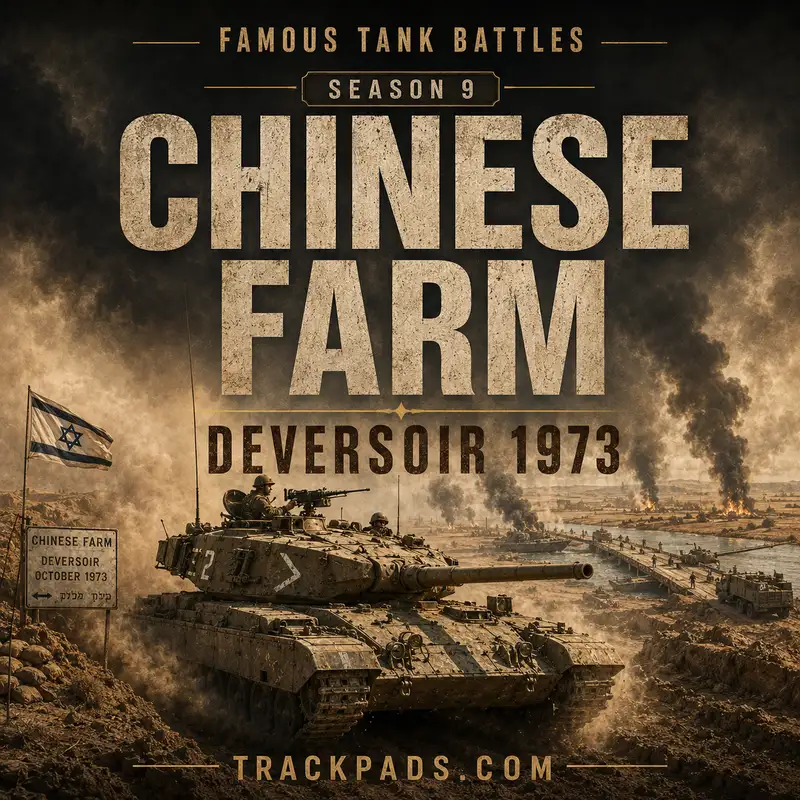
Chinese Farm: Episode 14 — Boats in the Dark
The most important Israeli crossing of the October War did not begin with a bridge. It began with men carrying rubber boats toward black water, trying to move quietly while the desert behind them growled with engines, radios, and distant gunfire. The Suez Canal had already become a symbol twice over: first as the barrier Egypt had broken on 6 October, and now as the barrier Israel hoped to turn back against Egypt. Around Deversoir, near the northern end of the Great Bitter Lake, the canal lay in darkness, narrow enough to cross in small craft but wide enough to swallow an operation if timing failed. The tanks and bridges would come later, if they came at all. First, Danny Matt’s paratroopers had to get across.
If you would like to move beyond the podcast, you can see my available books at Military Author dot me. And at Trackpads dot com, you will find magazines and galleries with hundreds of thousands of photos and videos to explore.
The men chosen for that first move belonged to a force trained for danger, but this task was different from a parachute drop or a raid behind enemy lines. They were being asked to establish a foothold on the west bank of the canal, in Egypt proper, before the Egyptians fully understood that Israel’s counteroffensive had begun. The larger plan depended on surprise, and surprise depended on scale remaining hidden for as long as possible. A few boats in darkness could look like a local probe. A bridge carrying tanks would announce a strategic crisis. So the first wave had to be light, fast, and exposed. They would cross with what they could carry, secure enough ground for follow-on movement, and trust that the heavy crossing equipment would somehow fight its way to the water behind them.
To follow the scene without a map, imagine the Israeli force moving from the east, out of Sinai, toward the canal. Behind it lay the hard-fought approaches around the Chinese Farm and the road network that had to be kept open. Ahead lay the west bank, the Egyptian rear, and the chance to threaten the system that had protected Egypt’s bridgeheads. The crossing point near Deversoir was chosen because it sat in the seam between Egypt’s Second Army to the north and Third Army to the south. But a seam is not the same thing as safety. There could be patrols, artillery fire, local defenders, and confusion enough to ruin everything. The first Israelis crossing would be stepping into uncertainty, not onto an empty shore.
The paratroopers’ boats had a strange importance out of proportion to their size. They were not imposing machines, not like the heavy bridges being dragged and fought toward the canal. They were fragile craft for carrying men over water, vulnerable to fire, puncture, panic, or simple mismanagement in the dark. Yet for those hours, they mattered as much as any tank in Sinai. Without them, there would be no first lodgment. Without the lodgment, the bridges would have nowhere secure to lead. Without the bridges, Israeli armor could not cross in strength. Modern armored warfare often appears to be about the biggest machine on the battlefield, but here the hinge of the campaign rested first on small boats, paddles, ropes, and men trying not to make a fatal noise.
The crossing also reversed the emotional meaning of the canal. For nine days, Israelis had lived with the shock of Egyptian soldiers crossing eastward, breaking the Bar-Lev Line, and forcing Israeli armor into costly counterattacks. Now Israeli troops were doing what Egypt had done, but under different conditions and for a different purpose. Egypt had crossed to seize bridgeheads and break a political deadlock. Israel crossed to unhinge those bridgeheads by reaching the rear behind them. The symmetry was striking, but it should not be overstated. Egypt had crossed with massed artillery, rehearsed engineering, and a broad assault plan prepared over years. Israel’s first westward move was narrower, more improvised, and born from recovery after surprise. It was not the opening blow of a confident campaign. It was a counterstroke by an army trying to regain the initiative before the chance disappeared.
For Danny Matt and his men, the first concern was not grand strategy but getting to the water and getting across alive. Night helped conceal them, but it also made everything harder. Equipment had to be carried, sorted, and launched in low visibility. Men had to know which boat they belonged to and where they were supposed to go when they reached the opposite bank. A shouted correction could carry too far. A delay could bunch men together on the near bank, making them vulnerable if Egyptian fire found them. The canal, so clean in the imagination, became a physical problem of mud, banks, weight, water, and balance. Every man who stepped into a boat was leaving the relative certainty of one shore for a far bank whose dangers were still mostly guessed.
What made the first crossing so tense was the gap between its quiet appearance and its enormous consequence. There was no triumphant surge of armor, no broad daylight panorama of mechanized power. The operation depended on restraint. Men moved low, boats slipped out, and the west bank came closer one dark length of water at a time. Somewhere behind them, Israeli tanks and armored vehicles were still fighting to hold the approaches open. Somewhere farther back, engineers and bridge convoys struggled with routes, congestion, and delays. The paratroopers could not control any of that. Their world had narrowed to the opposite bank. Yet the entire Israeli counteroffensive depended on the hope that their small, vulnerable movement would become the first thread of a much larger fabric.
The west bank, once reached, did not become safe by the mere fact of arrival. A landing force is often at its weakest just after it lands. It is disorganized by the crossing, separated from heavy support, and uncertain about enemy positions. Matt’s paratroopers had to gather themselves quickly, push out from the landing area, and create enough security to keep the crossing alive. They had to do this without drawing so much attention that Egyptian forces could crush them before reinforcement arrived. That balance was cruel. If they stayed too close to the bank, the lodgment would remain shallow and fragile. If they pushed too far, they risked becoming scattered and isolated. A foothold is not a possession. It is a claim that must be defended before the enemy understands its value.
The Egyptians on the west bank did not immediately face a massive armored breakout, and that helped the Israelis. Confusion, darkness, and the broader disorder of the battle delayed a full appreciation of what was happening. Some Egyptian commanders still saw the main danger in the east-bank fighting around the corridor. Others did not yet grasp that Israeli troops had begun to appear behind the canal line. This uncertainty mattered as much as any weapon. Armies respond best to threats they can define. A crossing that begins as rumor, scattered reports, or local contact may grow before headquarters names it correctly. Israel’s first advantage on the west bank was not strength. It was ambiguity. The crossing was real, but for a precious interval it was not yet fully understood.
That interval was exactly what the Israelis needed, because the first wave could not win the campaign by itself. Paratroopers could raid, seize, and screen, but they could not dismantle the Egyptian rear alone. The next stages required tanks, artillery, supplies, and more infantry to cross in numbers. This returned the operation to the same hard truth that had shaped every canal battle since 6 October: water separates courage from combat power unless engineers solve the crossing problem. The first boats made presence possible. The bridges would make weight possible. Between those two lay a dangerous pause, when men on the west bank waited for an army to follow and men on the east bank fought to keep the roads open long enough for that army to arrive.
The crossing in boats also carried a psychological power that grew as the hours passed. Once Israeli soldiers were west of the canal, Egypt’s rear was no longer an abstract space behind the front. It was contested ground. Surface-to-air missile sites, artillery positions, roads, depots, and command facilities that had helped sustain the Egyptian bridgeheads could now be threatened from an unexpected direction. The Egyptian armies east of the canal did not collapse because a few boats crossed at Deversoir, but their situation had changed. A front designed to face east now had danger behind it. This is one of the deepest purposes of maneuver in armored warfare. The object is not always to destroy the enemy where he is strongest. Sometimes it is to make his strongest position suddenly face the wrong way.
Yet the success of the boats should not make the crossing seem easy or inevitable. It survived because many things went just well enough, not because everything went smoothly. The approach routes on the east bank remained contested. The bridge convoys were delayed by terrain, traffic, and fighting. The area around Chinese Farm still had to be fought over with terrible cost. Egyptian resistance could stiffen at any moment. Men on both banks had only partial knowledge of the operation they were inside. A war story told afterward can make events seem like steps in a staircase. The men living through it often experienced them as loose boards over a dark drop, each one holding only when their weight was already on it.
For the paratroopers, the first hours on the west bank were a test of nerve and discipline. They had to secure ground quietly where possible and violently where necessary. They had to prepare for Egyptian reaction while also helping the crossing expand. They had to trust that the chaos behind them would not abandon them. This kind of trust is easy to overlook in military history because maps show connected arrows even when the men on the ground feel alone. A small force across water knows exactly how narrow its lifeline is. Behind it is the canal. Ahead is the enemy’s rear. Somewhere behind the opposite bank are bridges that may be late, roads that may be blocked, and commanders making decisions with information already aging by the minute.
Boats in the dark deserve their own place in this season because they remind us that decisive moments in armored warfare are not always armored in appearance. The tanks mattered enormously, and once they crossed the canal the campaign would change again. But the tanks could not be first. Before steel could roll west, men had to cross in small craft, establish a lodgment, and turn a risky idea into a physical fact on the far bank. In the long evolution of mechanized war, this moment belongs beside every bridge, breach, mine lane, and river crossing that made maneuver possible. It was quiet only in comparison with the thunder around it. On the dark water near Deversoir, the Israeli countercrossing began as a handful of vulnerable boats, and from those boats came the possibility of turning the war around.