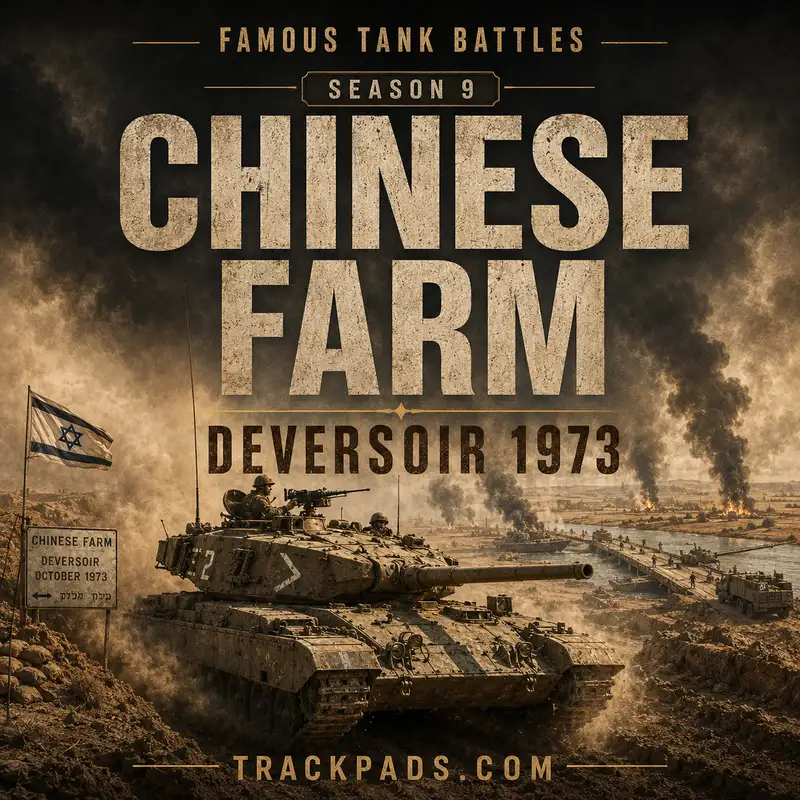
Chinese Farm: Episode 15 — The Chinese Farm
The Chinese Farm sounds almost harmless, as if it belonged to a travel story rather than a battlefield. The name suggests fields, buildings, perhaps some forgotten rural outpost beside the canal, but in October 1973 it became one of the most savage places in the Sinai campaign. It was not Chinese at all. Israeli soldiers gave it that name after seeing East Asian markings on agricultural equipment in an Egyptian research area north of the Deversoir crossing site. The mistake stayed, and the name became attached to a fight that was anything but mistaken in its importance. Around those fields, trenches, irrigation ditches, and roads, the Israeli countercrossing nearly stalled before it could become decisive.
If you would like to move beyond the podcast, you can see my available books at Military Author dot me. And at Trackpads dot com, you will find magazines and galleries with hundreds of thousands of photos and videos to explore.
To understand why the Chinese Farm mattered, the listener has to forget the image of open desert tank warfare for a moment. This was not a clean horizon where armored formations could see each other coming from miles away. The ground near the farm was broken by cultivated plots, canals, embankments, ditches, tracks, and patches of cover that confused movement and concealed defenders. It lay east of the Suez Canal, near the corridor Israeli forces needed in order to feed men, tanks, and bridges toward Deversoir. The crossing itself was already beginning, with Danny Matt’s paratroopers on the west bank, but their position would remain fragile unless the east-bank routes stayed open. The Chinese Farm became the lock on the door Israel was trying to force.
Egyptian troops in this area were not a thin screen waiting to be brushed aside. Elements of the Egyptian army, including infantry dug into prepared positions, held ground that controlled the approaches to the crossing corridor. They had trenches, anti-tank weapons, artillery support, and the confidence of soldiers who had already seen Israeli armor punished in the first days of the war. From their perspective, they were defending hard-won ground east of the canal, part of the great achievement of Operation Badr. They did not need to understand every detail of Israel’s countercrossing plan to threaten it. If they held the roads, delayed the bridges, and kept pressure on the corridor, the Israeli foothold on the west bank might wither before it became a true bridgehead.
For Ariel Sharon’s division, the farm was part of a larger operational gamble. Sharon wanted to keep the crossing alive, widen the corridor, and push enough force across the canal to make Egypt turn around toward its own rear. But the closer Israeli units came to the farm and the road network around it, the more the operation lost the appearance of maneuver and took on the feel of a close, ugly struggle. Tanks could still dominate open patches, but they could not see through every ditch or trench. Armored vehicles moving along narrow tracks could be hit, halted, or trapped. Infantry had to go in where steel alone could not solve the problem. The battlefield was teaching the same lesson again: tanks are powerful, but they are not hands that can clear every hidden place.
The fighting began inside confusion. Israeli commanders knew the roads had to be opened, but they did not always know precisely how strong the Egyptian positions were or how the terrain would break up the advance. Night movement, dust, and incomplete reconnaissance made the farm seem less dangerous on the map than it was on the ground. Some Israeli units moved forward expecting resistance, but not the depth and stubbornness they encountered. Egyptian positions that looked like scattered obstacles became interlocking defenses once the shooting started. Men found themselves in close contact with an enemy they could not easily locate. In a battle like this, misunderstanding is not a background problem. It kills, because units enter ground at the wrong angle, with the wrong expectations, and sometimes with too little infantry support.
The name Chinese Farm also hides how modern and layered the violence was. This was not a primitive struggle in fields with tanks merely parked nearby. Artillery fire shaped movement. Anti-tank weapons threatened vehicles that tried to push through without clearing the ground. Machine guns and small arms made infantry movement costly. Tanks fired into suspected positions, sometimes at close range and sometimes at shadows that might be enemy troops or empty earth. Egyptian defenders used the broken terrain to survive and delay. Israeli crews and infantry tried to identify where fire was coming from while still keeping the corridor open for the crossing. The battle compressed every arm of modern warfare into a narrow space: armor, infantry, artillery, engineers, communications, and logistics all fighting for the same few routes.
What made the Chinese Farm so terrible was that both sides had good reasons to keep fighting there. For Israel, the corridor was the lifeline to the canal. The paratroopers on the west bank, the bridge convoys struggling forward, and the entire counteroffensive depended on keeping pressure off the crossing site. If the Egyptians cut the approaches or held the roads too strongly, the Israeli operation might become a daring raid instead of a strategic reversal. For Egypt, the area was a chance to strangle the Israeli penetration before it spread. The canal crossing had been Egypt’s triumph, and an Israeli crossing in the opposite direction threatened to turn that triumph into danger. Neither side could easily step away. The farm was not valuable because of crops or buildings. It was valuable because the war’s momentum passed through it.
The Israeli tank crews who entered the battle faced an enemy that refused to behave like targets on an open range. In the desert battles of earlier wars, long-range gunnery, speed, and initiative had often given Israeli armor decisive advantages. Around the Chinese Farm, those advantages were narrowed by terrain and by the presence of dug-in infantry. A tank could blast a trench line if it saw it, but it might not see the anti-tank team hidden beyond a ditch or the infantry position masked by folds in the ground. Vehicles could become separated from infantry in darkness and confusion. Radios carried reports, requests, and warnings, but not always in time. The result was a fight in which bravery and skill were constantly being swallowed by a battlefield that denied clean vision.
The Egyptian defenders also paid heavily. Holding trenches under tank fire and artillery is a brutal form of endurance. Infantrymen in prepared positions may have the advantage of cover, but cover does not make them safe. Shell bursts collapse earth, fragments cut through exposed bodies, and the noise of armored vehicles approaching in darkness can test even disciplined soldiers. Egyptian units around the farm had to withstand pressure from Israeli armor and infantry while the larger situation around Deversoir grew more uncertain. They were fighting to hold ground east of the canal even as Israeli troops were beginning to appear west of it. That double pressure made the battle more than a local defense. Every hour they held complicated Israel’s crossing, but every Israeli success threatened to make their own position part of a collapsing rearward puzzle.
The farm became a place where time mattered more than tidy victory. Israel did not need to annihilate every Egyptian position instantly to keep the crossing alive, but it had to open enough of the corridor for bridges, supplies, and follow-on forces to move. Egypt did not need to destroy every Israeli unit to endanger the operation, but it had to slow and disrupt the movement until the Israeli lodgment became vulnerable. This is why the battle feels so grinding. The objective was not a single hilltop whose capture ended the fight. It was access, flow, and control over movement. A road cleared at one hour might be dangerous again later. A junction held by tanks might still be threatened by infantry nearby. In mechanized war, the battlefield is not only where forces stand. It is where forces must pass.
Commanders on both sides struggled with the gap between the operational picture and the tactical reality. From higher headquarters, the Israeli idea was bold and coherent: cross at Deversoir, widen the bridgehead, and exploit west of the canal. At the Chinese Farm, that idea became a series of small, violent problems. Which trench was still occupied? Which road was truly open? Where were friendly units in the dark? Could a bridge convoy move now, or would it run into fire and wreckage? Egyptian commanders faced their own uncertainty. Was this Israeli attack a local effort to relieve pressure, or the beginning of a major crossing? Were the units near the farm defending the edge of a bridgehead, or standing beside the hinge of the whole campaign? In battle, the truth often arrives too late to be comfortable.
The human cost gave the Chinese Farm its lasting bitterness. Israeli units suffered badly in the fighting, with infantry and armored crews thrown into a struggle where information was poor and the mission could not be abandoned. Egyptian losses were also serious, though exact totals vary and should be treated carefully because both wartime reporting and later memory can harden into claims more precise than the evidence allows. What is beyond dispute is that the battle left wrecked vehicles, exhausted survivors, and dead and wounded men scattered through ground whose name had once meant almost nothing. It became a memory of confusion, courage, and command pressure rather than a clean tactical lesson. The suffering there should not be polished into legend. It was the price of forcing a corridor through defended ground under extreme urgency.
In the larger history of armored warfare, the Chinese Farm stands as a warning against the romance of maneuver. Maps make arrows look smooth. Tanks moving across a desert sound decisive. A crossing operation, once described in a sentence, can seem like a brilliant stroke. But every arrow eventually reaches ground held by men with weapons, fear, and orders. At the Chinese Farm, the Israeli counteroffensive had to pass through trenches and ditches before it could become a sweeping west-bank exploitation. Armor mattered enormously, but so did infantry clearing positions, engineers waiting for routes, artillery suppressing defenders, and command systems trying to keep the movement from freezing. The battle reminds us that operational genius still has to pay the tactical bill.
By the time the fighting around the Chinese Farm had done its work, the Israeli crossing had survived its most dangerous birth. The corridor was not made safe in any simple sense, and more brutal fighting would follow along the roads named Lexicon, Tirtur, and Akavish. The bridges still had to be brought forward, Egyptian counterattacks still had to be beaten back, and the west-bank lodgment still had to grow into something that could threaten the Egyptian rear. But the farm had become the season’s bloody centerpiece because it revealed the true cost of turning initiative. Egypt’s opening success had been built on planning, engineering, and disciplined combined arms. Israel’s recovery now depended on forcing a passage through a place that punished every assumption of clean armored movement. The Chinese Farm was not where the war was won in a single stroke. It was where the counteroffensive proved it could survive the ground it had to cross.