Crusader: Episode 12 — The Airfield
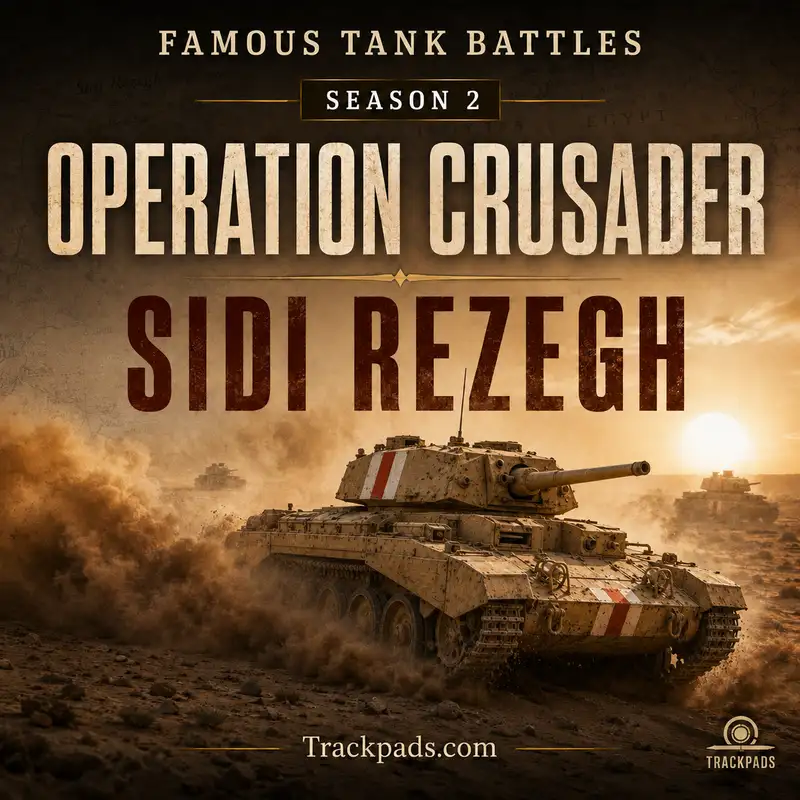
The Sidi Rezegh airfield became important not because it was grand, fortified, or dramatic to look at, but because it gave Operation Crusader a focal point in a battlefield that otherwise seemed to have no center. In the open desert south of Tobruk, a flat landing ground, a nearby ridge, and the tracks around them turned into a magnet for tanks, infantry, artillery, aircraft, and command decisions. The British offensive had begun with movement, but movement needed a purpose. Sidi Rezegh supplied one. It was close enough to threaten the Axis siege of Tobruk, visible enough to orient commanders, and exposed enough to become dangerous the moment troops tried to hold it.
An airfield in the desert was not like a paved modern base with permanent buildings and a neat boundary. It could be a cleared or usable stretch of hard ground where aircraft could operate if the area was secure enough. That made it valuable, but also fragile. It could be occupied by troops and still remain exposed to artillery, tank movement, and counterattack from surrounding ground. Its value came from what it allowed: reconnaissance, fighter cover, attack missions, and the projection of airpower closer to the front. But to use an airfield, an army first had to hold the land around it, and in Crusader that was the harder part.
The British push toward the airfield came from the larger ambition of Thirtieth Corps and Seventh Armoured Division. Their job was to drive into the desert south of Tobruk, draw Rommel’s mobile forces into battle, and create the conditions for a link with the garrison inside the fortress. Sidi Rezegh seemed to offer a practical step toward that goal. If the British could control it, they would be threatening the southern flank of the Axis siege system. They would also be near ground from which the Tobruk breakout might eventually connect. But every advance toward that possibility increased the risk that British armor would arrive before the rest of the combined arms system could secure the gain.
The strange feature of the Sidi Rezegh fight is that it blended mobility and fixity at the same time. Tanks could move quickly across the desert. Columns could swing around positions, probe flanks, and disappear into dust. Yet the battle kept pulling units back toward the same few places: the airfield, the ridges, the roads and tracks, and the approaches south of Tobruk. The desert looked open, but operationally it was full of invisible pressure points. Armies did not fight evenly across every mile of sand and rock. They fought where movement, observation, supply, and communication converged, and the airfield was one of those places.
For British tank crews, reaching the airfield did not mean the problem was solved. A tank can drive onto ground far more easily than an army can secure it. Holding required infantry to occupy positions, artillery to cover approaches, anti-tank guns to stop counterattacks, engineers to deal with obstacles, and supply columns to keep everyone alive. Without those supporting pieces, armored troops could become a temporary presence rather than a durable force. This was one of the recurring lessons of Crusader. A mobile formation might seize space, but space did not become useful until it was tied into a larger system of defense, supply, and command.
The airfield also mattered because of the ridge near Sidi Rezegh. In a desert campaign, even modest high ground could be decisive. A ridge gave observers a better view of movement, allowed artillery to be directed more effectively, and helped anti-tank weapons cover approaches. A tank crew on lower ground might see dust and flashes without fully understanding where the enemy was positioned. A commander on higher ground could make sense of movement across a wider area. The airfield itself was flat and exposed, but the ground around it decided whether that flat space was usable, defensible, or merely a killing ground.
This is where the battle began to punish the British habit of treating armored movement as if it could create its own security. The armored brigades had to push forward, but each move stretched the relationship between tanks, infantry, artillery, and supply. If tanks advanced too far ahead, they could be isolated. If infantry and guns lagged behind, captured ground might remain vulnerable. If headquarters believed an objective had been secured when only armored vehicles had passed through or paused there, the map could become dangerously misleading. The airfield made this problem visible because it was easy to identify, easy to claim, and hard to hold.
Rommel’s forces understood the danger of allowing the British to consolidate around Sidi Rezegh. If the airfield and nearby ridge remained in British hands, the pressure on Tobruk could grow. The siege front might be threatened from outside while the garrison prepared to break out from within. Axis commanders therefore had every reason to contest the ground fiercely, using mobile units, anti-tank guns, artillery, and counterattacks to prevent the British from turning arrival into control. The purpose was not always to hold every yard permanently. Sometimes the aim was to disrupt, delay, and break the coordination needed for the British plan to work.
The fighting around the airfield also revealed how information could become a weapon or a weakness. Reports of who held Sidi Rezegh, who was moving nearby, and whether enemy armor was approaching could change quickly and arrive late. A headquarters might receive news that sounded encouraging while the situation on the ground was already deteriorating. A tank unit might believe friendly infantry was near when it was actually separated by distance, fire, or confusion. In armored warfare, especially in the desert, a false sense of certainty can be deadly. The airfield became one of those places where the battle was fought not only with guns, but with incomplete understanding.
The Royal Air Force and Axis air forces add another dimension to the story, because the value of an airfield depends on more than the ground itself. Aircraft could help find enemy movement, attack supply columns, and protect friendly formations, but air operations depended on weather, serviceable aircraft, fuel, maintenance crews, and safe landing grounds. A forward airfield could shorten the distance between aircraft and battle, but only if it could be defended and supplied. Sidi Rezegh therefore connected ground combat to airpower in a practical way. It showed that the air war and tank war were not separate contests above and below each other, but interlocking parts of the same campaign.
The men fighting around Sidi Rezegh experienced the airfield less as a symbol than as an exposed place under pressure. Dust reduced visibility. Artillery fire could make movement dangerous. Tanks maneuvered across ground where friend and enemy were not always easy to distinguish at distance. Infantry had to endure the vulnerability of open desert while trying to hold positions that armored vehicles alone could not secure. Mechanics and recovery crews faced their own battle, trying to keep damaged vehicles from becoming permanent losses. The airfield drew all these experiences together because every arm of the force had a reason to be there, and every arm needed the others to survive there.
The contest for Sidi Rezegh also widened the gap between the British plan and the British experience of the battle. The plan imagined movement toward Tobruk, pressure against Rommel’s army, and a coordinated link with the garrison. The experience was a series of violent local struggles in which units were worn down, positions changed hands or became uncertain, and commanders had to judge whether a setback was local or operational. The airfield became the place where optimism was tested by friction. It was possible to see why the ground mattered and still fail to make it serve the larger purpose. That is one of the hardest truths of modern battle.
In the longer history of armored warfare, the Sidi Rezegh airfield matters because it shows that mobility does not eliminate fixed objectives. Even in a campaign famous for wide movement, tanks repeatedly fought over places that anchored the battlefield. Airfields, ridges, crossroads, passes, and supply routes gave shape to the desert. They told armies where power could be projected and where danger would gather. The airfield was not decisive because aircraft alone would determine the campaign, and it was not decisive because tanks could simply capture it and move on. It was decisive because it connected movement to purpose, and because both sides understood that connection.
The Airfield is therefore a story about the limits of speed. British armor could reach toward Sidi Rezegh, but the campaign required more than reaching. It required holding, supplying, defending, coordinating, and linking that ground to the relief of Tobruk. Rommel’s forces could contest the area not by making it impossible to enter, but by making it impossible to control cleanly. Around this exposed landing ground, Operation Crusader became less a planned advance and more a struggle to turn motion into a stable result. In that struggle, the history of armored warfare becomes clearer. Tanks can create opportunity, but only a combined arms force can make opportunity last.