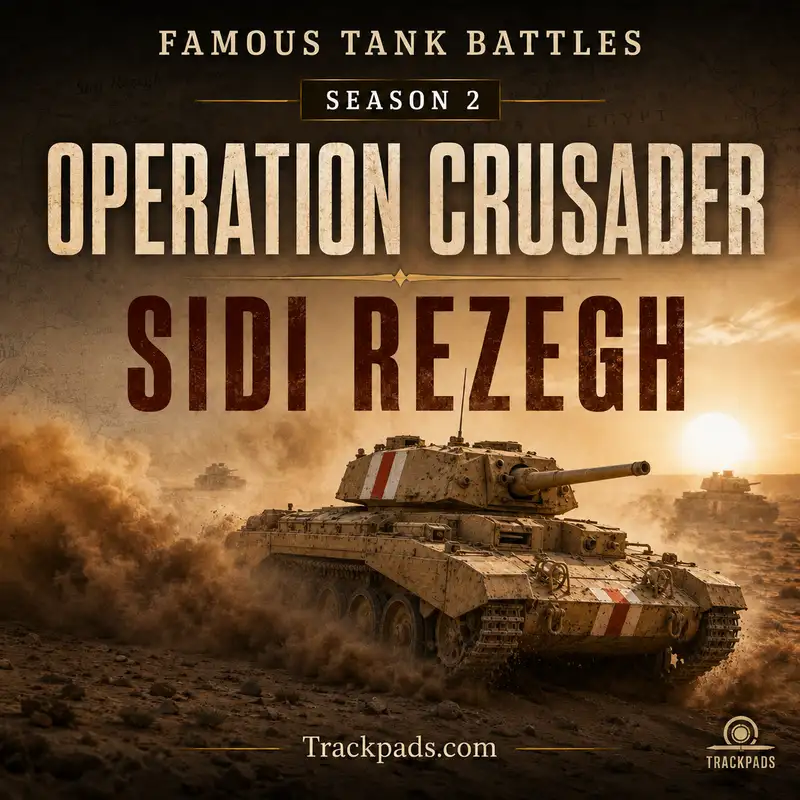
Crusader: Episode 14 — 7th Armoured Brigade in the Furnace
Seventh Armoured Brigade entered Operation Crusader carrying the reputation of the desert war’s most experienced British armored formation, but reputation did not spare it from exhaustion, confusion, or loss. Around Sidi Rezegh, El Adem, and the approaches to Tobruk, the brigade was drawn into the furnace at the center of the campaign. Its tanks and crews were expected to keep moving, keep fighting, and keep the wider operation alive while the battlefield became harder to understand by the hour. This was not armored warfare as a clean sweep across empty ground. It was a grinding contest of dust, radios, fuel, anti-tank fire, broken machines, and men being asked to do more than any formation could easily sustain.
Seventh Armoured Brigade belonged to the famous Seventh Armoured Division, the Desert Rats, a formation already tied deeply to British identity in North Africa. That identity mattered because units carry memory into battle. Veterans remembered earlier desert fighting, commanders remembered the failures of Brevity and Battleaxe, and headquarters expected experienced armored troops to solve problems that less seasoned formations might not manage. But experience was not a shield. In mobile war, even a veteran brigade could be worn down if it was committed repeatedly, separated from support, or forced to fight under conditions that gave the enemy the better tactical position. Crusader would test not only the brigade’s skill, but its endurance.
The brigade’s role was bound to the larger mission of Thirtieth Corps, which was to push into the desert south of Tobruk, threaten the Axis siege system, and bring Rommel’s mobile forces to battle. That sounded straightforward in planning language, but it became far more difficult on the ground. The brigade had to operate across distances where friendly units could vanish behind dust and broken terrain. Orders arrived into situations that had already changed. A neighboring formation might be farther away than expected, or an enemy force might appear from a direction that had seemed quiet. In such conditions, command was not simply issuing instructions. It was trying to keep a moving battle from dissolving into fragments.
For the tank crews, the furnace was physical before it was tactical. The desert heat, dust, vibration, and cramped fighting compartments punished men long before any shell struck home. Visibility could shift from open horizon to choking dust in moments. Engines ran hot, filters clogged, tracks suffered, and every halt created uncertainty about whether the next move would be ordered, delayed, or forced by enemy action. A crew might spend hours inside a machine that was both weapon and trap, listening for orders over imperfect communications while trying to judge whether distant movement was friendly armor, enemy panzers, transport columns, or only dust made sinister by fear.
The brigade’s tanks did not fight as isolated machines, even when the battlefield made them feel isolated. They needed artillery to suppress anti-tank guns, reconnaissance to find enemy positions, infantry to hold ground, engineers to open routes, and supply vehicles to keep fuel and ammunition moving. When those parts were not close enough, fast enough, or clearly coordinated, the tanks paid the price. This is one of Crusader’s most important lessons. A tank brigade could have courage, speed, and experience, yet still be reduced by repeated contact with a better-positioned enemy system. The battlefield did not ask whether crews were brave. It asked whether the whole combined arms structure was present when needed.
German and Italian anti-tank defenses were central to that punishment. A tank crew might expect to duel enemy armor, but the deadliest threat could be a gun concealed behind a rise or positioned to cover a likely line of approach. The desert’s openness did not mean every danger was visible. A gun that remained hidden until the range closed could stop a tank, disrupt a troop, and force an entire unit to deploy under fire. Panzers then added another layer, striking when British formations were already slowed or disordered. The enemy system worked best when it made British armor react piece by piece, and that was exactly the kind of fight Seventh Armoured Brigade increasingly faced.
Radio communication was supposed to help solve the problem of movement, but radios could not remove the fog of war. Messages could be missed, misunderstood, delayed, or overtaken by events. Commanders needed to know where their squadrons were, where the enemy had been seen, whether support was coming, and whether the wider plan still made sense. In the dust and violence around Sidi Rezegh, that knowledge was never complete. A radio net might carry urgency without clarity. Crews might hear fragments of a situation rather than the whole picture. Armored warfare had become faster than earlier wars, but human understanding still moved unevenly through noise, fear, and incomplete reports.
The brigade’s attrition was not only measured in tanks destroyed outright. It included vehicles damaged and recovered, vehicles damaged and abandoned, tanks temporarily lost to mechanical failure, crews killed or wounded, commanders replaced, and confidence slowly eroded by repeated shocks. A formation could appear on paper to retain strength while its real fighting power was already thinning. The loss of experienced crews mattered as much as the loss of machines, because a tank was not just steel and a gun. It was a team that knew how to move, observe, load, fire, communicate, and survive together. Once those teams were broken, replacement vehicles could not instantly restore the brigade’s old effectiveness.
The fighting around Sidi Rezegh pulled Seventh Armoured Brigade into a pattern that was hard to escape. It had to counter enemy moves, protect British gains, support the effort toward Tobruk, and respond to crises that appeared faster than the plan could absorb them. The brigade could not simply withdraw to rest because the wider campaign depended on pressure being maintained. Yet each fresh commitment risked further loss. This is the cruel rhythm of attritional mobile battle. A unit is too important to spare, so it is used again, and because it is used again, it becomes less capable of doing the very task for which it is indispensable.
The men inside headquarters did not always grasp the speed at which armored formations were being consumed. Reports could show that a brigade was engaged, that it had fought well, or that it remained in action, but such phrases hid the human and mechanical cost. They did not fully convey the stunned crews, the missing tanks, the damaged radios, the recovery teams working under threat, or the officers trying to rebuild order after each clash. A brigade could still exist on the map while its practical strength was fading. Crusader repeatedly exposed that gap between administrative knowledge and battlefield reality. Headquarters could see symbols; the crews lived the loss behind them.
Seventh Armoured Brigade’s ordeal also shows why armored warfare cannot be judged only by dramatic advances or famous counterstrokes. Much of the battle was a process of wearing down. Tanks advanced, halted, deployed, fired, withdrew, refueled, repaired, and went forward again into new uncertainty. The same crews might fight several actions in a short span while sleeping little and understanding less than they wanted to know. The battlefield around them did not pause for clean reorganization. Every hour brought the possibility that Rommel’s forces would appear somewhere dangerous, that the route to Tobruk would open or close, or that a local reverse would become a wider crisis.
This attritional experience marked a major stage in the British learning curve. Earlier tank warfare, from Cambrai onward, had often focused on the problem of breaking through a defended front. In the Western Desert, the problem had changed. The challenge was not only to break in, but to keep mobile formations coherent through days of movement and combat against an enemy that could counterattack from unexpected directions. Seventh Armoured Brigade was caught inside that transition. It was part of an army learning that armored warfare required not just bold thrusts, but rotation, recovery, intelligence, maintenance, and disciplined cooperation between arms. Without those, even elite formations could be burned down.
The furnace around Sidi Rezegh did not erase the brigade’s courage or its importance. It revealed the cost of using armored troops as the main instrument of decision in a battle that no one fully controlled. Seventh Armoured Brigade helped keep Operation Crusader alive, but it paid for that role in tanks, crews, cohesion, and strength. Its ordeal reminds us that famous armored battles are not only decided by the commander with the boldest arrow on a map. They are decided by whether formations can keep functioning after the first plan breaks, after the radios crackle with confusion, after the dust hides friends and enemies alike, and after losses mount faster than headquarters can truly understand. In that sense, the brigade’s story is one of Crusader’s clearest windows into the reality of modern armored war.