Crusader: Episode 15 — 23 November
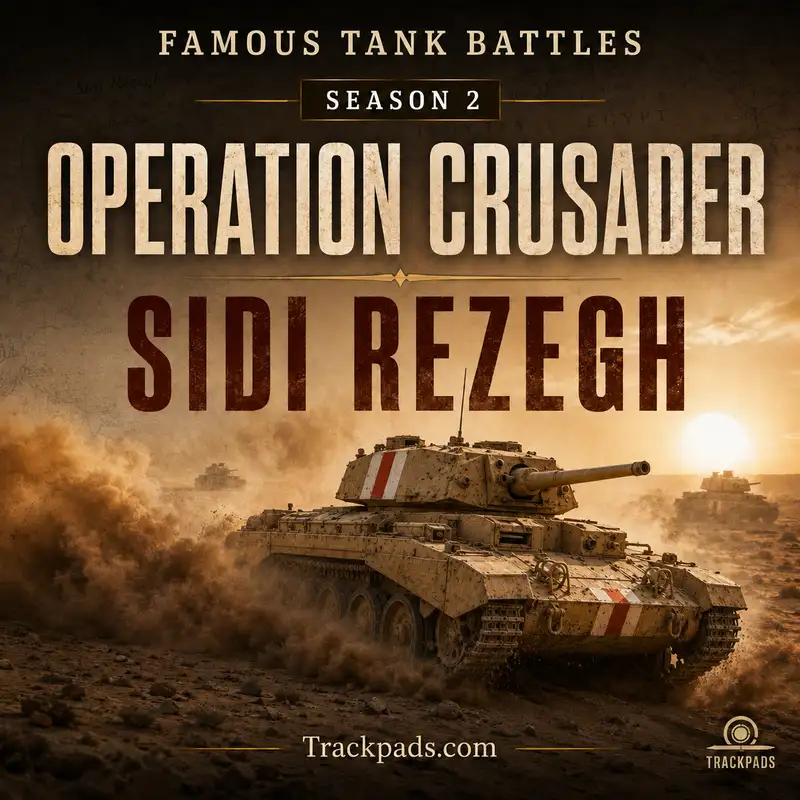
The twenty-third of November, Nineteen Forty-One, was the day Operation Crusader seemed to tip toward disaster. The campaign had already become confused, costly, and difficult to control, but around Sidi Rezegh the fighting now reached a breaking point. British armor had been worn down in repeated clashes, the Tobruk breakout had not yet produced secure relief, and Axis forces were reacting with the speed and violence that made Rommel so dangerous. For the men on the ground, the day was not a single neat battle but a collision of overlapping crises. Tanks, infantry, artillery, anti-tank guns, headquarters, and supply columns were all caught in a struggle where every local failure threatened to become operational collapse.
The date also carried a grim resonance for the German side, because it fell on Totensonntag, the Protestant Sunday of the Dead, a day of remembrance. Later accounts sometimes attach the name to the fighting around Sidi Rezegh, but the battlefield did not need symbolism to become terrible. The killing was real enough without decoration. German and Italian forces struck hard against British and Commonwealth units that had become exposed, stretched, and uncertainly connected. The British plan still aimed at relieving Tobruk and breaking the Axis siege system, but by this stage the plan was being tested by the harshest question in mobile war: could scattered forces survive long enough to become a coherent operation again?
Sidi Rezegh was the center of the crisis because it connected so many parts of the campaign. Its airfield, ridge, and nearby tracks made it valuable to both sides, and its position south of Tobruk gave it direct importance for the relief effort. British forces had pushed toward it because control there could threaten the Axis siege lines and support eventual contact with the garrison. But reaching the area had not settled anything. The ground was exposed, the enemy was active, and British units were not always mutually supporting. What looked like progress on a map became a dangerous salient of men and vehicles under pressure from several directions.
The British armored formations had already suffered heavily before this day. Seventh Armoured Brigade and other elements of Seventh Armoured Division had fought repeated actions that consumed tanks, crews, fuel, and command strength. A tank brigade can look formidable at the start of an offensive and still become fragile after days of movement, breakdown, recovery problems, and enemy fire. By the twenty-third, British armored power was not gone, but it was no longer the fresh instrument imagined at the start of Crusader. The loss of tanks mattered, yet the loss of cohesion mattered just as much. Crews and commanders were being asked to keep fighting while the larger picture grew more obscure.
The infantry around Sidi Rezegh faced an even more exposed ordeal. In a desert armored campaign, infantry could become fixed in place while tanks moved around them, leaving them dependent on anti-tank guns, artillery, and the hope that friendly armor would remain close enough to intervene. The Fifth South African Brigade was among the formations caught in this deadly pattern, and its situation worsened as Axis pressure increased. It had to hold ground that mattered to the operation, but holding ground in the open desert against mobile armor and concentrated fire was a punishing task. This was not static defense in a protected fortress. It was exposure under a moving storm.
The Axis attack combined several elements that made it especially dangerous. German panzers could maneuver against weakened British armor, but the real power came from combined action with anti-tank guns, artillery, and infantry. Italian forces also remained part of the battlefield, and their role in the wider Axis system should not be dismissed. The attackers were not simply racing forward in tanks. They were applying pressure against a British and Commonwealth force whose parts were no longer aligned cleanly. When anti-tank guns fixed or punished armor, when artillery disrupted infantry, and when mobile forces struck vulnerable points, the battlefield began to close around units that needed time and support they did not have.
For British headquarters, the day produced the kind of reports that make command in armored warfare so difficult. A unit might be holding but under severe pressure. Another might be moving but no longer strong enough to change the battle. A local reverse might be described before anyone understood whether it was temporary or catastrophic. In the desert, distance turned uncertainty into delay, and delay turned fear into decision pressure. Commanders had to decide whether to reinforce, redirect, continue, or pull back while the facts were still unsettled. Crusader’s command problem was not that no one cared what was happening. It was that the truth arrived in pieces, and those pieces did not always fit.
The Tobruk breakout added another layer of urgency. The garrison had attacked outward, hoping to meet the relieving force, but the link was not yet secure. Every setback around Sidi Rezegh threatened that possibility. If the outside force was driven back or broken, Tobruk would remain isolated and the whole purpose of Crusader would be in doubt. If the garrison pushed too far without reliable connection, it might be exposed. The campaign depended on two forces becoming one, but on the twenty-third of November the space between them felt full of danger. Relief was close enough to be imaginable and still far enough to fail.
This is why the day was filled with missed chances and bitter uncertainty. British armor might appear at a critical point but not in sufficient strength or at the right time. Infantry might hold longer than expected but still lack the support needed to survive concentrated attack. Commanders might see an opportunity but lack fresh reserves to exploit it. The desert battle did not unfold like a chess match where each piece moved cleanly in turn. It was more like several games being played at once on the same board, with pieces missing, messages delayed, and the enemy moving faster than the staff could fully track. Under those conditions, even courage could be spent without producing decision.
The losses around this period were not only mechanical or tactical. They were psychological. A campaign that had opened with the promise of initiative now seemed to be slipping into the old fear that Rommel could always turn British movement into British crisis. Every burning tank, every broken unit, every report of enemy armor in an unexpected place strengthened that fear. Yet fear did not mean the campaign was actually lost. One of the hardest things for commanders to recognize in mobile war is the difference between a battle that feels like collapse and a battle that is still recoverable. On the twenty-third, Crusader felt dangerously close to collapse.
The day also exposed the British difficulty in turning armored movement into combined arms control. Tanks had moved, infantry had fought, artillery had fired, and the Tobruk garrison had pushed outward, but these efforts were not always synchronized at the decisive point. The British Army was learning that mobile armored warfare required more than bravery and more than numerical strength. It required a system able to concentrate force, protect infantry, recover damaged vehicles, maintain communication, and make decisions at the speed of events. When that system faltered, local units bore the cost. The battlefield around Sidi Rezegh became a harsh lesson in the price of imperfect coordination.
Rommel’s achievement on this day was not that he had solved every problem facing the Axis army. His forces were also under strain, dependent on fuel, ammunition, recovery, and the ability to keep pressure on an enemy that was not yet defeated. But his command style exploited moments of confusion with great effect. He could make the British feel that the whole operation was being torn apart, even when the Axis situation had its own vulnerabilities. That was the danger of facing Rommel in the desert. His attacks did not merely destroy vehicles and positions. They attacked the enemy’s sense of the campaign’s direction.
By the end of the twenty-third of November, Operation Crusader had not failed, but it had been badly shaken. The fighting around Sidi Rezegh had shown how quickly a relief operation could become a battle for survival, and how easily armored warfare could consume the formations meant to decide it. The day stands as one of the campaign’s decisive moments because it forced the British and Commonwealth army to keep going after the plan had been bloodied almost beyond recognition. In the larger history of tank warfare, it teaches that operational success often depends on endurance through apparent disaster. Tanks create speed and shock, but armies win only if they can absorb confusion, rebuild coherence, and continue fighting when the battle’s first promise has burned away.