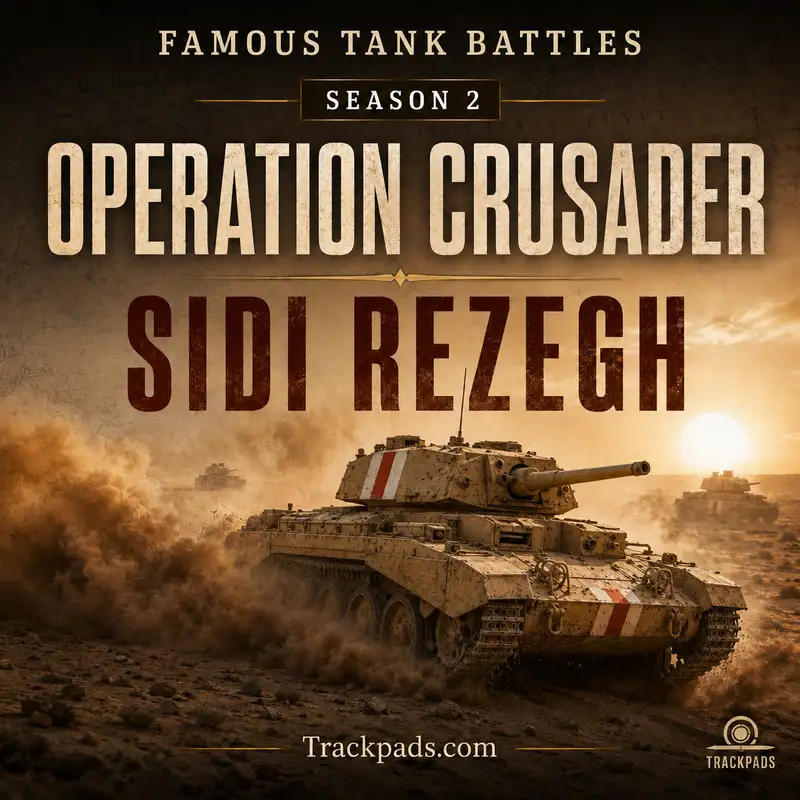
Crusader: Episode 17 — Five Hundred Tanks
By the time Operation Crusader reached its middle crisis, the armored losses had become too large to treat as temporary friction. The phrase five hundred tanks captures the scale of the reckoning, even if exact totals vary depending on whether one counts destroyed, damaged, abandoned, recovered, or temporarily unserviceable vehicles. Around Sidi Rezegh, El Adem, Bir el Gubi, and the approaches to Tobruk, the desert had consumed tanks at a rate that shocked commanders and exhausted crews. This was no longer the confident armored offensive imagined on the eighteenth of November, Nineteen Forty-One. It had become a battle in which machines, men, plans, and assumptions were being broken faster than anyone could fully control.
Tank losses in Crusader were difficult to measure cleanly because a tank could leave the battle in many ways. It might be knocked out by an anti-tank gun, disabled by artillery fire, damaged in a duel with enemy armor, lost to mines, abandoned when recovery failed, or simply broken down after days of desert movement. Some vehicles written off in one report might later be recovered and repaired. Others that looked repairable might be lost when the ground changed hands. This matters because armored warfare is not only about dramatic explosions. It is also about the quieter arithmetic of serviceability, recovery, repair time, crew survival, and whether a unit still has enough working tanks to fight as a formation.
For British and Commonwealth forces, the losses were especially painful because the offensive depended on armored pressure. Thirtieth Corps and Seventh Armoured Division had been expected to force Rommel’s mobile troops into battle, threaten the Axis siege system, and help open the way to Tobruk. But every engagement reduced the tank strength available for the next task. A brigade that began the operation as a powerful formation could become a thin and tired instrument after repeated actions. The loss of tanks did not merely reduce numbers. It changed what commanders could ask units to do. An armored brigade with too few tanks could still move, but it could no longer impose itself on the battlefield in the same way.
The destruction and damage were not evenly distributed, and that unevenness mattered. Some units were hit hard early, others were worn down gradually, and some formations found themselves committed again before they had recovered from previous fighting. The Twenty-Second Armoured Brigade’s shock at Bir el Gubi, the ordeal of Seventh Armoured Brigade around Sidi Rezegh, and the catastrophe that overtook Fifth South African Brigade all belonged to the same pattern of fragmentation. British armor was not being defeated in one single clean stroke. It was being consumed through repeated local crises, each one demanding attention, strength, and sacrifice. The cumulative effect was the weakening of the whole operational design.
The Axis forces also paid heavily. Rommel’s panzers were dangerous, but they were not limitless. German and Italian armored formations had to preserve fuel, maintain engines, replace crews, recover damaged vehicles, and keep enough strength to respond across a battlefield that seemed to stretch in every direction. Axis success in local counterattacks could therefore hide real strain. A panzer force might win a sharp engagement and still come away with fewer runners, less fuel, and more mechanical burden. Rommel’s army could create crisis for the British, but it was also being worn down by the same desert, the same distances, and the same demands of continuous armored combat.
The most visible losses were the tanks themselves, but the deeper loss was often crew quality and cohesion. A tank crew is not just a collection of men inside a vehicle. It is a trained team that has learned how to observe, load, fire, drive, command, communicate, and survive together. When a tank was destroyed or disabled, some crewmen might escape, some might be wounded, some might be killed, and some might be captured. Even survivors could be shaken, separated from their unit, or reassigned under pressure. Replacing a tank was hard enough. Replacing a seasoned crew, or restoring confidence after repeated losses, was harder still.
Recovery was one of the hidden battles behind the front line. In desert warfare, the side that held the ground after an engagement often had the better chance of recovering damaged vehicles. A tank knocked out in the morning might become a repair job if friendly recovery crews reached it, or a permanent loss if enemy forces moved through the area by afternoon. Recovery vehicles, mechanics, and workshop units were therefore part of the armored battle even when they were not firing guns. They worked under pressure, often near danger, trying to turn wreckage back into combat power. The ability to recover and repair tanks could determine whether a formation remained alive after a costly day.
Fuel and maintenance made the accounting even more complicated. A tank that still had its gun and armor intact could be useless if it had no fuel, a damaged track, engine trouble, or a failed component that could not be replaced quickly. The Western Desert punished every moving part. Dust entered machinery, heat strained engines, and long moves wore down vehicles before battle even began. Crusader’s armored losses therefore included the desert itself as an enemy. Commanders might count tanks at the start of a day, but the number that could actually fight at the decisive moment was often smaller. In mobile war, readiness is more important than inventory.
The scale of loss also exposed weaknesses in command understanding. Headquarters could receive reports of tank strengths, but those reports lagged behind reality and did not always convey the condition of the units. A brigade might technically have tanks remaining, but if crews were exhausted, radios damaged, commanders killed or displaced, and supply uncertain, its real fighting power had fallen sharply. Commanders needed numbers, but numbers could mislead. Ten tanks with fuel, ammunition, working radios, experienced crews, and clear orders might matter more than a larger group scattered, damaged, and confused. Crusader showed that armored strength was qualitative as well as numerical.
The British experience was especially sobering because the offensive had begun with the hope that more tanks, better planning, and a broader operation would avoid the mistakes of Battleaxe. Instead, the early days of Crusader showed how easily armor could still be defeated in detail. Tanks were sent toward important ground, but they were not always concentrated at the decisive point. They encountered anti-tank guns, panzers, artillery, and prepared positions in combinations that punished isolated movement. The result was not proof that tanks had failed as instruments of war. It was proof that tanks demanded a higher standard of coordination than the British system could always deliver under desert conditions.
For Rommel, British tank losses created opportunity, but they also created temptation. If the enemy seemed badly battered, an aggressive commander might believe the moment had come for a decisive stroke. That kind of thinking helped lead toward his dash to the frontier wire, a move that would soon deepen the command crisis inside Eighth Army. Yet heavy British losses did not mean the British offensive was finished. This is one of the paradoxes of Crusader. The battle could look like disaster at the tactical level while still remaining recoverable at the operational level. Losing tanks did not automatically mean losing the campaign, provided the army could keep pressure on the right points.
The phrase five hundred tanks should therefore be heard not as a neat statistic, but as a symbol of armored warfare’s brutal consumption. It represents wrecked vehicles scattered across desert ground, crews killed or missing, repair teams overworked, commanders unsure of their true strength, and plans forced to adapt to losses that mounted faster than expected. It also represents the danger of imagining tank warfare as clean maneuver. The armored battle around Sidi Rezegh was not a parade of machines deciding history by speed alone. It was an industrial and human grinding process, where every tactical clash changed the shape of what either side could do next.
In the longer story of armored warfare, this reckoning matters because Crusader showed both the power and the fragility of tank-heavy operations. By Nineteen Forty-One, tanks had become central to operational planning in a way that would have been unimaginable in the earliest days of armored warfare. Yet they remained dependent on everything around them: fuel, recovery, radios, mechanics, trained crews, infantry, artillery, engineers, reconnaissance, and command judgment. Five hundred tanks lost, damaged, or disabled meant more than a battlefield littered with steel. It meant the original plan had been battered almost beyond recognition. But it also forced armies to learn that armored power was not measured by how many tanks began an offensive. It was measured by how many could still fight together when the battle became chaos.