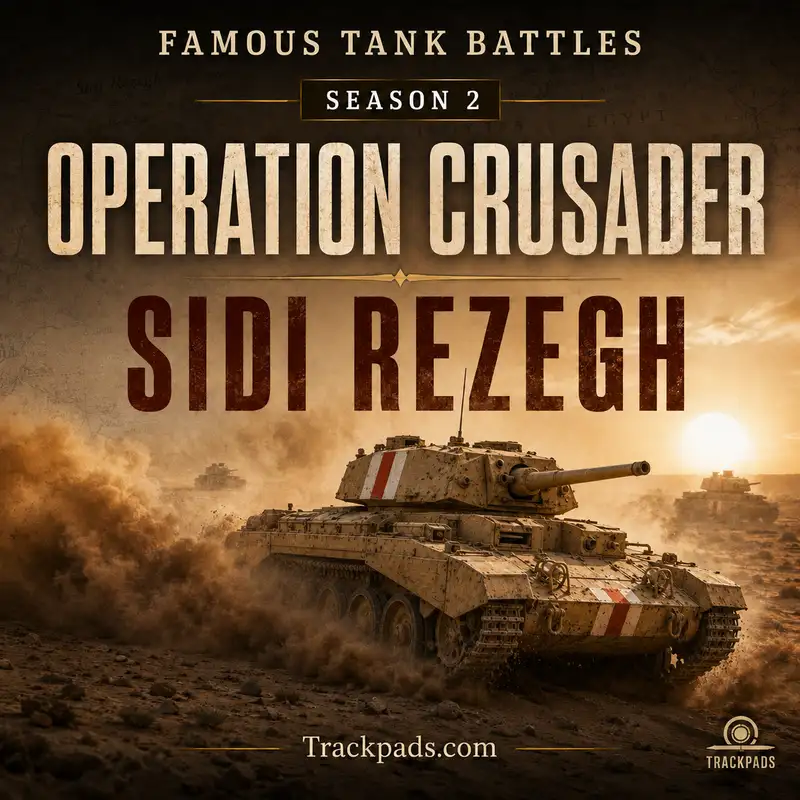
Crusader: Episode 2 — Why Tobruk Had to Be Saved
Tobruk mattered because it sat at the intersection of geography, supply, morale, and strategy in the North African desert war. By late Nineteen Forty-One, it was not just a besieged harbor on the Libyan coast, but a symbol of whether Britain and the Commonwealth could still resist, recover, and eventually take the offensive against Rommel. The Axis siege had begun in April, and month after month the garrison held on while the front moved and stalled around it. To save Tobruk was to do more than rescue trapped troops; it was to prove that British armor and British command could regain the initiative in a theater where confidence had been badly shaken.
The first thing to understand is that Tobruk was valuable because ports were life in the desert. Armies in North Africa did not simply drive across empty ground because maps showed open space. Every gallon of fuel, every artillery shell, every spare engine part, every ration, and every replacement track link had to move along long and fragile supply lines. A port close to the battlefield could shorten that burden dramatically. Tobruk’s harbor was not perfect, and it could be bombed, shelled, and obstructed, but its location made it a prize. Whoever controlled it could support operations farther west or deny that same advantage to the enemy.
For Rommel, Tobruk was an obstacle behind his forward ambitions. He had driven into Cyrenaica with stunning energy earlier in the year, but the fortress had not fallen when much of the surrounding territory did. That left an Allied garrison sitting on the coast, interrupting the neatness of Axis control and threatening the rear of any deeper push toward Egypt. Rommel could not ignore it, because a defended port behind or near his lines forced him to use troops, guns, and attention to contain it. A commander who lived by speed and momentum now had to deal with a fixed problem that would not move out of his way.
For the British and Commonwealth forces, Tobruk was a foothold inside a battlefield that had otherwise gone badly. Its defenders included Australian troops for much of the siege, later relieved in part by other Allied and Commonwealth formations, and their endurance carried enormous psychological weight. In a war where headlines often told of retreat and disaster, Tobruk became proof that the Axis advance could be stopped. The men inside the perimeter were not simply waiting passively to be rescued. They raided, repaired defenses, endured bombardment, and tied down enemy forces. Their presence made the whole desert campaign more complicated for Rommel and more hopeful for Britain.
The term fortress can make Tobruk sound stronger and safer than it really was. It had defensive works from earlier Italian construction, including a perimeter of posts, wire, mines, and prepared positions, but no position in modern war was safe when isolated. Its defenders had to live under air attack and artillery fire, with supplies coming in by sea under dangerous conditions. The Royal Navy and supporting ships paid a price to keep the garrison alive. The port could receive supplies, evacuate casualties, and bring in replacements, but every voyage into Tobruk carried risk. Holding the place required not only infantry endurance, but a whole maritime and logistical effort.
This is where Tobruk connects directly to the history of armored warfare. Tanks are often imagined as the decisive instrument of desert war, racing across open ground and deciding battles by speed and firepower. Yet tanks could not solve Tobruk by themselves. To relieve the fortress, British planners had to think about armored divisions, infantry divisions, artillery support, supply columns, engineers, anti-tank defenses, air support, and the timing of a breakout from inside the perimeter. If the armored force moved too fast and unsupported, it might repeat the mistakes of Battleaxe. If it moved too slowly, Rommel could concentrate against it before Tobruk was reached.
The problem was distance as much as enemy resistance. A relieving army had to advance from Egypt, fight through or around frontier defenses, push westward across desert tracks, and connect with the garrison before Axis forces could destroy the effort piece by piece. That meant the operation had to function across a wide battlefield, where different formations might be separated by miles of dust and uncertainty. Headquarters could issue a plan, but once units began moving, reports would be delayed, enemy positions would be misread, and armored brigades might find themselves fighting battles that did not match the original timetable. Tobruk had to be saved through coordination, not just determination.
The failure of earlier relief attempts made the next effort even more important. Operation Brevity had been limited and temporary, and Operation Battleaxe had been a painful warning that British armor could be mishandled against German anti-tank tactics and mobile counterattack. Those failures did not remove the need to save Tobruk; they made it more urgent and more difficult. British commanders now had to show that they had learned. They needed to avoid throwing tanks forward in isolated packets, avoid underestimating Rommel’s ability to react, and avoid confusing possession of ground with destruction of the enemy. The coming operation would test whether lessons had truly entered practice.
Tobruk also mattered because the desert war was partly a contest of reputation. Rommel’s image as a bold and almost unstoppable commander grew with each British setback. That reputation had practical effects, because commanders facing him could become cautious at exactly the wrong moment or overreact to incomplete information. The British needed a success that would puncture the sense of inevitability around the Axis advance. Relieving Tobruk would not automatically destroy Rommel’s army, but it would show that he could be forced back and that his siege could be broken. In war, morale is not decoration. It shapes how leaders decide, how units endure, and how publics understand sacrifice.
Inside the larger Allied war effort, Tobruk’s survival helped keep North Africa from becoming a simple story of Axis momentum. The Mediterranean theater affected shipping, imperial communications, Middle Eastern oil routes, and the defense of Egypt. If Tobruk fell, Rommel’s position in Cyrenaica would be stronger, his supply problem potentially eased, and the British political and military position weakened. If Tobruk held and was relieved, the Axis front would be stretched and the British could claim not just defense, but recovery. This was why the port mattered far beyond its perimeter wire. It was a local fortress with theater-level consequences.
Saving Tobruk required commanders to think in two directions at once. The force outside had to advance westward, while the garrison inside had to be ready to break outward at the right moment. That sounds simple until one remembers the reality of the desert battlefield. The two forces would have to find each other through fighting, dust, false reports, and changing enemy positions. If the breakout began too early, the garrison might be exposed without relief. If it began too late, the relieving force might be stopped short or defeated. The challenge was not merely to move toward Tobruk, but to synchronize action across chaos.
The battle to relieve Tobruk would also reveal a central truth about modern armored warfare: a breakthrough is only useful if it can be exploited and sustained. A tank brigade could punch into enemy space, but holding a corridor required infantry, anti-tank guns, artillery, engineers, and supply. A road or track could be opened in the morning and cut by evening. A ridge that seemed secure could become untenable if enemy guns reached its flank. Tobruk therefore became not a single destination but a test of whether the British could create a living connection across contested ground. Relief meant more than reaching the perimeter; it meant keeping the link open.
That is why Tobruk had to be saved, and why saving it would be so hard. It represented endurance under siege, the value of ports in desert logistics, the danger of leaving a fortress behind an advancing army, and the need for British and Commonwealth forces to prove they could conduct a complex armored offensive without repeating earlier failures. The coming campaign would not unfold as a clean rescue story. It would stagger through confusion, reverses, command crisis, and terrible armored losses before the siege was finally lifted. But Tobruk’s importance gave the effort its urgency. In the larger story of tank warfare, the relief of Tobruk would show that armored operations were never just about moving fast; they were about linking movement to supply, firepower, infantry, command, and the stubborn human will to hold on until help arrived.