Crusader: Episode 5 — Crusaders, Stuarts, and Panzers
The tanks of Operation Crusader have to be understood as battlefield tools, not as mechanical champions lined up for a simple contest. British cruiser tanks, newly arrived American-built Stuarts, and German panzers all entered the desert with strengths, weaknesses, reputations, and crews who had to make them work under punishing conditions. The fighting around Tobruk, Sidi Rezegh, El Adem, and the frontier would show that no tank was useful in isolation. Armor mattered, but so did radios, optics, maintenance, gunnery, recovery, doctrine, and the ability to fight alongside infantry, artillery, anti-tank guns, reconnaissance, and air support. Crusader became a harsh test of machines inside a much larger system of war.
The British cruiser tank idea came from a prewar concept that separated tanks by role. Infantry tanks were meant to move with foot soldiers and break into defended positions. Cruiser tanks were supposed to exploit openings, move fast, and fight the mobile battle beyond the first line. In the desert, that sounded promising, because open ground seemed to reward speed. But the cruiser tank concept also carried risk, because a fast tank that was thinly protected, mechanically strained, or poorly supported could be destroyed before its speed produced anything decisive. Operation Crusader would reveal that mobility alone was not maneuver. True maneuver required timing, coordination, and the ability to keep formations together once the shooting started.
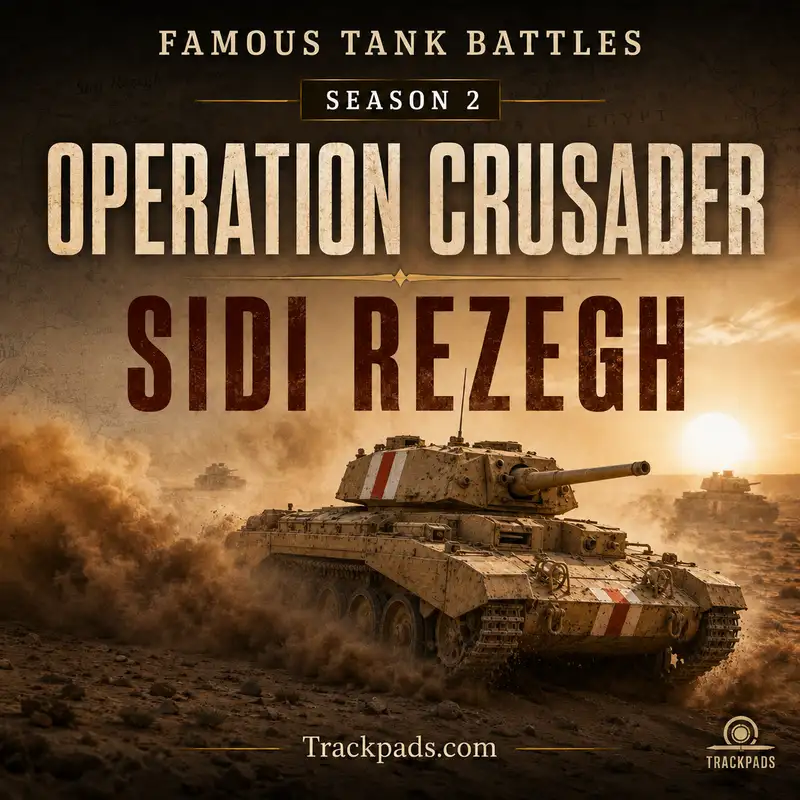
The Crusader tank, which gave the operation its name but not its outcome, was one of the main British cruiser tanks in the campaign. It was low, relatively fast, and designed for the mobile role British armored theory prized. To a crew, speed could feel like survival, because movement made it harder for enemy gunners to settle on a target and allowed a unit to shift across the battlefield quickly. But the Crusader also suffered from mechanical strain, limited protection, and a gun that could be dangerous in the right circumstances but did not solve every tactical problem. In desert fighting, where heat, dust, and long moves punished machinery, the tank’s weaknesses could become as important as its strengths.
The American-built Stuart light tank entered British service as the Honey, a nickname that reflected affection for its reliability and handling. Compared with some British designs, the Stuart was mechanically dependable, quick, and appreciated by many crews for its ability to keep going in rough conditions. That mattered enormously in North Africa, because a tank that broke down before battle was no better than no tank at all. Yet the Stuart was still a light tank. It was not built to absorb heavy punishment from German anti-tank guns or to dominate every armored duel. Its value lay in mobility, reconnaissance, pursuit, and local fighting, not in pretending that it was invulnerable.
German panzers brought their own strengths to the campaign, but their real advantage was not merely that they were better tanks in every category. The German armored force was dangerous because its tanks were used within a tactical system that often integrated reconnaissance, anti-tank guns, artillery, radios, and command judgment more effectively. German crews generally benefited from good optics, disciplined gunnery, and strong battlefield communication. When British tanks advanced aggressively but without close support, the panzers did not always have to meet them head-on. They could draw them toward anti-tank screens, counterattack exposed flanks, or use quick local concentration to defeat scattered British armored units in detail.
This is one of the central lessons of Crusader: a tank’s battlefield value depends on the fight it is placed inside. A Crusader tank fighting alone against a prepared gun line was in grave danger. A Stuart racing ahead without infantry or artillery support could find itself exposed. A German panzer unsupported by fuel, repair, or anti-tank cover was not a magic weapon either. The desert punished every army that forgot this. A tank’s armor, speed, and gun mattered, but so did the commander’s decision about where to send it, the reconnaissance that found or failed to find the enemy, and the supply system that kept it moving after the first engagement.
Radios were especially important. Modern armored warfare depends on the ability to communicate while moving, and the desert made that need even sharper. Units could become separated by dust, distance, and broken terrain, with visibility changing from broad openness to near blindness in minutes. German armored units often used radio communication more effectively, helping commanders adjust to fast-changing situations. British formations had radios too, but communications did not always translate into clear control, especially when units were scattered and reports were delayed or misunderstood. A tank formation that could not coordinate its movement might still be brave and well-equipped, but it could lose the battle’s rhythm.
Optics and gunnery also shaped the fighting. A tank battle in the desert often began at distances that were difficult to judge, over ground that shimmered with heat and dust. Seeing first, ranging accurately, and firing effectively could decide whether a crew lived long enough to maneuver. German sights and training gave their crews important advantages in many encounters, but British crews were not helpless or unskilled. The problem was that individual courage and local skill could be overwhelmed by tactical disadvantage. If British tanks charged into fire without enough reconnaissance or artillery support, even good crews were being asked to solve a problem that should have been solved by combined arms planning.
Anti-tank guns deserve special attention because they repeatedly shaped what tank crews experienced as armored battle. The most dangerous moment for a British tank might not be the sight of an enemy panzer, but the sudden crack of a concealed gun that had been waiting for the range to close. German use of anti-tank guns in depth gave their defenses a hard edge. These weapons could turn open desert into a hidden barrier, especially when tanks advanced faster than their supporting arms. The lesson was painful but clear. Armored warfare was not simply tank against tank. It was tank against a system of fire, observation, concealment, and movement.
Maintenance was another decisive factor. Every tank in Crusader had to survive the desert before it could survive the enemy. Sand and dust worked into engines, weapons, tracks, and bearings. Long approach marches consumed fuel and wore out vehicles before battle began. Recovery crews had to retrieve damaged tanks under dangerous conditions, while workshops tried to repair machines quickly enough to return them to the line. A formation’s tank strength on paper could be misleading, because some tanks were broken down, some were under repair, and some were moving only because crews and mechanics had forced them to keep going. In desert war, mechanical endurance was a form of combat power.
The British had numbers and determination, but they still struggled to use their armored strength as a unified instrument. Armored brigades could be sent forward with bold instructions, only to become separated from infantry, artillery, or one another. Once separated, they risked fighting a series of disconnected actions against Axis units that were better positioned or quicker to concentrate. This was not because British tank crews lacked bravery. It was because the army was still learning how to conduct large-scale mobile war under real battlefield conditions. The difference between owning many tanks and controlling an armored battle was one of the hardest lessons of Operation Crusader.
The Axis forces had their own limitations. German and Italian armor depended on fuel, spares, ammunition, and recovery just as British armor did. Rommel’s formations could strike with impressive speed, but they could also be strained by long movements and supply shortages. Italian armored and motorized units are sometimes treated unfairly as a background presence, but they were part of the Axis battlefield system and fought in conditions just as harsh as their German partners. The campaign should not be reduced to British tanks against German tanks. It was a coalition fight on both sides, shaped by unequal equipment, different doctrines, and the shared difficulty of keeping armies alive in the desert.
Operation Crusader therefore sits at an important point in the evolution of armored warfare. The tank was no longer the awkward experimental machine of the First World War, grinding through wire and trenches as it had at Cambrai. It was now faster, more mobile, and central to operational planning. Yet Crusader showed that greater speed created new problems. Tanks could now move far enough and fast enough to become lost, isolated, undersupplied, or committed before the rest of the army was ready. The dream of sweeping armored maneuver was real, but it demanded a command system, logistical system, and combined arms method strong enough to keep pace.
The story of Crusaders, Stuarts, and panzers is not a story of one perfect tank defeating inferior machines. It is a story of vehicles placed under stress by doctrine, terrain, command decisions, and the unforgiving mechanics of desert war. The British had fast cruisers and reliable Stuarts, but still had to learn how to mass them, support them, and keep them from being defeated in detail. The Germans had skilled armored tactics and dangerous panzers, but they too operated under limits of supply and endurance. Crusader matters because it reminds us that armored warfare is never only about the tank. It is about the whole fighting system that allows the tank to arrive, communicate, shoot, survive, recover, and move again.