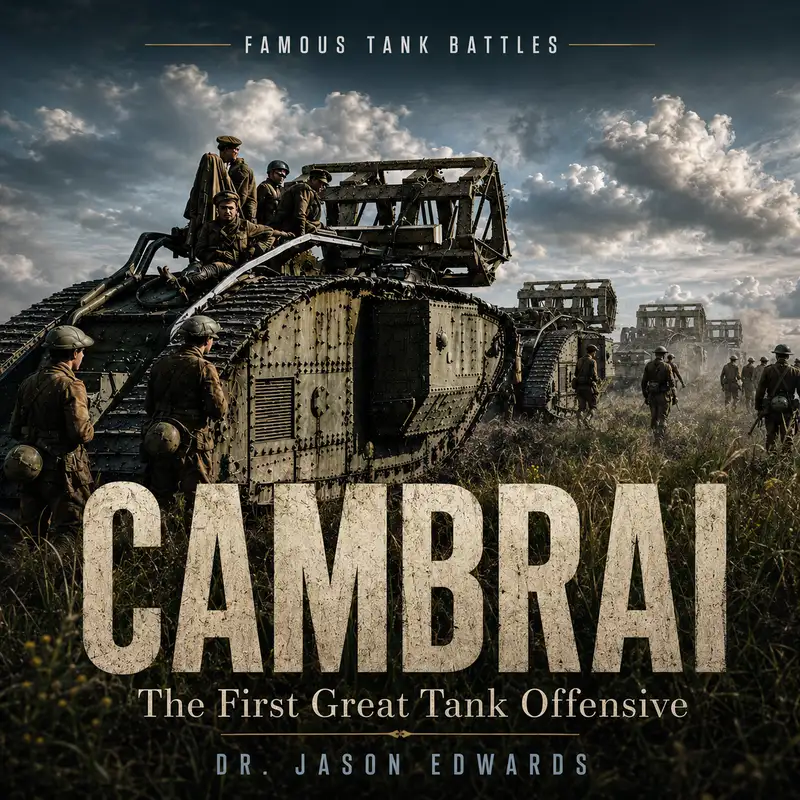
Cambrai: Episode 1 — After Passchendaele
By the time the guns finally began to quiet around Passchendaele in November 1917, Britain had not simply finished another battle. It had reached the end of a long, punishing lesson in what industrial-age warfare could do to men, machines, and military ideas when ambition outran battlefield conditions. The Third Battle of Ypres had begun in late July and ended with the Allies holding ground they could describe as a victory, but only after months of fighting for a few miles of ruined ridge and village. For soldiers who survived it, the place became a memory of mud, smashed roads, buried guns, and slow movement under constant fire. For British commanders, it posed a harder question than whether the offensive had technically succeeded. It asked whether the army could keep trying to win the war by battering forward in the same way, or whether it needed a different method entirely.
If you would like to move beyond the podcast, you can see my available books at Military Author dot me. And at Trackpads dot com, you will find magazines and galleries with hundreds of thousands of photos and videos to explore.
That question mattered because Passchendaele had not begun as an exercise in futility. Haig and the British high command wanted to break out of the Ypres salient, seize the high ground east of the city, and push toward the Belgian coast, where German submarine activity threatened Allied shipping. The timing also mattered. In 1917 the French Army was shaken after the failure of General Robert Nivelle’s offensive, and British leaders understood that Britain would have to carry more of the offensive burden on the Western Front for a time. So the Flanders offensive was conceived as a major strategic effort, not merely a symbolic gesture. Yet the plan was also risky from the start, because it aimed at decisive results on ground already fought over for years, and it did so after earlier British offensives had already strained the army’s resources.
The battlefield itself turned that risk into a trap. The Ypres salient sat in low country with a high water table, and years of shellfire had wrecked the drainage system that once kept the fields usable. Then the rain came. Heavy downpours after the opening attack churned ground already blasted by bombardment into a swamp that swallowed men, horses, guns, ammunition, and the little momentum an attack needs if it is going to become a breakthrough. Artillery observers lost sight of advancing troops, support fire became harder to adjust, and moving guns forward became almost impossible. That matters in armored warfare history because tempo is not an abstract idea. Tempo is the speed at which a force can keep pressure on a shaken defender, and at Passchendaele the ground itself stole that speed away.
It would be too easy, though, to tell the story of Passchendaele as if the British Army learned nothing and changed nothing. In fact, parts of the campaign showed real adaptation. General Herbert Plumer’s “bite and hold” method, used in battles such as Menin Road, narrowed objectives, relied on dense artillery support, and asked infantry to take limited bites of ground they could realistically consolidate. When the weather improved for a time, that method worked better than the earlier hope of a sweeping breakthrough on a wide front. More artillery was brought up, aircraft helped with observation and attack, and the British made significant progress along key ridges. But those gains were conditional. They depended on manageable ground, disciplined timing, and reliable communications, and once rain and confusion returned, especially in October, the larger dream of a decisive rupture still slipped away.
The cost of that failure was measured not only in territory but in exhaustion. Casualty figures vary depending on how they are counted, but British losses were roughly a quarter of a million, with German losses also immense, and total casualties across both sides nearing half a million by some estimates. Those numbers matter, but the institutional strain matters just as much. Units from across Britain and the wider empire were fed into the fighting, relieved, and fed back in again. Men were worn down physically and mentally by carrying ammunition through mud, evacuating wounded from wrecked tracks, and trying to hold shattered positions in weather that punished movement as much as enemy fire did. When an army comes out of a battle like that, it is not merely bloodied. It is hungry for any method that promises shock, surprise, and movement without another season of slow destruction.
This is where tanks return to the story, but not yet as triumphant machines. Tanks had first appeared in battle on the Somme in September 1916, and they had already shown both promise and weakness. At Flers-Courcelette they were used in small groups, many broke down before reaching the line, and the army struggled to coordinate them with infantry and artillery. Later fighting on the Somme and then at Passchendaele exposed the same problems in even harsher form. Mud, mechanical unreliability, and poor integration could neutralize the tank before its strengths had a chance to matter. Imperial War Museums notes that about 300 tanks became stuck during the Passchendaele fighting. That is a vivid number, but the deeper lesson is not that tanks were useless. It is that tanks were unusable if commanders asked them to solve the wrong battlefield problem in the wrong conditions.
So after Passchendaele, Britain did not simply need more courage, more shells, or more tanks. It needed a new way to connect all those things. The old pattern was becoming painfully clear: a long preliminary bombardment warned the defender, destroyed the ground the attacker then had to cross, slowed reinforcement and supply, and reduced the chance that any local success could spread before the enemy recovered. Infantry could fight brilliantly and still outrun their support. Tanks could terrify defenders and still fail if fed into battle piecemeal. Communications, often dependent on runners, signal lines, and visual methods, broke down under shellfire and distance. What the British Army needed was a method that combined surprise, concentrated force, manageable objectives, and terrain suited to movement. In other words, it needed not just a new weapon, but a new operational idea.
That search led commanders away from the Flanders swamps and toward the dry ground around Cambrai. Officers in the Tank Corps, especially J.F.C. Fuller, had been looking for terrain where tanks could move with some freedom instead of sinking into mud. The area southwest of Cambrai offered rolling ground, a sector of the Hindenburg Line, and conditions far more favorable to tracked vehicles than the soaked fields around Ypres. Britannica’s summary of Cambrai puts the connection bluntly: the horror of Passchendaele helped convince British command that fresh tactics were needed on the Western Front. What had seemed impossible to some commanders earlier in the year now looked necessary. After months of attrition in Flanders, the idea of surprise, concentration, and massed armor no longer felt like an experiment on the margins. It felt like the next serious attempt to break the deadlock.
What made that shift important is that it was never supposed to be a simple contest of tank against trench. The new concept around Cambrai aimed to avoid the long, obvious preparatory bombardment that had so often announced British intentions and wrecked the battlefield before the infantry even moved. Instead, British planners looked toward surprise artillery fire, tightly coordinated infantry movement, secrecy in assembly, and the massing of hundreds of tanks rather than scattering them in small packets. This was a major change in scale and confidence. Cambrai would be attacked on a front of about ten miles with 476 tanks available, of which about 378 were fighting tanks, the largest concentration yet assembled. That did not mean the tank had suddenly become a magic answer. It meant that, for the first time, the British were trying to build an operation around the conditions that gave the machine a real chance to help crack open fortified defenses.
There was also a human reason Britain needed a new way to fight. Passchendaele had damaged faith, not only among politicians and the public, but inside the army itself. That does not mean soldiers stopped fighting. It means that costly effort with limited visible return creates pressure for methods that can restore belief in progress. In 1917 the British Expeditionary Force was still enormous, but heavy losses in the attritional battles of 1916 and 1917 had already reshaped its character and foreshadowed the manpower strains that would become more visible in 1918. A successful surprise attack elsewhere on the front offered something more than tactical opportunity. It offered proof that the army could learn, adapt, and create movement again, rather than simply feeding men into another battlefield where the mud and wire did half the defender’s work.
Another lesson from Passchendaele was about control. Modern listeners sometimes imagine First World War battles as if commanders could see everything from above and push units around like markers on a map. In reality, once battle began, information moved slowly and often inaccurately. At Passchendaele, miscommunication after attacks in October contributed to commanders believing gains were larger and more secure than they really were. Orders were then built on a false picture of the field. That kind of distortion is deadly in any form of mobile warfare, but it is especially damaging when success depends on exploiting a narrow window before the enemy regroups. The British response was not to solve communications overnight, because they could not. It was to move toward battle plans that were simpler, more synchronized in advance, and less dependent on improvising a grand pursuit through ground and systems that could not support it.
Seen from a longer distance, this is why “after Passchendaele” matters so much in the history of armored warfare. The battle did not merely end a campaign. It forced a reckoning with the difference between courage and method. The British Army had already seen tanks at the Somme, and it had already learned valuable lessons about artillery and infantry cooperation in 1917, but Passchendaele showed with brutal clarity that no single innovation could deliver victory unless weather, ground, logistics, communications, and planning were aligned behind it. That insight would shape Cambrai in late 1917 and then the far more mature all-arms offensives of 1918, where surprise, artillery technique, infantry tactics, aircraft, and armor were joined more effectively. In that sense, the road to modern mechanized warfare did not run around Passchendaele. It ran through it.
The British needed a method that could break into enemy defenses without destroying the attacker’s own momentum, a method that treated tanks as part of a combined effort rather than as armored miracles, and a method that respected the basic truth that machines cannot outrun bad planning, bad ground, and broken supply. Passchendaele remained a symbol of suffering, but it also became a negative teacher. It taught the British Army what not to do if it wanted movement, surprise, and decision. Out of that bitter education came Cambrai, where modern armored warfare would appear not as a finished system, but as a bold, imperfect answer to the failure that came before it.