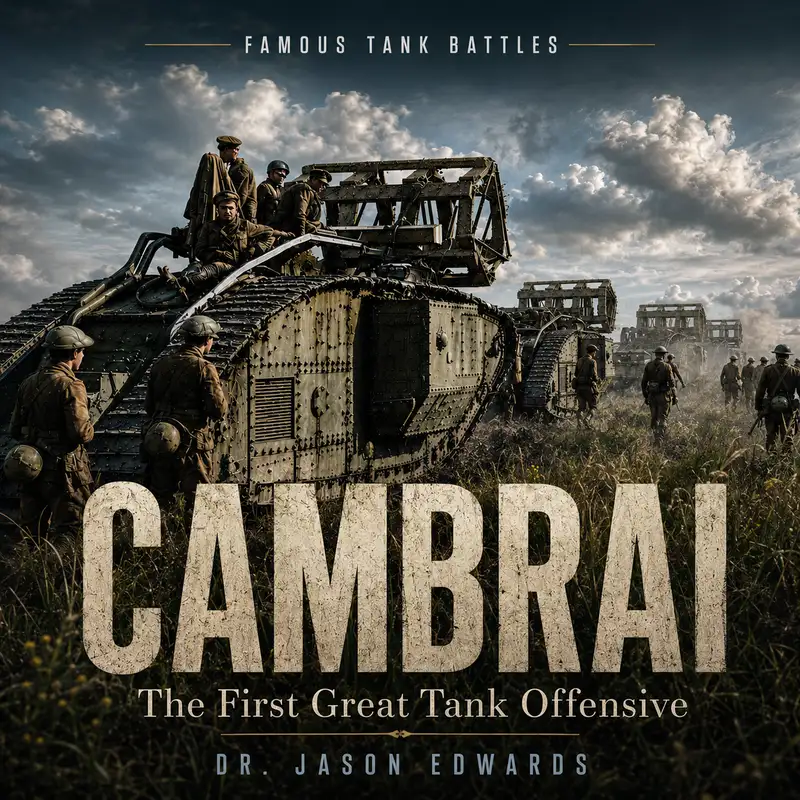
Cambrai: Episode 2 — Inventing the Breakthrough
By late 1917, the British Army was not just searching for a new weapon. It was searching for a new method, a way to tear open a fortified front before the defender could recover and turn the battlefield back into another slow massacre. That is the real meaning of breakthrough in the First World War. It did not mean simply taking the enemy’s first trench line, because armies had done that before and still failed. It meant cracking the front, moving through the gap, and doing it fast enough that the defender’s reserves, guns, and counterattacks could not seal the breach. Around Cambrai, that possibility began to look less imaginary because tanks, artillery science, and infantry tactics were finally starting to work toward the same purpose rather than operating as separate experiments.
This podcast is accompanied by a companion book that expands the story of the Battle of Cambrai, with additional historical context, maps, and dozens of enhanced colorized photographs from the battle. Your purchase helps support our mission to keep these podcasts free. You can find the book at Military Author dot me or at track pads dot com
The problem they were trying to solve had defined the Western Front for years. Trenches were only the visible surface of the defense. In front of them lay belts of barbed wire, behind them reserve lines, machine-gun positions, artillery zones, and roads that could bring fresh troops into danger points long before an attacker could move guns and supplies forward. Time was the defender’s ally. Even when an attacking force achieved surprise or courageously crossed no man’s land, it often arrived at the far side disorganized, exhausted, and vulnerable, while the defender still possessed interior lines, pre-sited artillery, and a system built to absorb punishment. That is why breakthrough proved so elusive. A local success was not enough. The attack had to destroy obstacles, suppress guns, preserve momentum, and keep enough order that success at the front edge could become movement in depth.
Tanks offered part of that answer, but only part. The early British machines were slow, mechanically fragile, and difficult to command once battle began. Their crews fought in heat, fumes, noise, and terrible physical strain, and breakdown was a constant companion even before enemy fire entered the picture. Yet for all those flaws, they could do something infantry alone could not do reliably on a defended First World War battlefield. They could crush wire, cross trenches, and bring machine guns forward behind armor, all while giving frightened infantry a moving shield of sorts at the point of contact. That mattered because much of the attacker’s momentum had previously died in front of wire and trench obstacles. Tanks did not solve the whole battle, but they offered a way to punch a hole in the crust of the defense if they could be delivered in numbers and used on ground firm enough to support them.
Artillery, meanwhile, was undergoing its own quiet revolution. Earlier offensives had often relied on prolonged bombardments meant to cut wire, destroy trenches, and warn everyone on the battlefield that an attack was coming. Those bombardments were loud, impressive, and often deeply counterproductive. They churned the ground into craters, made movement harder for the attacker, and surrendered surprise while still failing to eliminate enough defenders. By 1917 British gunners were learning to do more with mathematics, observation, sound ranging, flash spotting, and better survey work. Guns could increasingly fire without the old practice of long registration, which meant an army could prepare destructive and suppressive fire with far less warning. This was not glamorous innovation, but it was essential. A breakthrough attack needed artillery that did not merely roar. It needed artillery that arrived on time, struck the right targets, and preserved the conditions for movement.
That change in artillery practice mattered because the gun was still the dominant battlefield killer of the war. Tanks could shock, suppress, and help open the forward belt of defenses, but if enemy batteries remained active, any initial gain could still be broken apart by shellfire. So the British were learning to think about artillery in layers. Some guns would place a creeping barrage just ahead of the infantry to suppress defenders at the moment of assault. Others would focus on counter-battery work, trying to silence or disrupt German guns before they could break up the attack. Others still might isolate the battlefield by striking roads, assembly points, and command locations in the rear. When people speak of artillery science at Cambrai, this is what they mean. It was the growing ability to organize fire as a system of tasks, coordinated in time and purpose, rather than as a single wall of noise meant to solve every problem at once.
Infantry tactics were changing as well, and they had to. The old image of dense lines moving shoulder to shoulder across open ground had never told the full story, but by 1917 the British Army was increasingly adopting more flexible platoon methods built around different weapons and functions within the same small unit. Riflemen, bombers with grenades, Lewis gunners, and rifle grenadiers gave junior leaders more ways to fight through strongpoints once the first trench line was reached. This mattered enormously in a tank battle, because tanks rarely cleared every trench or bunker by themselves. They passed over ground, suppressed positions, and created confusion, but infantry still had to enter dugouts, secure crossroads, mop up machine-gun nests, and hold the captured terrain when armor moved on or broke down. The breakthrough concept only worked if infantry could act with more initiative, more firepower, and more tactical independence than in the earlier years of the war.
What began to emerge, then, was not a new machine replacing old arms but a choreography. Tanks would break wire and help cross the first trench systems. Artillery would suppress defenders, cut off reaction, and hide the exact shape of the assault until it was already under way. Infantry would follow closely enough to exploit the shock but with enough discipline not to become tangled under the tanks or lost in the barrage. Engineers had a role too, because crossings, repairs, route marking, and obstacle reduction could decide whether success spread or stalled. Even cavalry still appeared in British thinking as a possible exploitation force, not because cavalry represented the future, but because commanders still hoped that once a hole existed, faster moving forces might pour through before the front solidified again. That hope tells us how transitional Cambrai really was. The British were inventing breakthrough using both modern and older ideas at the same time.
Cambrai offered a place to test this convergence because it promised conditions that Flanders had denied. The ground was drier and firmer, better suited to tanks than the waterlogged wreckage around Ypres. The target also mattered. The Germans had built the Hindenburg Line as a major defensive system, and attacking it successfully would carry practical and symbolic value. If tanks and coordinated fire could rupture one of the strongest defensive zones on the Western Front, then the result would be more than a local gain. It would be proof that fortified trench systems were not beyond the reach of methodical, combined attack. British planners therefore selected the battlefield not just because it was important, but because it gave the emerging method a chance to work. That choice shows a crucial lesson in armored warfare that would remain true long after 1917. Good doctrine cannot rescue impossible terrain, and operational ideas must match the ground on which they are asked to perform.
Secrecy and surprise became central to the plan because previous offensives had often announced themselves days in advance. One of the boldest ideas at Cambrai was to reduce or avoid the kind of preliminary fire that told the Germans where and when the blow would fall. Instead, the British aimed for a brief but intense opening based on predicted artillery fire and tightly synchronized timing. Tanks would move up concealed as best they could, infantry would assemble quietly, and the attack would begin with a suddenness that earlier Western Front battles had rarely achieved on such a scale. Surprise did not mean the Germans would be defenseless. Their positions were strong, and once alerted they could fight hard. But surprise could steal the first precious hours, and on the Western Front those hours might be the difference between a temporary dent in the line and a genuine rupture. Breakthrough was not only about force. It was about force arriving before the defender was ready.
Yet there was still a stubborn weakness at the heart of the whole design, and that weakness was communication. Tanks in 1917 did not carry the sort of reliable real-time communications that later armored warfare would depend upon. Commanders could not instantly redirect the entire attack once it encountered unexpected resistance, and infantry, artillery, and armor could easily drift out of rhythm once smoke, dust, shellfire, and broken ground took hold. This is why the planning before Cambrai mattered so much. Because battlefield control would be limited, the operation had to be simplified and rehearsed in principle. Timetables, objectives, barrage schedules, routes, and responsibilities had to be clear in advance. The British were inventing breakthrough under conditions where the battle, once begun, could not be managed minute by minute. That forced a style of planning that was both sophisticated and brittle. When it worked, it created momentum. When reality diverged from the plan, recovery could be painfully slow.
Underneath all of this sat the unromantic foundation of logistics and maintenance. Tanks had to be brought forward, fueled, repaired, and positioned. Crews needed training not only in driving and gunnery but in navigation, cooperation with infantry, and the simple endurance required to fight inside those machines. Spare parts, recovery arrangements, and workshop support mattered before the first shot was fired, because every mechanical failure reduced the weight of the assault. Ammunition for the artillery had to be stockpiled and distributed with precision, and roads had to support the movement of supplies into a sector that would become crowded the moment the battle began. In later armored warfare, fuel and maintenance would become even more decisive, but Cambrai already pointed in that direction. A breakthrough was not invented only by generals and inventors. It was assembled by crews, mechanics, gunners, engineers, and transport systems that made the theory physically possible.
When the attack opened on 20 November 1917, the convergence worked well enough to shock both the Germans and many of the British themselves. Massed tanks rolled forward with the infantry while the artillery struck in carefully prepared patterns, and major sections of the German defenses were penetrated with a speed that had become rare on the Western Front. Wire that might once have halted an infantry assault was crushed. Trenches were crossed. Defenders who expected the old sequence of warning and attrition instead faced a rapidly unfolding assault that felt different in character from many earlier battles. On the first day British forces advanced several miles in places, a dramatic result by the standards of the front. This is why Cambrai matters so much. It demonstrated that the trench system could be broken into by a carefully coordinated all-arms attack in which tanks were important not as independent heroes, but as one part of a broader operational design.
But inventing the breakthrough was not the same as mastering it. The deeper the British moved, the more the old problems returned in new forms. Some tanks were knocked out or failed mechanically, and obstacles that seemed manageable on planning maps became harder under fire. At Flesquières, resistance and confusion slowed progress in one key area. Elsewhere, the problem became not opening the front but exploiting the opening before German defenses could reorganize. Cavalry proved far less decisive than earlier hopes suggested, canal crossings became critical bottlenecks, and reserves were not always positioned or committed in a way that turned tactical success into operational collapse for the enemy. This is the heart of the Cambrai lesson. Breaking in had become more achievable. Breaking through remained vastly harder. The British had created a new way to start success, but not yet a complete system for extending and sustaining it.
Cambrai was not the first appearance of tanks, and it was not the final answer to trench warfare. What it offered was something more historically important than either of those simple claims. It showed how separate lines of military adaptation were beginning to meet. Tanks had matured enough to contribute at scale under the right conditions. Artillery had become more scientific, more precise, and better able to support surprise. Infantry had become more flexible and more capable of exploiting local opportunities. When those elements converged, the battlefield changed. The result still contained friction, disappointment, and incompleteness, but it pointed toward the combined-arms methods that would become far more refined in 1918 and, decades later, central to mechanized warfare in the Second World War and beyond.
So the breakthrough was not invented in a single flash of genius or in the silhouette of one tank crossing one trench. It was built out of painful lessons, technical improvements, doctrinal adjustment, and the acceptance that no arm could win alone. Cambrai deserves its place in the history of tank battles because it revealed the emerging logic of armored warfare before armored warfare fully existed. It taught that machines must be matched with fire plans, infantry skill, engineering support, and realistic operational design. It also taught that early success is only the first test, because any true breakthrough must survive confusion, distance, supply, and enemy adaptation. In that sense, Cambrai was the birthplace of a modern idea in unfinished form: a powerful vision of combined arms movement, brilliant enough to change military thinking, but still incomplete enough to remind everyone how hard real battlefield transformation would be.