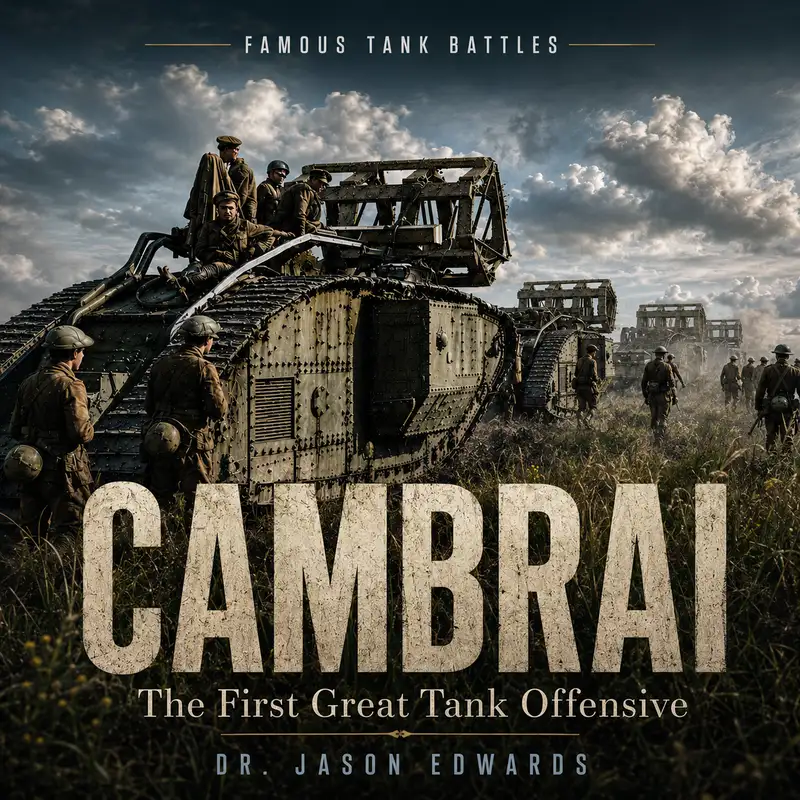
Cambrai: Episode 3 — The Cambrai Breakthrough
Cambrai stands at one of the great turning points in the history of armored warfare because it was the moment when the tank stopped being merely an alarming novelty and became part of a serious battlefield method. On the Western Front, that mattered enormously. For years, armies had been able to smash each other, exhaust each other, and deform each other without reliably restoring movement to battle. At Cambrai, on the twentieth of November, Nineteen Seventeen, the British briefly showed that a heavily fortified trench system could be broken open by surprise, careful artillery planning, massed tanks, and closely coordinated infantry. Yet the battle also showed something just as important. Breaking into the enemy line was not the same as breaking through it, and the gap between those two achievements would define the whole struggle.
This podcast is accompanied by a companion book that expands the story of the Battle of Cambrai, with additional historical context, maps, and dozens of enhanced colorized photographs from the battle. Your purchase helps support our mission to keep these podcasts free. You can find the book at Military Author dot me or at track pads dot com
The context of the battle explains why British commanders were willing to take such a risk. The year had already been one of terrible strain, especially after the long agony of Passchendaele, where mud, shellfire, and attritional logic had swallowed men and momentum alike. The British Army did not emerge from that fighting convinced that courage was lacking. It emerged convinced that method was lacking. Another great warning bombardment followed by another slog through shattered ground promised more loss than decision. So the search for a new answer grew more urgent. Tanks alone could not provide that answer, but tanks combined with artillery science, engineering preparation, and improved infantry tactics seemed to offer at least the possibility of a different kind of opening blow.
Cambrai looked like the place where such an experiment might become a real operation. The ground there was far firmer than the waterlogged wreckage of Flanders, which meant tanks had a genuine chance to move rather than disappear into mud. The Germans also held the area as part of the Hindenburg Line, a deep and formidable defensive system whose breach would matter both tactically and psychologically. Cambrai itself was a useful rail and road center, but the battle was never simply about taking the town and planting a flag. The deeper operational logic lay in proving that a heavily fortified front could be ruptured under the right conditions. If the British could do that here, then trench warfare would no longer seem quite so permanent, and the tank would no longer seem quite so experimental.
The British plan reflected that ambition. Instead of beginning with a long registration bombardment that would warn the enemy and destroy the attacker’s own routes of movement, the assault relied on predicted artillery fire, a sudden opening barrage, smoke, and a carefully timed creeping barrage to cover the infantry. Hundreds of tanks were gathered for the blow, an enormous concentration by the standards of the war, and engineers prepared special equipment such as fascines to help machines cross major trenches. Infantry were trained to move close behind the tanks and use the openings they created rather than waiting for every defensive point to be reduced by artillery alone. Even cavalry remained in the plan, not because cavalry represented the future, but because commanders still hoped that once the defensive crust was cracked, mounted troops might exploit the opening before the Germans recovered.
When the battle began before dawn on the twentieth of November, the effect was startling. The artillery opened without the prolonged warning that defenders had come to expect, and the tanks moved forward almost at once with the infantry. Wire that might once have held attackers in place for fatal minutes was crushed. Trenches that had previously absorbed whole battalions were crossed with a speed rare for the Western Front. In several sectors, German defenders were hit before their artillery and local command system could regain balance. The first day produced an advance of roughly five miles in places, and by the standards of trench warfare that was an extraordinary result. It was not merely a tactical gain. It was a demonstration that surprise, concentration, and coordination could change the tempo of battle.
The shock was real because the British were attacking as a system rather than as a single arm. Tanks created openings, but artillery preserved surprise and suppressed the defenders at the moment of assault. Infantry followed closely enough to clear strongpoints, occupy villages, and hold the ground once the tanks moved on or broke down. Engineers and route planners had already shaped the battlefield behind the scenes so the assault would not collapse before it began. This mattered because trench warfare was not just a contest of courage. It was a contest of sequence. At Cambrai, the British briefly reversed the usual sequence. Instead of warning, delay, and attrition, they achieved surprise, shock, and movement. That reversal is why the battle still echoes so strongly in the history of modern warfare.
But the breakthrough was never as clean as its opening seemed. Around Flesquières, strong local German resistance and effective artillery fire checked the British advance and knocked out a damaging number of tanks. In the center and right, places like Ribécourt and Marcoing showed how much could be achieved when the attack kept its momentum, but the canal crossings near Masnières revealed how fragile success remained. A bridge collapse there sharply narrowed the possibility of rapid exploitation eastward. Cavalry, the arm supposed to ride through the breach and widen it, could not pass in enough strength and at enough speed to turn German dislocation into outright collapse. So even on the day of its greatest promise, Cambrai exposed the central problem of early armored warfare. The line could be cracked. The system beyond the line was far harder to master.
As the battle moved beyond the first day, the British found themselves drawn toward Bourlon Ridge and the villages and woods around it. This shift was militarily logical, because the ridge commanded the northern shoulder of the new British salient, and without it the gains already won remained exposed to enemy observation and counterattack. Yet the struggle for Bourlon changed the character of the whole operation. What had begun as a fast and surprising all-arms rupture now became close fighting in woods, village streets, and shell-torn approaches where tanks were less decisive and artillery became more oppressive than liberating. The battle slowed, then thickened. Every attempt to secure Bourlon Wood, Fontaine-notre-Dame, and Bourlon Village consumed more infantry, more time, and more strength. Momentum narrowed into attrition, and the offensive began paying for the ground it had won rather than turning that ground into something larger.
The tank itself, so dazzling on the first morning, also revealed its limits more harshly with each passing day. Many machines were destroyed by enemy fire, especially where German guns found good fields of direct fire. Many more were lost to breakdown, ditching, mechanical exhaustion, and the sheer punishment of crossing trenches, rubble, roads, and shell-marked ground. By the end of the opening day, a large part of the British tank force was already out of useful action. That did not mean the tank had failed. It meant the tank had succeeded at a very high cost. Cambrai proved that armor could restore movement to battle, but it also proved that early armor could consume itself frighteningly fast while doing so. Future armored warfare would have to solve not only the problem of the opening blow, but the problem of sustaining armored strength after that blow landed.
The Germans, for their part, did not simply watch these lessons unfold. They learned, adapted, and prepared their answer. Once the first shock had been contained and the British salient exposed itself more clearly, German commanders assembled reserves, concentrated artillery, and prepared a deliberate counterstroke. Their assault methods emphasized short, violent bombardment, infiltration by small flexible groups, and the bypassing of strongpoints when possible. The British salient was exactly the kind of target such a method could punish. It projected forward, but it had shoulders and lines of communication that could be struck from more than one direction. So when the German counterattack came on the thirtieth of November, it was not merely revenge. It was a modern answer to a modern offensive, aimed at the vulnerable shape British success had created.
That counterattack nearly transformed British triumph into disaster. In the south, mist, short artillery preparation, and infiltration tactics broke through a weakly organized sector and sent German forces streaming toward Gouzeaucourt, threatening the rear of the whole salient. The crisis there became one of the decisive moments of the battle, because if Gouzeaucourt had remained securely in German hands, the entire British position around Bourlon might have begun to unravel from behind. Emergency British counterattacks by Guards, artillery, cavalry, and even tanks that had been headed away for refit prevented that complete collapse, but the damage was done. The offensive dream had ended. The British still held important ground, but they no longer held it as an army preparing to exploit success. They held it as an army trying to prevent success from shrinking into defeat.
In the end, Cambrai was close to a draw in immediate military terms. The British retained only part of the ground they had taken in their dazzling first advance, and both sides suffered heavily. Yet the battle’s historical weight was never going to be measured only by the final line on the map. Cambrai mattered because it showed, more clearly than before, how tanks, surprise, artillery calculation, infantry tactics, and logistics could converge into a new method of war. It also mattered because it exposed every missing piece in that method: communications, exploitation, mechanical endurance, route control, and the secure handling of a salient after success. In that sense, the battle was not a finished victory but an unfinished revelation. Background references consulted for the battle overview, the massed use of tanks, the first-day advance, the later fighting at Bourlon, the German counterattack, and Cambrai’s larger significance in the evolution of armored warfare.