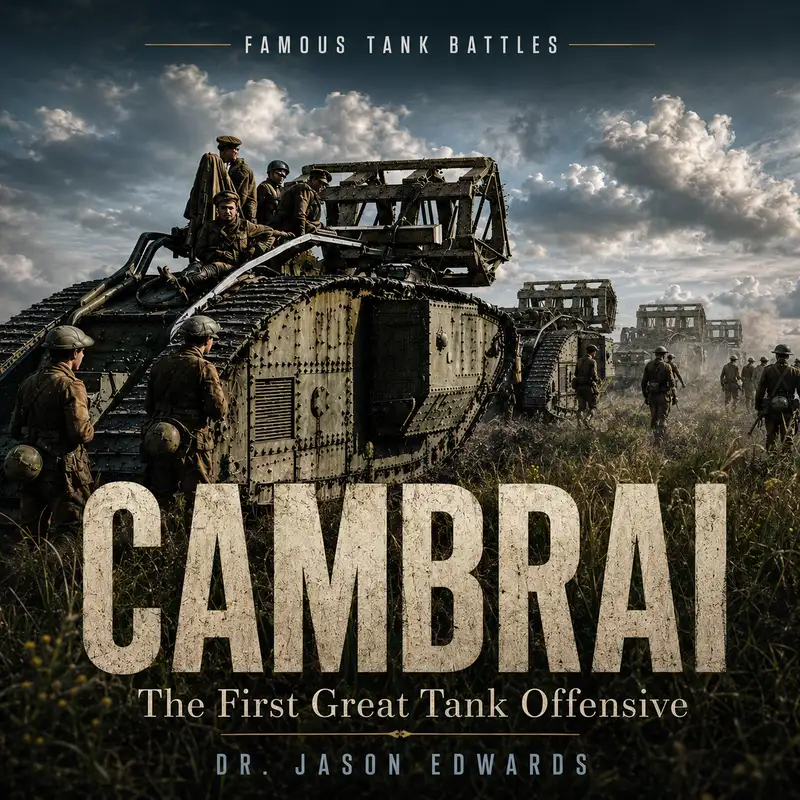
Cambrai: Episode 4 — Why Cambrai?
Cambrai was not chosen by accident, and it was not chosen simply because someone wanted to try tanks somewhere new. It was selected because, in the dark months after Passchendaele, British planners were looking for a place where a different kind of battle might actually be possible. Around Cambrai, southwest of the town itself, the ground offered something Flanders had denied them: firmer rolling country that was far less broken by months of bombardment and therefore better suited to tracked machines. Just as important, the sector sat on the German Hindenburg Line, one of the strongest defensive systems on the Western Front. If British forces could break in there, the result would carry both tactical and psychological weight.
This podcast is accompanied by a companion book that expands the story of the Battle of Cambrai, with additional historical context, maps, and dozens of enhanced colorized photographs from the battle. Your purchase helps support our mission to keep these podcasts free. You can find the book at Military Author dot me or at track pads dot com
To understand why that mattered, it helps to think like an army rather than like a map reader. A battlefield is not valuable only because it contains enemy troops. It is valuable because of what movement across it can open, close, or threaten. Cambrai mattered because it sat within a web of roads and rail connections that helped support German forces in this part of the front. The town itself was an important supply center, and pressure against it promised more than a local success in a trench line. If the British could rupture the defenses west of Cambrai and push forward in an orderly way, they might unsettle the entire German position in the area and force the enemy to respond to a wider operational danger rather than merely patch a damaged trench.
Terrain was the first and most obvious reason the place attracted the Tank Corps. In Flanders, mud had swallowed movement, broken tempo, and turned tanks into burdens as often as weapons. Near Cambrai, by contrast, the rolling chalk downland offered firmer going and fewer of the waterlogged disasters that had crippled operations farther north. That did not mean the battlefield was easy. It still contained trenches, wire, machine-gun nests, and strongpoints that could punish any careless advance. But it meant that the basic promise of the tank could at least be tested under conditions that gave it a chance to move, steer, and support infantry instead of simply sinking or bogging down. In military history, that difference is enormous. Good ideas need ground that lets them live.
The roads mattered almost as much as the open ground. Tanks in the First World War were not sleek raiders that could wander anywhere without support. They needed transport arrangements, fuel, repair systems, and carefully organized approaches to the battlefield. Artillery needed roads as well, both to come forward and to sustain a battle once it began. A well-connected area offered practical advantages long before the first shell landed. British planners knew that if they were going to mass guns, move hundreds of tanks into place, and support an attack on a broad front, they needed a sector that allowed preparation without instant collapse into logistical chaos. Roads also shaped the battle after the opening attack, because any force hoping to move beyond the first trench systems had to think about where reserves, cavalry, ammunition, and follow-on infantry could actually go.
Yet the same landscape that made Cambrai attractive also made it dangerous. One of the most important features in the sector was the Saint-Quentin Canal, a major obstacle that cut through the operational picture in a way tanks alone could not solve. On a planning table, the canal could look like an edge to a German-held pocket or a boundary that helped define the attack. On the ground, it was a barrier that could delay or block exploitation at exactly the moment speed mattered most. If British forces reached it quickly but could not cross in strength, then an attack that looked brilliant in the first hours might begin to lose momentum before the larger objective came into reach. Cambrai was therefore appealing not because it removed obstacles, but because it concentrated both opportunity and risk into one battlefield.
This is where the operational logic becomes especially important. Fuller and other tank advocates had originally imagined a large-scale raid into a canal-enclosed pocket, a blow that would exploit suitable terrain and surprise rather than attempt an unrealistic march to distant victory. That concept then grew. Senior commanders adopted the basic idea but expanded it into a larger offensive with wider aims, including the capture of Cambrai itself and movement beyond it. In other words, Cambrai began as a carefully defined experiment and became something more ambitious once the opportunity seemed too promising to ignore. That expansion helps explain both why the target was chosen and why the battle later became so complicated. A battlefield selected for a sharp, controlled rupture is not always the same battlefield suited to a deep exploitation.
The Hindenburg Line also played a decisive role in the choice. By attacking near Cambrai, the British were not striking a weak backwater but taking aim at one of Germany’s most formidable defensive systems. This gave the operation a special significance. If tanks, artillery, infantry, engineers, and surprise could combine effectively here, then the result would challenge the growing belief that modern field fortifications were practically unbeatable except by months of attrition. Cambrai therefore offered more than tactical promise. It offered a test case. A successful attack there would suggest that the Western Front was not permanently frozen and that carefully coordinated force could break into even a prepared defensive belt. That symbolic value mattered deeply after the disappointments of earlier offensives. The place was important not just because it was there, but because success there would mean something larger.
Another reason for choosing Cambrai was that surprise seemed more achievable there than in the exhausted ritual battlefields farther north. British planners wanted to avoid the long preliminary bombardments that had become almost a form of battlefield announcement. Around Cambrai they believed they could assemble tanks in large numbers, move artillery into place, and rely on predicted fire rather than days of obvious registration. That mattered because surprise on the Western Front had become rare and precious. The point was not simply to startle the enemy. It was to gain the first hours of the battle before German artillery, reserves, and command systems could respond effectively. A sector that allowed a sudden blow against a major defensive system was therefore far more attractive than one where the enemy would have days to watch every preparatory step unfold.
There was also a geographical logic to the immediate objectives inside the battlefield. Places like Flesquières, Masnières, Marcoing, and above all Bourlon Ridge mattered because they sat astride the movement routes and observation lines that would decide whether a breakthrough remained alive or not. Bourlon Ridge, in particular, was not just another name on a staff map. It was high ground overlooking the area, and whoever held it possessed a stronger position from which to observe, direct fire, and shape further movement. That is why later fighting there became so intense. Once British progress across the canal crossings proved more difficult than hoped, the ridge assumed even greater importance. Cambrai’s geography kept forcing the battle to answer the same question: was this an opening for movement, or the beginning of a vulnerable salient?
The canal crossings reveal the brilliance and fragility of the whole target choice. British planners saw the canal line as part of the operational structure of the battlefield, something that defined a pocket and helped shape the intended thrust. But when forces approached crossings like those near Masnières and Marcoing, the problem became painfully concrete. A breakthrough is only real if enough men, guns, supplies, and follow-on forces can pass through the gap faster than the enemy can recover. If bridges fail, if crossings bottleneck, or if too few troops can get over in time, then the promise of the opening attack begins to drain away. Cambrai was chosen partly because it looked like a place where movement could happen. It also proved how quickly geography can transform movement into stoppage.
Seen in that light, Cambrai was almost the perfect battlefield for a new military idea because it exposed every strength and every weakness of that idea at once. The firm ground made massed tanks plausible. The road network and the town’s operational importance gave the target real meaning. The Hindenburg Line made success politically and militarily significant. The canal and the ridges imposed discipline on the plan by reminding everyone that movement still had to pass through chokepoints, under fire, against an enemy capable of rapid adaptation. This is why the battle belongs in the history of armored warfare. It was not a simple machine test. It was an operational test in which landscape, supply, timing, and command all shaped what tanks could and could not accomplish.
So the answer to “Why Cambrai?” is that it brought together exactly the features British commanders were searching for and exactly the hazards they had not yet fully solved. It offered dry enough ground for tanks, roads and approaches that could support a massed assault, a major German defensive system worth attacking, and a town whose loss would threaten the enemy’s local position. At the same time, it included the canal barriers, ridge lines, and exploitation problems that would expose the limits of early armored warfare the moment the attack moved beyond its opening success. Cambrai was chosen because it looked like the place where breakthrough might finally be invented in practice. It became famous because the battlefield proved that the invention was real, but still unfinished.