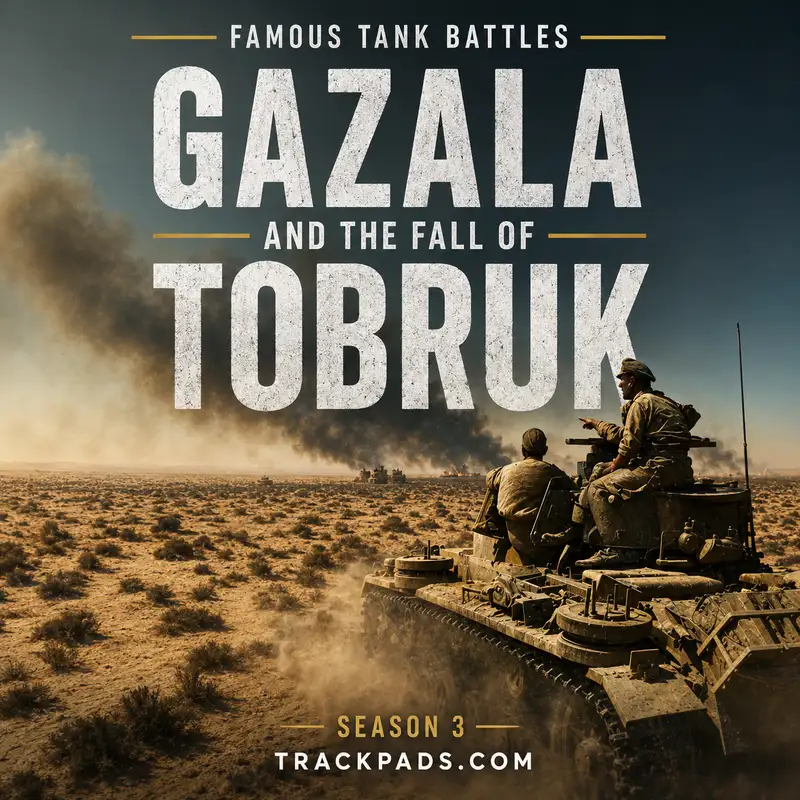
Gazala: Episode 15 — The Great Counterattack
By early June, Nineteen Forty Two, the British Eighth Army still had one great hope at Gazala: Rommel had gone too far, and a properly coordinated counterattack could destroy him in the Cauldron. The Axis army had swept around the southern flank, fought its way behind the Gazala Line, and then settled into a dangerous pocket east of the minefields. British commanders could see the logic of striking hard before that pocket became fully secure. If they could break into the Cauldron, overwhelm the Axis anti-tank defenses, and sever the routes that kept Rommel supplied, the whole offensive might collapse. The promise was enormous. One well-executed blow might turn weeks of confusion into a decisive British victory.
If you would like to move beyond the podcast, you can see my available books at Military Author dot me. And at Trackpads dot com, you will find magazines and galleries with hundreds of thousands of photos and videos to explore.
The counterattack was born from a real opportunity, not from fantasy. Rommel’s position remained exposed, and his army still depended on narrow, vulnerable corridors through the minefields for fuel, ammunition, water, and replacement vehicles. Bir Hakeim still held in the south, continuing to complicate Axis movement and supply. British forces still possessed substantial armor, artillery, infantry, and air support. The Eighth Army had not been destroyed, and the Gazala Line had not yet become irrelevant. In fact, from a distance, the battle could still be read as a chance to punish a daring enemy who had trapped himself behind the very defenses he had tried to turn.
The plan that emerged, often associated with Operation Aberdeen, was intended to apply concentrated pressure against the Axis pocket and break its fighting structure. The British needed infantry to advance against prepared positions, engineers to deal with mines and routes, artillery to suppress enemy guns, and armored formations to exploit success once a path had been opened. This was not supposed to be another scattered armored thrust into Rommel’s anti-tank screen. It was supposed to be a coordinated combined-arms attack, the kind of blow that would finally connect the pieces of the Gazala system. The hope was that planning and weight would accomplish what earlier attacks had failed to do.
The idea sounded like the correct answer to the problem. Rommel’s strength in the Cauldron came from turning a vulnerable pocket into a defensive fighting zone, with tanks, anti-tank guns, artillery, engineers, and supply corridors supporting one another. To beat that system, the British had to attack as a system of their own. Tanks had to be protected from hidden guns. Infantry had to clear and hold ground instead of leaving armor to fight alone. Artillery had to blind and disrupt the Axis defenders before British vehicles entered the killing areas. Engineers had to make movement possible through ground where mines and obstacles could otherwise break the rhythm of the attack.
The counterattack also carried a heavy emotional burden because the Eighth Army needed a success badly. Rommel had seized the initiative, survived the Cauldron’s early danger, and forced British commanders into repeated reactions. The longer he remained inside the pocket, the less trapped he seemed and the more dangerous his position became. British armored losses were already mounting, and confidence in the Gazala system was under strain. A major coordinated attack offered more than a tactical solution. It offered the chance to restore the army’s sense that events could still be shaped, that Rommel could still be forced onto the defensive, and that Tobruk could still be protected before the campaign slid toward disaster.
Yet planning a counterattack in the desert was far easier than conducting one. The battlefield around the Cauldron was not a clean parade ground where units could form neatly and move on a fixed timetable. It was a dusty, confusing, mined, and contested space in which every route had to be understood and every report might be incomplete. A formation told to move at a certain time might be delayed by navigation, enemy fire, mechanical trouble, or uncertainty about friendly positions. A headquarters might believe several parts of the plan were moving together when, on the ground, they were already drifting apart. Combined arms requires synchronization, and synchronization was the one thing Gazala kept trying to destroy.
Rommel’s forces were not passive targets waiting for the blow to land. They had spent days hardening the Cauldron, improving anti-tank positions, bringing up supplies, and learning where British attacks were likely to come from. German and Italian troops understood that British armor would have to move across exposed ground to reach them. Anti-tank guns could be placed to cover likely avenues of approach, while tanks remained available to counterattack, shift positions, or lure British formations forward. The Axis did not need to defeat the whole British plan at once. They needed to disrupt its timing, break up its leading elements, and turn one coordinated attack into several disconnected fights.
For the infantry assigned to the counterattack, the task was especially hard. Infantry in desert warfare did not simply walk behind tanks and occupy ground after the dramatic part was finished. They had to move under fire, identify positions that were often difficult to see, deal with wire, mines, machine guns, and artillery, and hold what they took long enough for armor and guns to come forward. If infantry advanced but armor did not arrive at the right time, they could become isolated. If armor moved but infantry had not cleared the necessary positions, tanks could be exposed to hidden anti-tank guns. The counterattack required each arm to trust that the others would be there when the moment came.
The armored formations faced their own difficult balance. They had to be aggressive enough to exploit any opening, but not so aggressive that they charged into the same kind of anti-tank trap that had already punished earlier efforts. Tank crews had to move through dust and fire while trying to distinguish enemy vehicles, friendly positions, gun flashes, and landmarks that might barely exist in the open desert. The Grant tanks gave British crews real hitting power, but no tank could make itself immune to a well-sited gun. The armored role was decisive, but it could only become decisive if the attack created conditions where tanks could maneuver rather than simply advance into a prepared wall of fire.
Artillery was supposed to help create those conditions, but artillery in a mobile desert battle had its own limitations. Guns needed ammunition, observers, communications, and accurate knowledge of enemy positions. The Axis defenses around the Cauldron were not all fixed in obvious places, and dust or movement could make targeting difficult. Suppression is not the same as destruction; an anti-tank gun crew might keep its head down during a bombardment and then return to action when the tanks appeared. Artillery could support the counterattack, but it could not guarantee success by itself. Its effect depended on timing, observation, and whether the infantry and armor moved while the enemy was still disrupted.
Airpower also promised help, but it could not solve the central coordination problem. Aircraft could attack Axis concentrations, vehicles, and supply routes, and they could add pressure to Rommel’s exposed position. But close cooperation between aircraft and ground forces was still difficult in a battlefield where front lines shifted, dust obscured movement, and friendly units might be close to enemy positions. Air attacks could damage, delay, and unsettle the Axis, yet the Cauldron still had to be broken on the ground. The British needed the enemy’s supply corridors closed, his anti-tank defenses overcome, and his armored formations forced into a disadvantage. Aircraft could contribute to that outcome, but they could not replace the hard work of combined-arms assault.
The great counterattack therefore became a test of whether the Eighth Army could finally impose order on the battle. The British had strong reasons to believe the moment was still recoverable. They had local courage, improved weapons, defended positions, and an enemy who had accepted enormous risk. They also had a plan that recognized the need for coordination rather than another purely armored rush. But the plan depended on many moving parts functioning together under pressure from a commander whose greatest gift was making his opponents lose their balance. Rommel’s army might have been vulnerable, but it was alert, dug in where it mattered, and ready to punish hesitation or separation.
The importance of this counterattack lies in the hope attached to it. Gazala had not yet become an unavoidable defeat, and the fall of Tobruk was not yet written into the campaign’s future. A powerful, synchronized British blow against the Cauldron could have changed the story dramatically. It might have destroyed Rommel’s pocket, restored the defensive line, and turned Bir Hakeim’s endurance into part of a wider victory. That possibility is what makes the moment so tense. The Eighth Army was preparing to strike not because it had already lost, but because it still believed the battle could be won. The tragedy was that belief alone could not coordinate infantry, tanks, guns, engineers, aircraft, and supply columns. The counterattack promised decision, but in the desert, every promise still had to survive contact with dust, fire, timing, and fear.