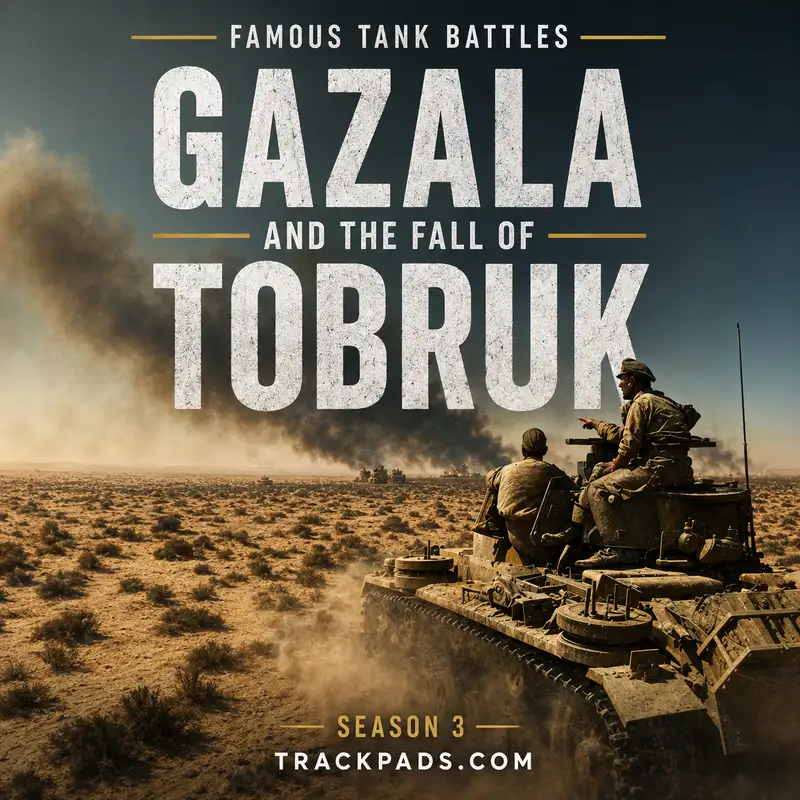
Gazala: Episode 16 — When the Counterattack Broke Apart
The great British counterattack against the Cauldron was meant to be the moment when the Gazala battle finally turned. Rommel’s force had pushed behind the line, survived in a dangerous pocket, and built a defensive position where the attacker looked trapped but still fought with control. British commanders hoped that one coordinated blow would cut through the Axis defenses, close the supply corridors, and destroy the force that had caused so much confusion since the night march around the southern flank. Instead, the counterattack broke apart. The failure did not feel like one single collapse, but like a sequence of missed timings, misunderstood positions, scattered attacks, and lethal anti-tank fire that slowly revealed how far the battle had slipped from British control.
If you would like to move beyond the podcast, you can see my available books at Military Author dot me. And at Trackpads dot com, you will find magazines and galleries with hundreds of thousands of photos and videos to explore.
The plan required several arms to work together under extremely difficult conditions. Infantry had to move forward against prepared enemy positions, engineers had to deal with mines and routes, artillery had to suppress Axis guns, and armor had to exploit openings before Rommel could recover. That was the correct theory, because tanks alone had already suffered badly when thrown against the Cauldron’s defenses. But correct theory is not the same as battlefield execution. The desert around the Cauldron was full of dust, darkness, uncertain landmarks, enemy movement, and incomplete reports. Every part of the plan depended on other parts arriving at the right time, and once that timing failed, the attack lost the unity that gave it purpose.
Night movement caused some of the earliest problems. Moving men and vehicles across desert ground in darkness was always difficult, especially when minefields, uncertain routes, and enemy positions shaped the approach. Units could lose direction, arrive late, or find themselves short of where they were supposed to be when the attack began. In a coordinated assault, delay in one part of the force could expose another part to danger. Infantry might go forward without enough armored support, or tanks might wait for infantry that had not reached the expected point. The counterattack depended on synchronization, but Gazala punished synchronization almost from the beginning.
The Axis defenders were ready for exactly this kind of breakdown. Rommel’s forces had used the days inside the Cauldron to create a battlefield where British armor could be drawn into prepared fire. Anti-tank guns were placed to cover likely approaches, while tanks and mobile units could respond to pressure without being wasted in a simple head-on duel. German and Italian troops did not need to guess perfectly where every British attack would fall. They needed to hold their nerve, let the British come forward, and exploit the moment when the attacking system began to separate into pieces. Once the attack fragmented, the Cauldron’s defensive structure became deadly.
British infantry found itself facing a harsh and confusing fight. Moving on foot in the desert under fire was slow, exposed, and mentally exhausting. Positions that looked manageable on a map could be difficult to identify on the ground, especially when dust, smoke, and shellfire blurred the battlefield. Infantry had to deal with machine guns, artillery, wire, mines, and the possibility of armored counterattack. If they advanced without enough tanks or artillery support, they could be pinned down or isolated. If they waited for armor that had been delayed, the attack’s momentum drained away before it reached the enemy’s vital positions.
British armored formations faced a different but connected disaster. Tanks moved into areas where Axis anti-tank guns were waiting, often without the infantry and artillery effects needed to protect them. Crews inside Grants and cruisers had to make decisions through limited vision, dust, noise, and incomplete understanding of where friendly units were. A tank commander might see enemy movement ahead, but not the concealed gun off to the side. When British armor pressed forward in separated groups, it offered Rommel the kind of fight he wanted. The tanks could be engaged, halted, and burned without ever achieving the concentration needed to break the Axis position.
The anti-tank guns were the central instruments of the British failure. They turned open desert into a series of invisible walls. A crew could wait until a British tank came into range, fire from a prepared position, and then shift attention to the next target. Larger guns could kill at longer distances, while smaller guns still mattered when well sited and handled with discipline. The panzers were important, but the British were not simply losing tank battles in the narrow sense. They were losing a combined-arms contest in which Axis guns, armor, engineers, observation, and command worked together better at the decisive moment than the British attack did.
Command friction deepened the crisis. Reports from the front came back confused, delayed, or incomplete, and headquarters struggled to understand whether the attack was succeeding, stalled, or failing outright. One unit might report progress while another was already under heavy fire. A commander might believe supporting armor was on its way when it was delayed or diverted. Decisions about reinforcement, withdrawal, or renewed pressure had to be made without a clean picture. This is one of the hardest truths about armored warfare: the commander’s map can look orderly long after the battlefield has become chaos. At Gazala, that gap between plan and reality widened with every hour.
Rommel’s advantage was not that his army was free from danger. The Axis force still had supply problems, still depended on corridors through the minefields, and still faced the risk of being overwhelmed if the British attack had struck with full weight. His advantage was that he had converted danger into a structure that could absorb incomplete blows. The Cauldron did not have to be comfortable to be effective. It had to be organized enough to survive pressure and inflict losses. By the time the British counterattack began to unravel, Rommel’s army had the one thing the attackers lacked: a working battlefield method in the place where decision was being sought.
The failure also drained British armored strength at a moment when strength could not be easily replaced. Every tank lost in the counterattack was not available for the next crisis. Every damaged vehicle that could not be recovered became a permanent reduction in the army’s ability to maneuver. Crews who survived still faced exhaustion, confusion, and the strain of repeated action. Workshops and recovery units could return some machines to service, but they could not undo the operational effect of losing too much armor in attacks that failed to decide the battle. Gazala was not slipping away because one order failed. It was slipping away because each failed effort left the Eighth Army less able to impose its will on the next day.
Bir Hakeim still held out to the south, and that fact should have given the British a continuing advantage. The Free French garrison was still complicating Rommel’s flank and supply situation, still forcing Axis attention toward a position he wanted removed. But the failure of the counterattack meant that Bir Hakeim’s endurance was not being matched by decisive action elsewhere. This is the painful imbalance at the heart of Gazala. Local resistance could be heroic and tactically important, yet the broader battle could still move in the wrong direction. The defenders at Bir Hakeim were buying time, but time only helps if the larger army can turn it into action.
The British defeat in the counterattack did not immediately destroy the Gazala Line, and it did not instantly decide the fate of Tobruk. That is important, because campaigns often collapse gradually before they collapse visibly. After the counterattack failed, the British still held positions, still had units in the field, and still possessed commanders trying to recover the situation. But the initiative had shifted more firmly toward Rommel. The Eighth Army had tried to deliver the blow that would end his offensive and had instead spent precious strength against the Cauldron’s defenses. The psychological effect was severe. An army can begin losing before its maps show defeat, because the belief that it can shape events begins to fade.
When the counterattack broke apart, Gazala entered a darker phase. The British had not been defeated by cowardice, and they had not lacked equipment or courage. They were defeated in this moment by the failure to make a complicated combined-arms plan work against an enemy who was organized, alert, and tactically ruthless. Rommel had been vulnerable, but the Eighth Army could not concentrate enough force, at the right time, in the right way, to turn vulnerability into destruction. That is why this episode matters in the history of armored warfare. It shows that tanks and strong positions are not enough unless command, timing, reconnaissance, artillery, infantry, engineers, and supply all move together. At Gazala, the hoped-for knockout punch missed its mark, and the battle began to slide toward Rommel.