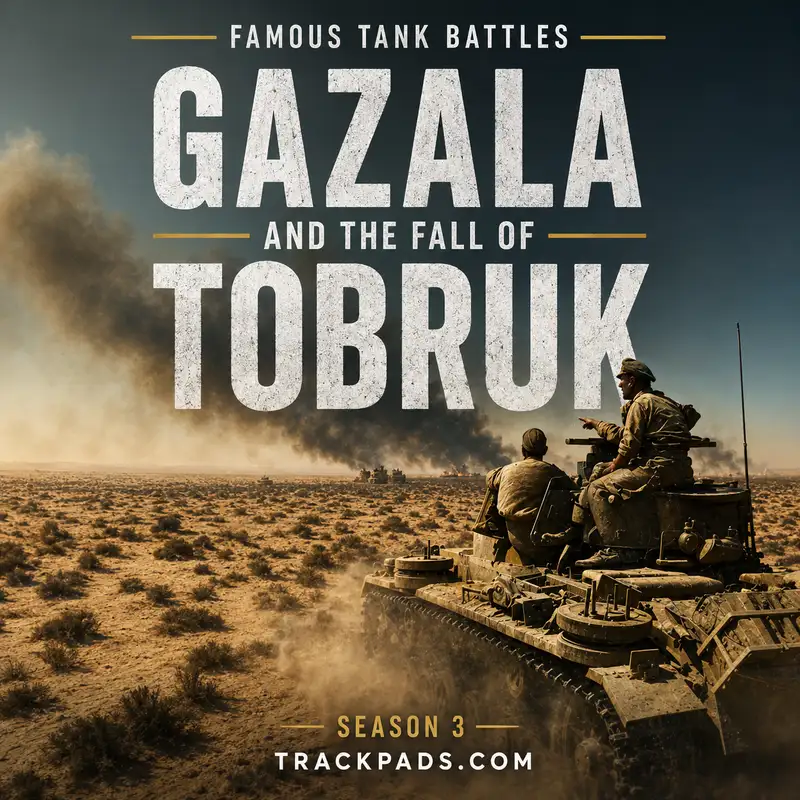
Gazala: Episode 17 — Rommel Regains the Initiative
After the failed British counterattack against the Cauldron, the battle of Gazala changed in a way that was not immediately visible on a simple map. The British still held boxes, still had units in the field, and still possessed enough force to make Rommel’s position dangerous. Bir Hakeim continued to resist in the south, and the Gazala Line had not yet been abandoned. Yet the character of the battle had shifted, because the Eighth Army had tried to crush Rommel at his moment of apparent vulnerability and had failed. From that point forward, the question was no longer only whether Rommel could survive inside the Cauldron. The deeper question was whether the British still had the coordination, confidence, and armored strength to impose their will on the battle at all.
If you would like to move beyond the podcast, you can see my available books at Military Author dot me. And at Trackpads dot com, you will find magazines and galleries with hundreds of thousands of photos and videos to explore.
Initiative in armored warfare is not just movement. It is the power to make the enemy answer your problems instead of forcing you to answer his. In the days after the counterattack broke apart, Rommel increasingly regained that power. He had entered the Cauldron in danger, but he had survived the British blows, reopened enough supply routes to keep fighting, and made the pocket into a defensive base rather than a fatal trap. The British, meanwhile, had spent precious armored strength in attacks that failed to produce a decision. The balance did not change because one side suddenly became invincible. It changed because Rommel’s options widened while the British options began to narrow.
This did not mean the Axis position was easy or secure. Rommel’s army still depended on fuel, ammunition, water, repair work, and routes through a difficult battlefield. German and Italian units had taken losses, and the desert remained unforgiving to every vehicle and every supply column. Bir Hakeim still complicated the southern flank, and British air and ground pressure could still hurt Axis movement. But the central fact had changed: Rommel was no longer simply trying to avoid destruction. He was beginning again to shape the battle around his own intentions, and that restored the psychological force that had made him so dangerous throughout the desert war.
For the British, the realization came unevenly. Armies rarely understand all at once that a battle has turned against them. One headquarters might still see opportunities, one unit might still hold firm, and one commander might still believe a renewed blow could restore the situation. On the ground, however, formations felt the cost of the failed attacks in a more immediate way. Tank strength had been reduced, crews were exhausted, recovery and repair systems were strained, and confidence in the ability to coordinate a decisive counterstroke had been damaged. The Eighth Army had not collapsed, but its ability to act boldly was becoming weaker just when boldness was most needed.
Rommel’s recovery of initiative depended heavily on the way his forces combined armor and anti-tank defense. The Cauldron had taught the British that attacking Axis positions directly could be ruinously expensive when anti-tank guns were properly sited and supported. Once Rommel had survived the attempt to crush him, that same method became a platform for further action. He could hold certain sectors with guns and infantry while moving armor to threaten British formations elsewhere. He could draw British units into defensive fire, then exploit their losses and confusion. This was not a pure tank charge across open sand. It was a system of movement, fire, deception, and timing, and by early June it was working better for the Axis than for the British.
The British command problem became sharper because the battlefield no longer offered a clean choice. Should they continue trying to reduce the Cauldron? Should they reinforce the boxes? Should they prepare to withdraw from exposed positions? Should they concentrate remaining armor for one more major effort? Each option carried danger, and none could be chosen in perfect certainty. Rommel’s presence behind the original line had already distorted the battlefield, and now his survival inside the Cauldron made the distortion worse. British commanders had to defend a system whose logic depended on mutual support, but the battle was increasingly pulling that system into separated fights.
Bir Hakeim remained a source of Allied pride and Axis frustration, but even its endurance could not reverse the wider shift by itself. Koenig’s Free French garrison continued to delay, absorb pressure, and interfere with Rommel’s southern freedom of movement. The defense still mattered tactically and symbolically, and it still imposed costs on the Axis timetable. Yet the fate of Gazala depended on more than one brave strongpoint. If the British mobile force could not regain control of the open battle, Bir Hakeim’s resistance would become an isolated achievement rather than the anchor of a successful defensive system. That is one of the hard lessons of the campaign: local heroism can buy time, but it cannot guarantee that time will be used effectively.
Rommel also benefited from the emotional effect of having survived the worst danger. His men had been short of supply, pressed by British attacks, and positioned in a place that many observers might have considered untenable. When they endured that phase and remained operational, the meaning of the battle changed for both sides. For the Axis, survival created renewed confidence and confirmed that aggressive improvisation could still pay off. For the British, the same fact deepened uncertainty. If Rommel could not be destroyed when trapped in the Cauldron, then what would it take to stop him when he began moving again?
This psychological dimension mattered because armored warfare is not fought by machines alone. Crews, commanders, drivers, engineers, gunners, and infantry all interpret the battle through fatigue, expectation, fear, and confidence. A unit ordered forward after several costly failures does not feel the same as it did before those losses. A commander deciding whether to commit his remaining armor must think not only about numbers on a strength return, but about readiness, morale, repair status, fuel, and the possibility that another failed attack might leave the whole line unable to respond. The Eighth Army still had brave soldiers and capable weapons, but the belief that it could dictate the battle was eroding.
Rommel’s next steps were shaped by a clear understanding that the British had lost their best opportunity to destroy him. He still had to deal with Bir Hakeim, secure his supply situation, and reduce the risk posed by British forces around the Cauldron. But he could now begin thinking beyond mere survival. The Axis army could press against the British armored formations, threaten the remaining defensive structure, and prepare to turn tactical recovery into operational advantage. The initiative had returned not because every problem was solved, but because Rommel could once again make the British react to his timing. In desert war, that was often enough to begin a larger unraveling.
The British weakness after the failed counterattack was not simply numerical loss. It was the loss of coherence between plan, perception, and action. The Gazala Line had been designed as a flexible system of boxes, minefields, and mobile armor, but the mobile element was being worn down and the boxes were increasingly vulnerable to isolation. Reports could still show units in position, but positions mattered less if the enemy controlled the tempo of movement around them. A defensive line can fail before every strongpoint falls. It fails when its parts can no longer create a common effect, and after the Cauldron fighting, that danger grew with every passing day.
This pivot also reveals why Gazala became one of Rommel’s greatest victories rather than merely one more desert battle. He did not win because his army had unlimited resources, or because the British lacked courage, or because the desert automatically favored the attacker. He won the initiative back by surviving danger, exploiting British hesitation and fragmentation, and turning anti-tank defense into a weapon of operational recovery. His gamble around the southern flank had nearly produced disaster, but the British failure to finish him allowed the gamble to mature into advantage. Gazala was becoming a battle in which the side that seemed trapped began dictating the next phase.
By the time Rommel regained the initiative, the road to British defeat was not yet inevitable, but it was becoming much easier to see. The Eighth Army still had decisions to make, and the Gazala Line still had defenders who would fight hard. Yet the campaign had crossed a threshold. The attacker who had been caught in the Cauldron was no longer merely enduring pressure; he was generating it. The defenders who had planned to use boxes, minefields, and armored reserves as a coordinated system were now struggling to keep that system alive. In the larger story of armored warfare, this moment matters because it shows how quickly initiative can change ownership. Once an army begins losing the ability to shape events, defeat may begin before retreat is ordered, before a fortress falls, and before the final battlefield disaster becomes visible to the world.