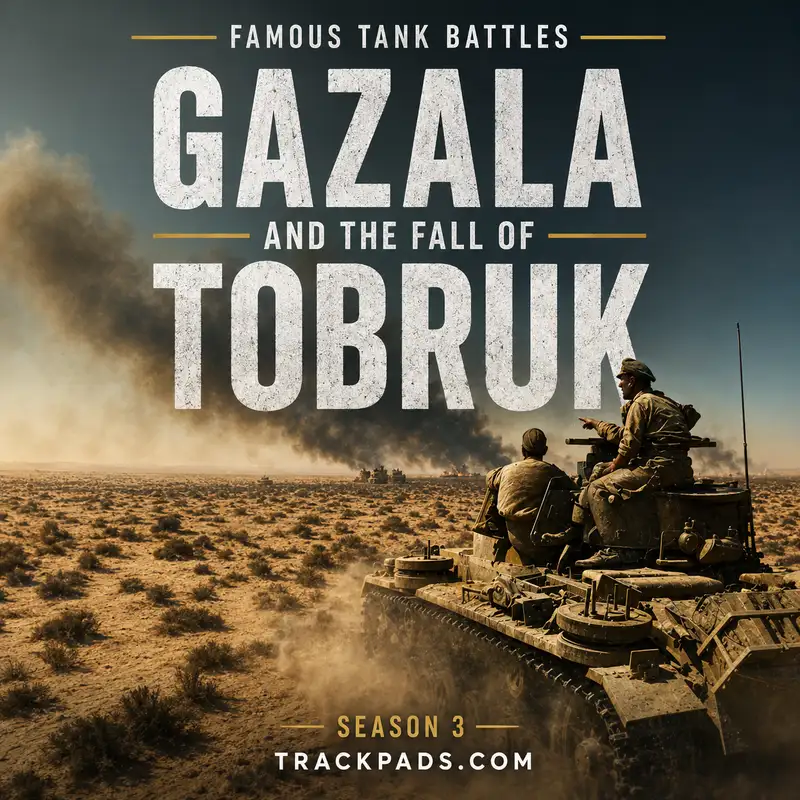
Gazala: Episode 18 — Breakout From Bir Hakeim
By the night of June tenth into June eleventh, Nineteen Forty Two, Bir Hakeim had already become more than a defended box at the southern end of the Gazala Line. For days, General Marie-Pierre Koenig’s Free French garrison had endured artillery fire, air attack, heat, thirst, and repeated pressure from Axis forces determined to erase the position from Rommel’s flank. The box had delayed the Axis timetable, complicated supply movement, and given the wider Allied cause a symbol of resistance at a moment when the larger battle was turning dark. But even the strongest stand has a limit. Bir Hakeim had done its work, and now the defenders had to escape before endurance became annihilation.
If you would like to move beyond the podcast, you can see my available books at Military Author dot me. And at Trackpads dot com, you will find magazines and galleries with hundreds of thousands of photos and videos to explore.
The decision to break out was not a confession that the defense had failed. It was a recognition that the tactical value of the position had changed. The Free French had held long enough to impose delay and cost on Rommel’s southern maneuver, but the wider Gazala battle was moving against the British. The failed efforts to crush the Cauldron had left the Eighth Army weaker, and Rommel was regaining the initiative. Bir Hakeim remained brave, but bravery could not refill water cans, replace ammunition, repair every damaged vehicle, or guarantee relief. A garrison that had fought well still had to be preserved if preservation could serve the larger war.
A breakout from a surrounded desert box was a different kind of operation from holding a perimeter. During the siege, the defenders had used mines, wire, guns, trenches, and prepared positions to make the enemy come to them. Now they had to move through the very kind of danger their own defenses had created. Vehicles, guns, wounded men, infantry, drivers, and small groups all had to pass through or around minefields and enemy fire in darkness and confusion. The goal was not to win a neat tactical engagement. The goal was to get as many men as possible out of a tightening ring and back to Allied lines before daylight made movement even more dangerous.
Night offered concealment, but it did not offer safety. In the desert, darkness could hide a column from enemy observation, but it could also hide landmarks, tracks, minefield edges, and the distance between friendly vehicles. A route that seemed clear in daylight might become frighteningly uncertain at night, especially after days of bombardment and movement had altered the ground. Drivers had to keep formation without bunching up, losing contact, or drifting into danger. Men moving on foot had to follow guides and signals while carrying weapons, equipment, and exhaustion. A breakout depends on discipline because panic can turn a narrow escape route into a trap.
The wounded made the movement harder and more human. They could not be treated as an afterthought, because a fighting force is also a community of obligation. Vehicles needed space for men who could not march. Medical personnel had to balance urgency with care. Every delay increased the risk of discovery or renewed fire, but leaving men behind carried its own moral weight. This was not the clean drama of armored columns racing across empty sand. It was a practical and painful movement by a battered garrison trying to bring its people out of a place that had become both a battlefield and a symbol.
Axis forces around Bir Hakeim understood that the garrison might try to escape, but no encirclement in the desert was perfectly sealed. Distances were too wide, darkness too uncertain, and the battlefield too disturbed for a continuous wall of men and guns. Still, the danger was severe. Axis patrols, artillery, machine guns, anti-tank weapons, and minefields could turn any route into chaos if the breakout was detected or delayed. The Free French had to pass through a hostile belt where surprise, speed, and luck mattered alongside planning. It was one thing to hold against attacks from prepared positions. It was another to move out through the enemy’s grip.
Koenig’s leadership mattered because the breakout required controlled risk rather than desperate flight. A force that simply scattered might save individuals, but it would lose organization, abandon equipment unnecessarily, and leave too many men behind. A force that moved too slowly might be caught before it cleared the danger zone. The balance was brutal. The garrison had to preserve enough order to survive as a unit, but enough urgency to escape a position the Axis wanted to seal. Leadership in that moment meant making movement possible for exhausted men who had spent days under pressure and now had to perform one of the hardest tasks in war: leaving a position without dissolving.
The breakout also showed how deeply the Free French stand had affected the wider campaign. Rommel wanted Bir Hakeim gone because it interfered with his freedom of action, especially around his southern flank and supply arrangements. The garrison’s escape denied him the full satisfaction of destroying or capturing the whole force. The position would be lost, but the men who had made it famous could continue the war. That distinction matters. In military history, ground is sometimes less important than the force that holds it. Bir Hakeim as a place could be abandoned, but Bir Hakeim as a legend survived because so many of its defenders got out.
The movement out of the box was not clean or painless. Breakouts rarely are. Vehicles could be hit, separated, or lost. Some men were killed, wounded, or captured. Some groups found their way through danger while others suffered in the confusion that surrounds every night operation. Casualty and escape figures vary in different accounts, and the exact experience differed from one group to another. What is clear is the larger result: a substantial portion of Koenig’s garrison broke through and reached safety after one of the most intense defensive stands of the Gazala campaign. That survival turned a tactical withdrawal into an act of defiance.
For the British Eighth Army, the escape from Bir Hakeim came at a moment when the wider situation remained dangerous. The garrison had bought time, but the British had not been able to turn that time into decisive control over the battle. Rommel’s forces had survived the Cauldron, supply corridors had been opened, and British armored strength had been worn down. The loss of Bir Hakeim removed an obstacle from the Axis southern flank, but by the time the garrison left, the position had already imposed its cost. The tragedy was that this local success could not reverse the larger unraveling of the Gazala Line.
In the history of armored warfare, the breakout matters because it reminds us that mobility is not only the possession of tanks. Infantry in a defended box can create operational delay, and a surrounded garrison can preserve combat power by moving at the right time. Mines, anti-tank guns, artillery, and fortifications had helped the Free French hold; vehicles, guides, discipline, and night movement helped them escape. The same battlefield that had favored prepared resistance now demanded mobility under pressure. Bir Hakeim’s defenders had to change roles quickly, from an anvil that absorbed blows to a moving force slipping through danger before the hammer came down.
The emotional power of the breakout comes from that transformation. For days, the garrison’s achievement had been measured in holding: holding the perimeter, holding the guns, holding under bombardment, holding despite thirst and fatigue. In the final act, success meant movement. The men had to leave behind the ground that had given their stand its name, but they carried away the meaning of that stand with them. The desert box could be taken after they left, but it could not be made irrelevant. By escaping, the Free French turned Bir Hakeim from a doomed outpost into a lasting symbol of endurance, discipline, and survival.
That is why the breakout from Bir Hakeim became more than an episode inside the Gazala campaign. It was a tactical loss because the position could no longer be held, but it became a strategic legend because the defense had delayed Rommel, inspired the Allied cause, and preserved much of the force that had made the stand. The larger battle still moved toward British defeat, and the road to Tobruk was becoming more dangerous with every passing day. Yet Bir Hakeim complicates the story of Gazala by showing that defeat can contain honor, and withdrawal can preserve victory of a different kind. At the end of the line, Koenig’s men had held long enough to matter, and then escaped so that their stand would not end in silence.