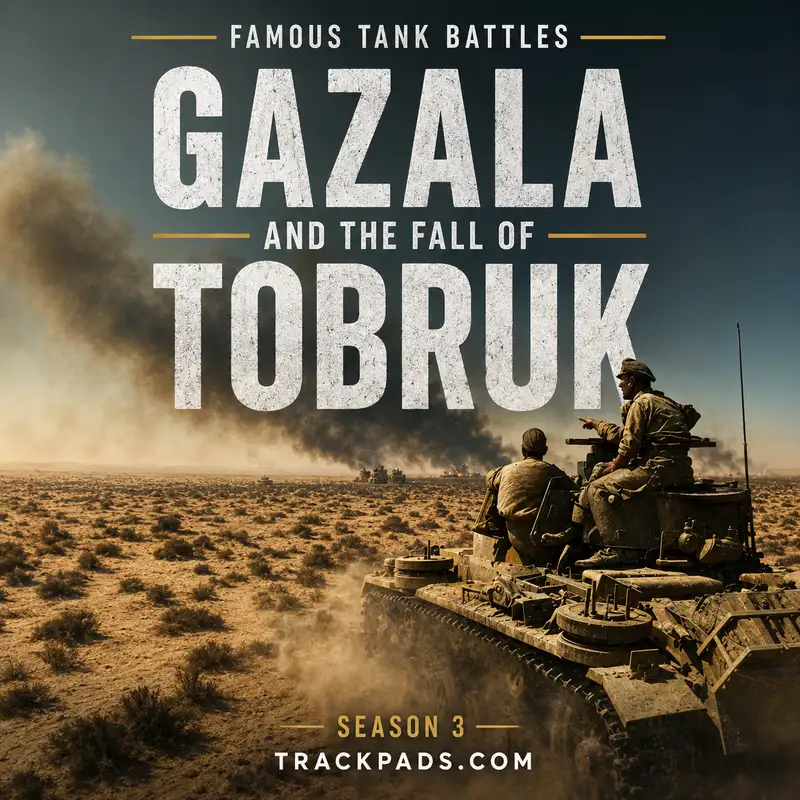
Gazala: Episode 19 — The Narrow Corridor
After the breakout from Bir Hakeim, the battlefield at Gazala began to contract in a dangerous way. The desert still looked enormous, stretching outward in pale distances that seemed to promise room for maneuver, but the operational space available to the British Eighth Army was shrinking. Rommel’s force had survived the Cauldron, kept supply moving through the minefields, and removed the southern obstacle that had delayed and irritated his plan. Now the Axis could press eastward and northward with greater confidence, threatening the remaining British armor and the defensive boxes that had once seemed to form a strong system. The open desert was becoming a narrow corridor, and inside that corridor tanks could no longer move freely enough to escape converging fire.
If you would like to move beyond the podcast, you can see my available books at Military Author dot me. And at Trackpads dot com, you will find magazines and galleries with hundreds of thousands of photos and videos to explore.
This was one of the most dangerous transformations in armored warfare: a mobile battlefield becoming compressed without everyone recognizing it at once. A desert army depends on space because space allows movement, withdrawal, regrouping, and flanking action. When that space narrows, the same tanks that once seemed free can be forced into predictable routes and exposed approaches. Minefields, defensive boxes, Axis anti-tank positions, supply routes, and the need to protect Tobruk all began to shape British movement into a tighter zone. The Eighth Army still had armor, but armor trapped in a narrowing battlefield does not have the same meaning as armor with room to maneuver.
Rommel understood that the British armored force had been worn down by earlier fighting, but he also understood that it could not be ignored. If the remaining British tanks could concentrate effectively, they might still disrupt Axis movement or threaten the supply corridors that kept his army alive. His solution was not merely to chase them. It was to make the battlefield dangerous in the places where they had to move. Axis tanks, anti-tank guns, artillery, and reconnaissance worked together to create pressure from several directions. The British were not simply facing an enemy in front of them; they were being drawn into a space where every movement seemed to uncover another threat.
The narrow corridor was not a formal road or a neat passage marked on a map. It was a tactical condition created by the shape of the battle. To the west and southwest lay the Axis position that had grown out of the Cauldron. To the south, the loss of Bir Hakeim opened possibilities for Axis movement that had been harder before. To the north and east lay British boxes, routes toward Tobruk, and the remaining defensive structure the Eighth Army still hoped to hold. British armor moving through this zone had to think about several dangers at once: panzers, anti-tank guns, minefields, air attack, fuel, orders, and the risk of being caught too far from support.
The British had intended the Gazala Line to combine fixed resistance with mobile reaction, but by this stage the balance between those two elements was failing. The boxes could still hold ground and resist attack, but the mobile formations that were supposed to protect the system had been battered. Armored brigades that had already suffered losses could not simply be restored by order. Crews were tired, vehicles needed maintenance, and replacement tanks did not arrive at the speed the battle demanded. A formation might still exist in name, and it might still contain brave and capable crews, but its ability to deliver a decisive counterstroke had been reduced by days of costly fighting.
Inside this compressed battlefield, anti-tank guns became especially lethal. In wide-open maneuver, tanks can sometimes avoid a strong gun line by shifting direction or using speed to reach a flank. In a narrowing corridor, choices become fewer. If British tanks had to move along predictable approaches or respond quickly to Axis pressure, they were more likely to enter fields of fire that had been prepared or anticipated. German and Italian gunners did not need to defeat every tank in a dramatic duel. They needed to stop enough of them, in the right places, to break momentum and make the next British decision harder.
The panzers remained important, but their value came from the system around them. German tanks could threaten, withdraw, counterattack, or appear at a flank, forcing British commanders to react. Yet the killing ground often depended on anti-tank guns, artillery, and tactical patience. A British armored formation might see enemy tanks and move to engage, only to be hit from gun positions that had remained hidden until the moment of advantage. This method had already punished British attacks around the Cauldron, and now it helped shape the narrowing space east of it. The desert did not need hills or forests to create an ambush. Dust, distance, and expectation could do much of the work.
For British crews, the pressure must have felt relentless. They had to keep watching for enemy armor while also fearing guns they could not see. They had to obey orders that might already be outdated by the time they arrived. They had to conserve fuel while moving fast enough not to be caught. They had to navigate through dust and smoke, identify friendly formations, and understand a battlefield in which the old west-facing defensive logic had been overturned. The men inside the tanks were not pieces on a diagram. They were exhausted soldiers trying to make life-or-death judgments through narrow vision, radio noise, heat, and confusion.
This stage of the battle also exposed the cost of earlier missed opportunities. If the British had crushed Rommel when he first appeared vulnerable in the Cauldron, the narrow corridor might never have formed. If the counterattack had broken his pocket, Axis pressure would have eased, and the Gazala Line might have regained coherence. Instead, Rommel had survived, and each failed British effort had reduced the armor available for the next crisis. Armored warfare is cumulative in that way. A lost tank matters immediately, but it also matters tomorrow, when one more company is missing from the counterattack that might have restored the situation.
The pressure on British command increased as the battlefield narrowed. Decisions that had once allowed several options now seemed to offer only bad choices. Reinforce one sector, and another might open. Attack Rommel’s armor, and the tanks might run into anti-tank guns. Hold back, and the Axis might keep tightening the corridor. Withdraw too early, and the defensive boxes could be compromised. Wait too long, and the remaining armor might be caught before it could disengage. The Eighth Army’s commanders were not dealing with a simple tactical puzzle. They were trying to preserve an army while the battle’s geometry turned against them.
Rommel’s drive eastward also threatened the idea that Tobruk could remain protected by the Gazala position. The port had strategic and symbolic importance, but its security depended on the mobile battle to the west and southwest. If the British armor was forced back, worn down, or compressed into a killing zone, then Tobruk’s wider shield would weaken. This is a crucial point in understanding the campaign. Tobruk did not fall because it was suddenly important on its own. It became vulnerable because the field army around it lost the ability to control the approaches. The narrow corridor was therefore one step on the road from Gazala to the fortress crisis.
The desert’s apparent openness makes this episode especially important. Listeners can easily imagine North African tank warfare as endless movement across empty sand, with columns sweeping wherever commanders wished. Gazala shows the opposite. Even in open terrain, a battlefield can close in. Minefields, supply limits, strongpoints, gun lines, command confusion, and enemy pressure can compress an army until it has fewer choices than it appears to have. The British were not trapped in the way soldiers might be trapped inside city streets or mountain passes, but they were being forced into a tactical environment where movement became predictable and danger approached from more than one direction.
The narrow corridor marked the transition from a battle that the British still hoped to repair to one that was beginning to threaten their survival as a coherent defensive force. Rommel had not yet completed the destruction of the Gazala position, and the most famous shocks were still ahead. Knightsbridge, Black Saturday, the withdrawal order, and the fate of Tobruk all remained to come. But the shape of defeat was now becoming clearer. British armor was being squeezed into a zone where it could not easily maneuver, could not easily concentrate, and could not easily escape the combined pressure of Axis tanks and guns. In the history of armored warfare, this phase teaches a hard lesson: open ground does not guarantee freedom. When command, supply, terrain, obstacles, and enemy fire converge, even the desert can become a funnel.