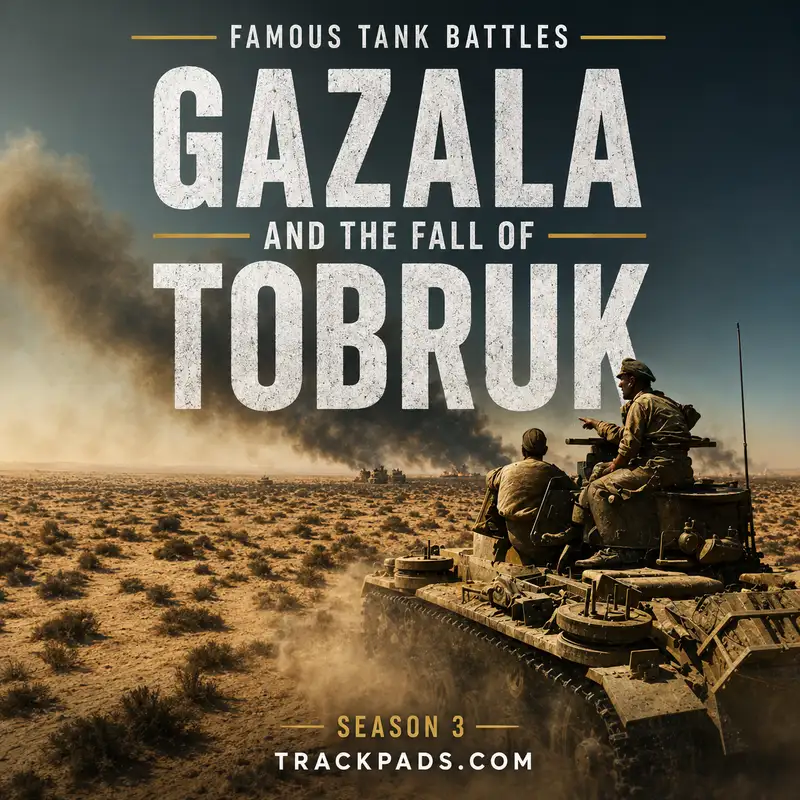
Gazala: Episode 20 — Knightsbridge
Knightsbridge was not a city, and it was not a fortress in the way Tobruk was a fortress in British imagination. It was a desert position, a box and a battlefield reference point in the confused space east of the Cauldron, where tracks, armored movement, artillery fire, and command decisions began to converge. By June of Nineteen Forty Two, that name had become one of the places where the Gazala battle tightened into crisis. Rommel had survived the Cauldron, Bir Hakeim had been evacuated, and the British defensive system was losing the ability to act as one. Around Knightsbridge, the campaign’s middle phase stopped being a struggle for advantage and began to feel like a fight for survival.
If you would like to move beyond the podcast, you can see my available books at Military Author dot me. And at Trackpads dot com, you will find magazines and galleries with hundreds of thousands of photos and videos to explore.
The Knightsbridge position mattered because it sat in the zone where the British still hoped to protect the remaining structure of the Gazala Line while keeping a mobile shield in front of Tobruk. It was not important because of natural grandeur or obvious terrain dominance. In the desert, a place could become important because routes passed near it, because headquarters used it as a reference point, or because forces trying to move, defend, or withdraw all found themselves drawn toward it. Knightsbridge became one of those points. It was a place where fixed defense, armored maneuver, and command confusion overlapped, and that made it far more important than its appearance on the ground might suggest.
The British box system had always depended on connection. A defended position could hold only if it remained part of a larger pattern of mutual support, mobile counterattack, artillery coverage, and supply. Knightsbridge tested that idea under some of the worst conditions of the campaign. The garrison and nearby troops could resist, but the wider question was whether British armor could still move effectively around them. If the tanks could strike, block, and recover, Knightsbridge might remain an anchor. If the mobile battle collapsed, the box would become another isolated position in a defensive system that was beginning to lose its operational meaning.
Rommel’s pressure around Knightsbridge came after he had solved the immediate danger of the Cauldron. He had not solved every problem, because his army still depended on fuel, ammunition, transport, repair, and narrow routes through a battlefield crowded with mines and enemy positions. But he had survived the British attempts to destroy him, and survival had given him freedom to act. With Bir Hakeim no longer holding the southern end, Axis movement became less constrained. German and Italian forces could now focus more directly on breaking the remaining British armor and forcing the Gazala Line into a decision it did not want to make.
The fighting around Knightsbridge was never just a tank battle, even though tanks were central to it. British Grants and cruiser tanks still had real power, and their crews were not passive victims waiting to be destroyed. Axis panzers remained dangerous, but they too were part of a wider system. Anti-tank guns, artillery, reconnaissance, engineers, infantry, and supply vehicles shaped what the tanks could actually do. The lesson of the Cauldron now followed the British into this new zone of pressure. Armor moving without enough information, support, or coordination could be drawn toward enemy fire and reduced before it achieved anything decisive.
For British commanders, Knightsbridge sharpened every difficulty that had been building since the night of May twenty-sixth. Reports came from multiple directions, and the battlefield’s shape kept changing faster than headquarters could comfortably interpret it. A unit might be told to counterattack, another to hold, another to prepare for movement, while each was working from a different understanding of where the enemy really was. Rommel’s forces were not simply advancing in a straight line. They were applying pressure, shifting weight, and forcing the British to decide whether they were still defending Gazala or already trying to preserve the army for the next line to the east.
Command breakdown in this phase did not always look dramatic from a distance. It was often made of smaller failures that accumulated. Orders arrived late, or did not match conditions on the ground. Armored formations were not always concentrated at the moment and place where concentration was needed. Infantry boxes expected support that could not arrive in time or could not be coordinated effectively. Tank strength on paper did not reflect crews exhausted by days of fighting, vehicles under repair, machines short of fuel, or formations reduced by previous losses. By the time Knightsbridge became the focus, the Eighth Army was still fighting, but it was fighting with less coherence than the plan required.
The men in and around the Knightsbridge Box experienced the battle in immediate and physical terms. They faced shellfire, dust, heat, air attack, and the knowledge that enemy armor might appear from directions that no longer felt predictable. Anti-tank gun crews had to remain ready even when visibility was poor and reports were confused. Infantrymen dug in and waited, knowing that a box could become a battlefield on all sides if the wider line was turned. Artillerymen needed targets and communications, both of which became harder to maintain as movement and dust distorted the fight. For the men on the ground, command failure was not an abstract idea. It meant uncertainty about where help was, where the enemy was, and whether the position still fit into a larger plan.
Axis pressure worked because it combined threat with method. Rommel could use armor to force British movement, but he did not need to spend his tanks recklessly if anti-tank guns could do the killing. He could push, pause, draw, and strike, turning British reactions into opportunities. German and Italian troops had learned how to make the open desert behave like prepared defensive ground when enemy tanks approached. A British formation might move toward what looked like a chance to engage panzers, only to meet concealed guns covering the approach. Around Knightsbridge, that method helped turn British resistance into further attrition.
The loss of armored strength was now becoming decisive. Earlier in the campaign, British commanders could still hope that one coordinated counterattack might restore the situation. By the time the fighting concentrated around Knightsbridge, that hope was fading. Tanks lost around the Cauldron and in earlier counterattacks could not simply reappear. Damaged vehicles needed recovery and repair, and some could not be recovered at all. Crews who survived still carried fatigue and shock into the next fight. An armored army can decline gradually and then suddenly discover that it no longer has enough striking power to solve the next crisis.
Knightsbridge also mattered because it stood between the remaining Gazala defense and the fate of Tobruk. The port had not yet fallen, and the fortress question had not yet become the campaign’s final disaster, but the connection was already visible. Tobruk could not be understood separately from the mobile battle outside it. If the field army west and southwest of the port lost control of the approaches, then Tobruk would be left increasingly exposed. Knightsbridge was one of the places where that larger danger took shape. The British were not merely defending a box. They were trying to prevent the shield in front of Tobruk from cracking.
The tragedy of Knightsbridge is that it revealed the gap between a defensive concept and battlefield reality. The British had built boxes because they knew infantry needed firm positions in the desert. They had kept armor mobile because they knew fixed positions alone could be bypassed. They had improved tanks and anti-tank guns because earlier battles had shown how badly those tools were needed. Yet none of that could substitute for unified command, timely information, and coordinated action. At Knightsbridge, the ingredients of a serious defense were still present, but they no longer combined reliably enough to stop Rommel from tightening the battle.
In the history of armored warfare, Knightsbridge deserves attention because it shows how a campaign can reach the edge of collapse before the famous breaking point arrives. Black Saturday would soon give the disaster a sharper name, and the order to abandon the Gazala Line would make the retreat unmistakable. But Knightsbridge was where the fragility became visible. The British Army still had men, weapons, and courage, but courage inside a box and tanks on a strength return could not restore a system already losing cohesion. Around Knightsbridge, the desert narrowed, the armor bled, and the road toward Tobruk began to open. The next blow would show just how badly the balance had shifted.