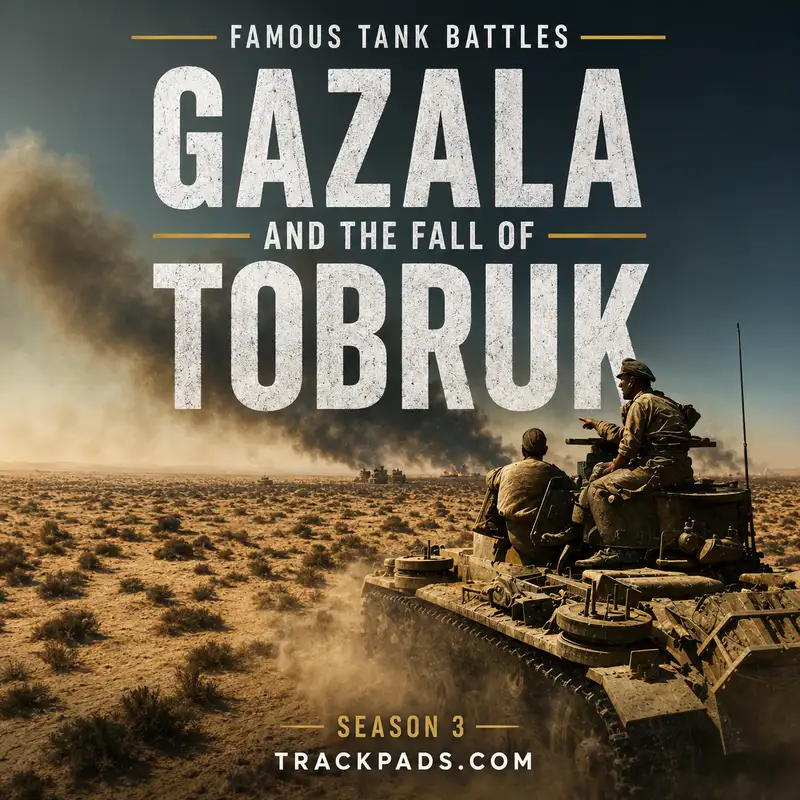
Gazala: Episode 25 — 20 June
On June twentieth, Nineteen Forty Two, the argument over Tobruk ended with brutal speed. For days, the fortress had stood behind the retreat from Gazala as a name heavy with memory, expectation, and danger. It had held once before, and that earlier endurance shaped what many people hoped it might do again. But Rommel did not approach Tobruk as a commander willing to repeat the long siege of the previous year. He came after breaking the mobile battle to the west, after wearing down British armor, and after forcing the Gazala Line to be abandoned. The assault on Tobruk was therefore not an isolated attack on a perimeter. It was the final consequence of a field army losing control outside the fortress.
If you would like to move beyond the podcast, you can see my available books at Military Author dot me. And at Trackpads dot com, you will find magazines and galleries with hundreds of thousands of photos and videos to explore.
Tobruk’s defenses still mattered, but they were now being tested under conditions very different from those of Nineteen Forty One. The garrison under Major-General Hendrik Klopper included South African, British, Indian, and other Allied troops, and the port still contained valuable stores, guns, vehicles, and military facilities. Yet the defensive system had not settled into the same long rhythm of siege warfare that had made the earlier defense famous. Time was short, the wider army was retreating, and Rommel held the initiative. A fortress can look strong in outline while being fragile in organization, and on June twentieth the Axis attack struck at that gap between reputation and readiness.
The Axis assault was built around shock, concentration, and combined arms. Rommel’s forces did not simply roll tanks toward the perimeter and hope armor alone would settle the matter. Artillery and air attacks prepared the way, striking defensive positions, communications, and likely strongpoints. Engineers moved forward to deal with mines, wire, and obstacles. Infantry and armor were coordinated to exploit any breach before the defenders could restore the line. This was the mature form of the lesson learned throughout the desert war: tanks were most dangerous when they were part of a system. At Tobruk, that system was focused on speed because speed could prevent the garrison from turning the attack into a prolonged defense.
The main blow fell against the southeastern sector of the perimeter, where Axis pressure sought to open a gap large enough for mobile forces to pass through. Once a breach began to form, the meaning of the battle changed quickly. A perimeter defense depends on preventing penetration, but it also depends on being able to counterattack if penetration occurs. If the attacker breaks in and moves fast, defenders inside the fortress must shift reserves, redirect artillery, control routes, and prevent confusion from becoming collapse. Tobruk’s danger was that the Axis attack did not stop at making a hole. It pushed through that hole, turning a defensive problem into a command crisis.
Airpower added to the shock. Bombing did not have to destroy every position to be effective; it had to disrupt communications, exhaust defenders, obscure the battlefield, and help break the rhythm of command. Men under bombardment must still receive orders, move ammunition, operate guns, treat wounded comrades, and judge where the real threat is developing. If communications falter and headquarters loses a clear picture, even brave units can fight isolated battles while the larger defense unravels. At Tobruk, the combination of air attack, artillery, and fast ground movement created exactly the kind of pressure that a hurried fortress defense was least able to absorb.
The defenders were not simply swept away because they lacked courage. Many Allied soldiers fought where they stood, and some local positions resisted with determination even as the wider situation deteriorated. But local resistance does not automatically stop a coordinated breakthrough. Anti-tank guns must be sited and supplied, infantry must know where support will come from, artillery must receive usable information, and reserves must move before the enemy’s penetration becomes too deep. Once Axis armor and infantry were inside the defensive belt, Tobruk’s problem became internal as well as external. The battle was no longer only about holding the perimeter. It was about preventing the fortress from being split, confused, and overwhelmed from within.
Rommel’s success depended on turning the fortress’s fixed defenses against it. A fixed position can concentrate strength along a perimeter, but if that perimeter is breached, the defender must rapidly reorganize in depth. Every road, supply dump, command post, and artillery position inside the fortress becomes part of the next phase of the fight. The attacker wants to move faster than the defender can reorient. That is what made June twentieth so dangerous for Tobruk. Axis forces did not need to reduce every strongpoint one by one before the day mattered. They needed to create a breach, exploit it quickly, and make the garrison’s command system feel the battle slipping beyond recovery.
The stores inside Tobruk added urgency to both sides’ decisions. For the Allies, the port contained supplies that had to be defended, moved, or denied to the enemy. For Rommel, those same stocks represented a possible solution to some of the logistical strain created by the long desert fight. Fuel, ammunition, vehicles, food, and equipment were not background details. They were part of the strategic prize. In North Africa, logistics could decide whether a victory became a pursuit or merely a pause. If Tobruk fell with large quantities of supplies intact, Rommel would gain more than a famous name. He would gain material power for the next stage of the campaign.
The speed of the attack also damaged the moral structure of the defense. A garrison expecting a siege can prepare itself for endurance, rationing, routine bombardment, and the long discipline of holding out. A garrison hit by a rapid breakthrough faces a different psychological shock. Rumors spread, reports conflict, commanders lose contact with sectors, and troops begin to sense that the enemy is not merely outside the fortress but inside the defensive system. That feeling can be as dangerous as physical loss of ground. Once defenders believe the battle is moving faster than their commanders can control, the fortress begins to lose the confidence that gives fixed defense its staying power.
For British and Allied leadership, Tobruk’s sudden crisis carried consequences beyond the immediate perimeter. The fortress had been left behind after Gazala because it was believed, or at least hoped, that it could delay Rommel and deny him the port. Instead, the assault showed that the defeat of the field army had already weakened the fortress before the first major blow fell. This is one of the central lessons of the campaign. Tobruk did not fall in isolation. It was made vulnerable by the loss of the mobile battle to the west, by the destruction and exhaustion of British armor, and by the inability to prevent Rommel from concentrating against the port on his own timetable.
The assault of June twentieth also belongs in the larger history of armored warfare because it shows how tanks can defeat a fortress without fighting like siege artillery. They do it by exploiting a breach, moving quickly through the defender’s disrupted system, and forcing decisions faster than the defense can make them. Engineers, artillery, aircraft, infantry, and armor all mattered in that process. The tanks alone did not create the victory, but once the breach opened, armored movement gave the attack its terrifying speed. Tobruk’s defenses were not irrelevant, but they were not able to slow the battle into the kind of prolonged contest that might have favored the garrison.
By the end of June twentieth, Tobruk’s fate was already darkening. The fortress had not yet formally surrendered, but the assault had changed the meaning of the defense in a matter of hours. Axis forces had broken in, the garrison’s coherence was under severe strain, and the possibility of a long repeat of the earlier siege had largely vanished. The next day would bring surrender, prisoners, captured supplies, and a shock that reached from the Libyan desert to London. But the decisive rupture came on June twentieth. That was the day Tobruk stopped being a symbol of what had once been endured and became a warning about what happens when a fortress is left behind after the mobile battle around it has been lost.