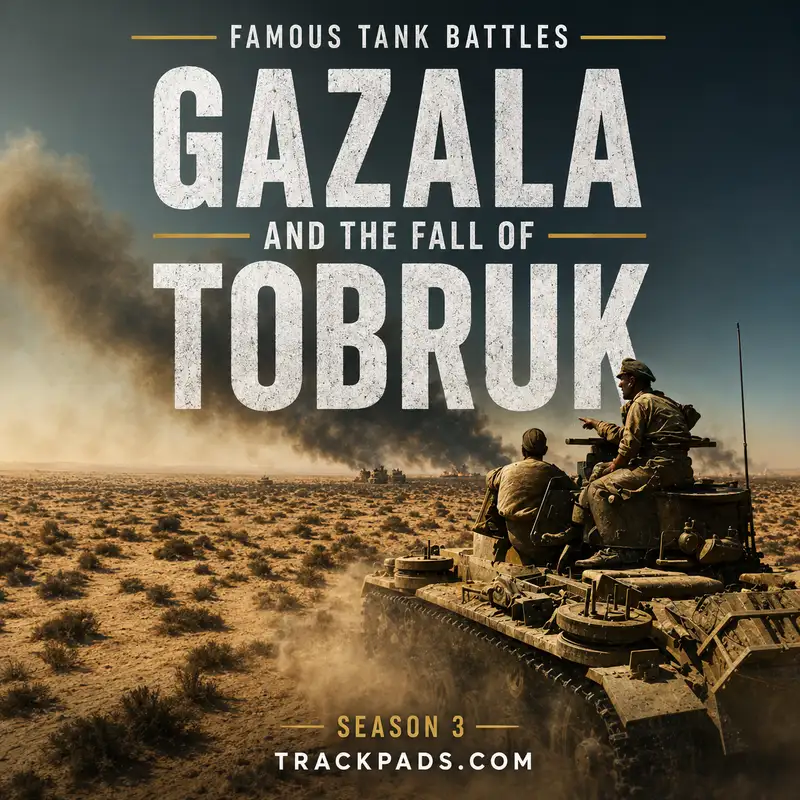
Gazala: Episode 9 — Ariete at Bir Hakeim
On May twenty-seventh, Nineteen Forty Two, the southern edge of the Gazala battle began to show Rommel that a bold plan could still be slowed by a single stubborn position. The Axis armored sweep around the British flank had been designed to move fast, disorient the Eighth Army, and turn the Gazala Line from behind. Yet near Bir Hakeim, the Italian Ariete Armored Division ran into a defense that was far more serious than a lonely desert outpost might have suggested. This episode matters because it shows how a small point on a vast battlefield could interfere with the rhythm of an entire offensive. At Bir Hakeim, the Axis discovered that the southern flank was not empty space, and that speed alone could not erase prepared resistance.
If you would like to move beyond the podcast, you can see my available books at Military Author dot me. And at Trackpads dot com, you will find magazines and galleries with hundreds of thousands of photos and videos to explore.
Ariete was an Italian armored formation, and it deserves to be treated as a real fighting force rather than a footnote to German operations. Too often, the desert war is simplified into Rommel and the Germans on one side and the British on the other, leaving Italian formations in the shadows. That version misses how Rommel’s army actually functioned. Italian divisions provided armor, infantry, artillery, transport, and staying power that the Axis campaign could not do without. Ariete had already seen hard fighting in North Africa, and its crews were operating under the same brutal desert conditions as everyone else. At Bir Hakeim, its attack would become one of the first sharp tests of the Free French box and of the southern part of the Gazala system.
The Free French position at Bir Hakeim had been prepared with the expectation that it might have to fight alone. General Marie-Pierre Koenig’s garrison understood that it sat at the exposed southern end of the British defensive system, where a mobile enemy would likely appear if he tried to turn the line. The defenders had built trenches, gun positions, minefields, observation posts, and protected areas for supplies as best they could in the desert ground. Their strength did not come from massive walls or natural heights. It came from careful preparation, disciplined fire, and the ability to make a seemingly open approach dangerous. Bir Hakeim was not large, but it was organized to resist.
For Rommel’s plan, time was critical. The southern hook could only achieve its full effect if Axis mobile forces moved quickly behind the British line and kept the defenders reacting to events. A hard fight at the southern end threatened that tempo. Every hour spent dealing with Bir Hakeim was an hour in which British commanders might identify the main danger, move reserves, and begin to understand the shape of the attack. Every vehicle damaged near the box was a vehicle not available for deeper movement. The Axis did not need Bir Hakeim to be a major fortress for it to become a problem. It only needed the position to delay, disrupt, and refuse to disappear.
As Ariete approached, the battlefield must be imagined not as a clean meeting of two armies, but as movement through dust, uncertainty, and danger. Tank crews advancing across desert ground could not always know exactly where the mines began, where anti-tank guns were hidden, or how strong the defenders really were. The open desert could deceive attackers into thinking that nothing substantial lay ahead until fire suddenly proved otherwise. Italian tank crews had to move, observe, communicate, and fight while enclosed in hot, noisy machines with limited visibility. Their commanders were trying to keep the momentum of a larger operational plan alive. The defenders were trying to make that momentum bleed away in front of their perimeter.
The Free French defense revealed itself through mines, anti-tank fire, artillery, and stubborn control of the ground around the box. Mines forced vehicles to slow, channel, or halt, which made them more vulnerable to guns already positioned to cover likely approaches. Anti-tank crews had to hold their nerve, because opening fire too early could reveal positions before the target was truly vulnerable. Artillery and infantry weapons added to the confusion, turning the attack into something more than a tank charge against a fixed point. The key was not one weapon acting alone. It was the combination of obstacles, fire, concealment, and discipline that made Bir Hakeim harder to crack than Ariete expected.
For the Italian crews, the fight was costly and frustrating. Tanks that looked powerful while moving in formation became vulnerable when mines interrupted their movement and anti-tank guns found their range. Some vehicles were knocked out, some became disabled, and some crews were forced into situations where the attack no longer had the speed or cohesion it needed. This should not be understood as a simple story of poor Italian performance. Armored attacks against prepared positions were dangerous for any army when the defenders had mines, guns, and clear fields of fire. Ariete encountered the central truth of the Gazala defense: a box that was properly prepared could make tanks pay heavily for trying to rush it.
The fight also shows why tanks rarely win battles by themselves. A tank is powerful because it moves firepower under armor, but it still needs reconnaissance to understand the enemy, engineers to deal with mines, artillery to suppress guns, infantry to clear positions, and supply vehicles to keep the attack alive. When those pieces do not come together at the right moment, armor can be stopped by a defender who has less mobility but better preparation. At Bir Hakeim, the Free French turned a fixed position into a combined-arms problem for the attacker. Their mines shaped movement, their guns exploited that movement, and their infantry held the position when the pressure rose. That is armored warfare in miniature, seen from the defensive side.
The immediate result was that Bir Hakeim began to interfere with Rommel’s timetable. The Axis sweep had not failed because Ariete was checked, and the wider battle was still moving rapidly behind the Gazala Line. But the southern anchor had proven that it could not be ignored. A bypassed position can still threaten routes, observe movement, and force an attacker to divert attention. The garrison’s survival complicated the Axis supply problem, because Rommel’s columns needed secure paths through and around the minefields to sustain themselves. In a campaign where fuel, water, and ammunition were as decisive as courage, a strongpoint sitting near the southern route had importance far beyond its perimeter.
For the Free French, the first clashes at Bir Hakeim carried an emotional meaning that reached beyond tactics. These men were fighting under a banner that insisted France remained in the war despite defeat, occupation, and exile. Their stand did not depend on romantic gestures or speeches invented after the fact. It depended on practical soldiering: preparing fields of fire, manning guns, conserving ammunition, maintaining communications, and enduring bombardment and heat. Yet the symbolic weight was real. Every hour that Bir Hakeim held made the garrison more than an isolated desert unit. It became proof that a force could be small, exposed, and still impose itself on the course of a campaign.
The British should have benefited from this resistance, because Bir Hakeim was doing what the southern box was meant to do. It was slowing and complicating Rommel’s plan. It was giving warning that the main danger lay around the flank. It was demonstrating that prepared infantry and anti-tank defenses could hurt Axis armor. But the value of delay depends on what the larger army does with the time it gains. Gazala’s tragedy would be that local resistance and wider operational control did not always connect. Bir Hakeim could hold, but it could not by itself coordinate British armored brigades, clarify confused reports, or turn opportunity into a decisive counterstroke.
Ariete would continue to fight in the Gazala campaign, and the early setback at Bir Hakeim did not remove Italian armor from the battle. The Axis offensive remained dangerous, and Rommel’s forces would soon create a far larger crisis behind the British line. Still, the clash mattered because it stripped away any illusion that the southern sweep would be easy. It showed that the desert flank contained prepared resistance, that the Free French could not be brushed aside, and that the Axis plan carried logistical and tactical risks from the beginning. In a campaign often remembered for Rommel’s audacity, Bir Hakeim reminds us that audacity always meets the ground, the mines, the guns, and the men ordered to hold.
The first blows against Bir Hakeim did not decide Gazala, but they changed the meaning of the battle’s opening phase. A position that might have looked remote became a stubborn center of friction. An Italian armored attack that was meant to help open the southern route instead revealed how hard that route could become. For the history of armored warfare, the lesson is clear and enduring: movement is powerful, but movement can be slowed by preparation; tanks are dangerous, but tanks are vulnerable when forced into a defender’s plan. At Bir Hakeim, Ariete discovered that one hardpoint at the edge of the battlefield could reach into the larger campaign and disturb the timing of an army trying to win by speed.