Kursk: Episode 1 — After Stalingrad
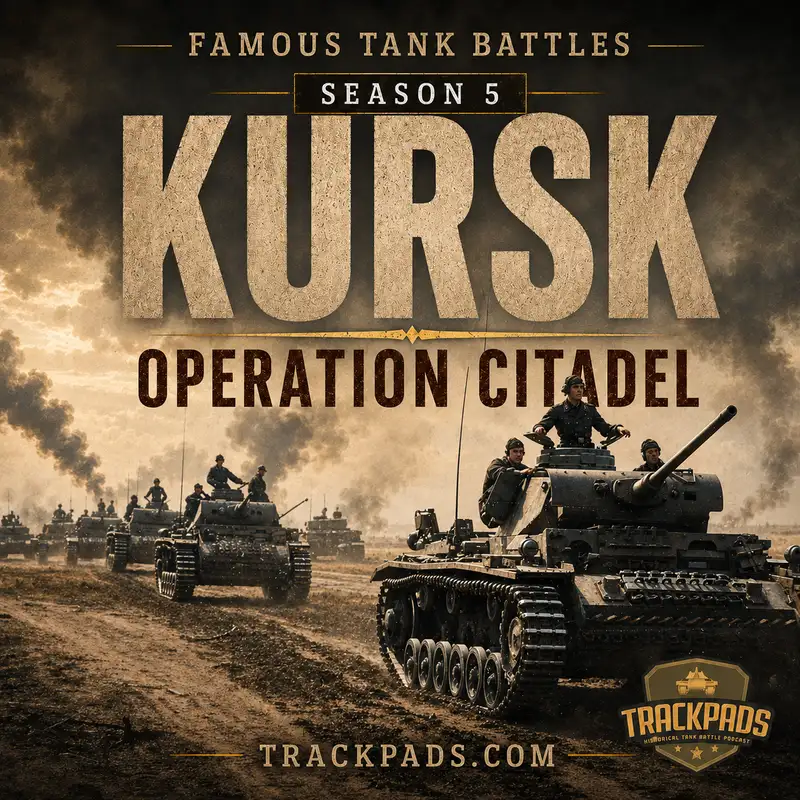
The Battle of Kursk did not begin with engines starting on a summer morning in 1943. It began in the frozen wreckage left by Stalingrad, where Germany lost not only an army, but much of the confidence that had carried its armored forces across Europe and deep into the Soviet Union. After Stalingrad, the Eastern Front was no longer the same war that German commanders had imagined in 1941. The Red Army had survived the worst Germany could bring, and now it was growing stronger in men, machines, and operational skill. Kursk matters in the history of armored warfare because it became the place where Germany tried one last great offensive solution in the east, and where the Soviet Union showed that tanks, guns, mines, reserves, and patience could be organized into something stronger than a dramatic breakthrough.
If you would like to move beyond the podcast, you can see my available books at Military Author dot me. And at Trackpads dot com, you will find magazines and galleries with hundreds of thousands of photos and videos to explore.
Stalingrad was a disaster on a scale that is difficult to reduce to a number. The German Sixth Army and allied Axis formations had been trapped, starved, bombarded, and finally destroyed in a campaign that consumed men, transport, aircraft, and precious time. For Germany, the loss was military, political, and psychological all at once. The myth of unstoppable German operational skill had been badly damaged, even if German units remained dangerous and often tactically effective. For the Soviet Union, Stalingrad was not the end of suffering, but it proved that the Wehrmacht could be surrounded and beaten. It also showed that the Red Army could conduct large, coordinated operations in which infantry, artillery, armor, engineers, and logistics worked together across immense distances.
Yet after Stalingrad, the German army in the east did not simply collapse. This is one of the reasons the road to Kursk is so important to understand. German commanders still had experienced panzer leaders, hardened crews, flexible staff systems, and a tradition of moving quickly when opportunities appeared. Even after terrible losses, German armored forces could concentrate strength at selected points and inflict severe punishment on Soviet units that advanced too far, too fast, or without enough coordination. The Soviet winter offensives after Stalingrad created real danger for Germany, but they also stretched Soviet supply lines and exposed forward formations. In that unstable moment, the Germans still believed that a well-timed armored counterstroke could restore order and perhaps recover the initiative.
The key figure in that recovery was Field Marshal Erich von Manstein, one of Germany’s most skilled operational commanders. In early 1943, on the southern part of the Eastern Front, Manstein used mobile forces to strike Soviet spearheads that had pushed westward after Stalingrad. This counteroffensive did not erase the disaster on the Volga, but it did temporarily stabilize the front and led to the German recapture of Kharkov in March. For German officers, this mattered enormously. It seemed to prove that, even after Stalingrad, the old principles of armored maneuver still worked when applied with discipline and timing. If the enemy overextended, German panzer formations could still cut, encircle, and destroy. The danger was that this success encouraged a larger conclusion than the situation could support.
The fighting around Kharkov also helped create the shape that would define the next campaign. As the front stabilized, a large Soviet-held bulge remained around the city of Kursk. This kind of bulge, or salient, is easy to understand without a map. Imagine a front line that should run roughly north and south, but instead bends westward into German-held territory like a fist pushing forward. To German planners, that shape looked vulnerable. If German armies could strike the base of the salient from north and south, they might meet behind it, trap the Soviet forces inside, and shorten the line. On paper, it was the kind of problem German operational thinking liked to solve: concentrate armor, attack both shoulders, close the pincers, and destroy the enemy pocket.
But the map did not show everything that mattered. It did not show the growing Soviet capacity to anticipate German plans, build defenses, move reserves, and absorb losses while keeping armies in the field. It did not show how much Germany had lost in trained infantry, reliable transport, fuel reserves, and operational freedom. It did not show how difficult it had become for German armored forces to achieve surprise against an enemy that had learned from earlier defeats. The tank battle that would come was therefore never just about tanks. It was about whether Germany could still create the conditions in which tanks did their best work: surprise, speed, coordination, and exploitation into open space. Without those conditions, even excellent armored troops could be forced into a slow fight on ground chosen by someone else.
The German desire to attack after Stalingrad was born from both calculation and desperation. Strategically, Germany could not afford to sit passively while Soviet strength increased month by month. The longer the war continued, the more the Red Army benefited from industrial production, manpower mobilization, improving command methods, and a deepening understanding of combined arms warfare. Politically, Adolf Hitler needed a victory to restore confidence after the shock of Stalingrad and to show allies and enemies alike that Germany could still shape events. Militarily, many German leaders believed that defense alone would surrender the initiative to the Soviets. A successful operation at Kursk seemed to offer a way to destroy a large Soviet force, regain momentum, and perhaps delay the shifting balance of the war.
The problem was that an offensive designed to restore speed slowly became an offensive trapped by delay. German planning for the attack that became Operation Citadel stretched through the spring of 1943. Some commanders wanted to attack sooner, before the Soviets could strengthen the salient. Hitler and others placed hope in new armored vehicles, including heavy tanks and new tank destroyers that promised greater firepower and protection. Waiting for these machines seemed reasonable to those who believed technology could compensate for worsening strategic conditions. But every week of delay also gave the Red Army time to turn the Kursk salient into a prepared killing ground. The Germans were waiting for sharper tools, while the Soviets were building the workshop in which those tools would be blunted.
This is where Kursk begins to reveal a major lesson in armored warfare. Tanks are most powerful when they operate as part of a system, not when they are treated as independent symbols of strength. A panzer division needed fuel, spare parts, recovery vehicles, bridging equipment, artillery support, engineers to clear mines, infantry to seize and hold ground, reconnaissance to find weak points, and radios to keep movement coordinated under fire. If any part of that system failed, momentum could slow or vanish. At Kursk, the Germans still possessed formidable armored formations, but the conditions for a clean operational breakthrough were deteriorating. The enemy was not surprised. The terrain was being prepared. The offensive timetable was known in broad outline. The attackers would have to fight their way into a defense designed to waste time.
The Soviet side had changed as well. Earlier in the war, German armored thrusts had often shattered Soviet formations before commanders could understand what was happening. By 1943, the Red Army was still uneven and still capable of costly mistakes, but it was no longer the same force that had been stunned in 1941. Soviet commanders had learned to think in depth, placing obstacles, anti-tank guns, infantry positions, artillery, and reserves in layers rather than relying on a single line. They were also learning how to let an enemy advance into prepared zones where movement became predictable and casualties accumulated. This did not make Soviet defense painless or simple. It meant that the Germans would be forced to spend their strength before reaching the kind of open ground where panzer warfare could become decisive.
After Stalingrad, then, both armies carried different lessons into the Kursk campaign. German leaders looked at the recent recapture of Kharkov and saw evidence that armored counterattack could still rescue the war in the east from disaster. Soviet leaders looked at Stalingrad and the following months and saw evidence that German offensives could be absorbed, channeled, and then answered with overwhelming force. Each side was partly right. German armored units remained dangerous, and Soviet armies could still suffer heavily when thrown into battle. But the larger trend favored the Soviet Union. The Red Army could replace losses more easily, build reserves more deeply, and prepare the battlefield with a patience that Germany increasingly lacked. Kursk would test not just courage or equipment, but whose interpretation of the previous six months was closer to reality.
The battle also belongs in the longer story of tanks because it marked a shift from the dream of sudden armored decision to the reality of modern mechanized attrition. At Cambrai in 1917, tanks had first appeared as a way to break the trench deadlock, but they were fragile, slow, and not yet part of a mature combined-arms system. In the early Second World War, German panzer warfare showed what could happen when tanks, radios, aircraft, infantry, and operational planning worked together against opponents who were surprised or poorly coordinated. Kursk showed the next stage. A defender who understood the armored threat could build depth, use intelligence, integrate anti-tank fire, and hold reserves until the attacker lost tempo. In that sense, Kursk was not a rejection of tank warfare. It was proof that tank warfare had become more demanding.
For Germany, the decision to attack the Kursk salient was therefore a gamble with shrinking margins. A quick victory might have shortened the front, destroyed Soviet forces, and restored some freedom of action. A slow battle, however, would favor the side with deeper reserves and greater industrial strength. This was the central danger hidden beneath the confidence of the plan. Operation Citadel required speed, but the Germans were preparing to attack one of the most heavily fortified sectors they had ever faced. It required surprise, but the Soviets expected it. It required enough strength to exploit success, but German resources were being consumed across a war that stretched from the Atlantic to the Mediterranean and deep into the Soviet Union. The plan was offensive in form, but defensive in spirit: an attack launched because the strategic situation was slipping away.
The aftermath of Stalingrad explains why Kursk became inevitable, or at least why it seemed inevitable to the men who chose it. Germany had lost the broad initiative, but it had not yet accepted that loss as permanent. The Soviet Union had gained confidence, but it still had to prove that it could defeat a major German armored offensive in prepared battle and then turn defense into sustained advance. Between those two realities lay the Kursk salient, a shape on the map that invited a classic pincer operation while concealing a battlefield of mines, guns, trenches, reserves, and waiting armies. That is why the story begins here, before the great armored clash, before Prokhorovka, before the myths and arguments that would follow. After Stalingrad, the war in the east stood at a hinge point, and Kursk would show which way that hinge was turning.