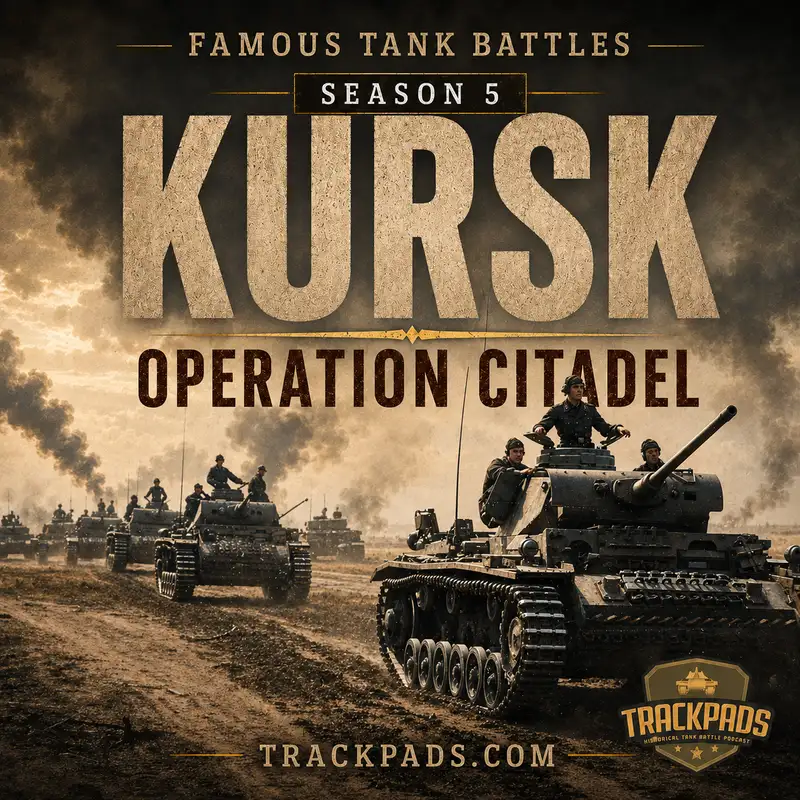
Kursk: Episode 11 — Ponyri
Ponyri was a small settlement north of Kursk, but in July 1943 it became one of the places where the German plan for Operation Citadel began to lose its future. It sat on the northern face of the salient, along a railway line and among fields, ridges, and village structures that suddenly mattered far beyond their size. For the Germans, the area was part of the route southward, one piece of the northern pincer meant to help close the trap around the Soviet armies inside the bulge. For the Soviets, Ponyri was a place to make that pincer bleed, slow, and stall. Its importance in armored warfare history lies in how a campaign built around mobile encirclement could be dragged down into a brutal local struggle over rubble, rails, trenches, and time.
If you would like to move beyond the podcast, you can see my available books at Military Author dot me. And at Trackpads dot com, you will find magazines and galleries with hundreds of thousands of photos and videos to explore.
The northern attack was already becoming a grinding fight before Ponyri took on its later reputation. General Walter Model’s Ninth Army had attacked from the Orel region, but it was not bursting into open country. It was pushing into the prepared defenses of Konstantin Rokossovsky’s Central Front, where mines, anti-tank guns, artillery zones, infantry strongpoints, and reserves were arranged in depth. Ponyri lay within that larger defensive web. It was not valuable because it was a great city or a strategic capital. It was valuable because it sat in the path of movement, and movement was what the German plan needed most. A local hold at Ponyri could help deny the Germans the speed required to make the northern arm of the pincer meaningful.
Without a map, the listener can picture Ponyri as a settlement where open approaches narrowed into a defended point. The railway line gave direction to the landscape, running roughly north and south through the area and linking the settlement to the wider operational route. Around it were fields, tracks, low rises, and village buildings that could be turned into firing positions. The station, embankments, houses, and nearby strongpoints became anchors in a battle that repeatedly folded large operational ambition into small tactical spaces. Tanks approaching such a place could not simply keep going if enemy infantry, guns, and mines controlled the approaches. The settlement became a knot in the road, and at Kursk, knots mattered because every delay weakened the German timetable.
The forces fighting around Ponyri were not just tank formations colliding in the open. German infantry, armor, artillery, engineers, and assault guns all had roles in trying to break the Soviet position and push the attack forward. Soviet rifle units, including formations of the Central Front’s defending armies, held trenches and strongpoints while artillery and anti-tank guns supported them from prepared positions. Tanks were used, but they were only part of a much more complicated struggle. Engineers mattered because obstacles had to be cleared or restored. Artillery mattered because it could isolate a strongpoint or smash an assembly area. Communications mattered because commanders had to understand whether a local gain had opened a real path or merely led into the next layer of resistance.
The first German pushes into the Ponyri area showed the pattern that would define the fight. Artillery and air attacks might batter Soviet positions, and German assault groups might seize ground, but the defense did not simply collapse behind the first trench. Soviet troops fell back, counterattacked, or continued firing from deeper positions. Minefields and covered approaches forced German armor to slow and bunch, while anti-tank guns and artillery punished the pauses. Even when German infantry entered parts of the settlement, holding them was another matter. The battle did not move like a clean arrow. It lurched forward, stopped, reversed, and started again, with each gain carrying the cost of clearing the next building, trench, or rail-side position.
Ponyri later gained the nickname of a small Stalingrad, and the comparison should be handled carefully. It was not Stalingrad in scale, strategic weight, or urban density, and turning every hard fight into another Stalingrad can blur more than it clarifies. Yet the phrase captures something about the character of the fighting. Ponyri became a place of close combat, rubble, repeated counterattacks, and positions changing hands under artillery fire. It was the opposite of the wide, clean armored maneuver imagined in headquarters. Buildings, station facilities, trenches, and broken ground absorbed men and machines. The Germans had come to Kursk seeking the conditions for mobile decision, but at Ponyri they found a kind of attrition that made movement painfully local.
For tank crews, Ponyri was a dangerous environment precisely because it narrowed the advantages of armored vehicles. A tank in open ground with good visibility, infantry support, and room to maneuver could dominate a battlefield sector. A tank in and around a defended settlement faced mines, close-range anti-tank weapons, hidden guns, debris, poor visibility, and the risk of becoming separated from supporting infantry. Armor could blast strongpoints and support assaults, but it could also be immobilized in a lane or forced to wait while engineers and infantry did work that steel alone could not do. This is one of Ponyri’s central lessons. Armored warfare is not simply about the power of a tank’s gun. It is about whether the whole force can keep moving together under resistance.
Soviet counterattacks around Ponyri were often costly, but they served a larger purpose than simply retaking a patch of ground. They disrupted German consolidation, forced the attackers to fight in multiple directions, and denied the Germans the breathing space needed to reorganize for a clean advance. Some counterattacks were conducted by infantry, others with tank support, and many unfolded amid confusion because the front line inside and around the settlement could shift quickly. A counterattack that failed to restore the entire position could still buy time or force German units to expend ammunition, fuel, and energy. At Kursk, time was a battlefield resource. Every hour spent fighting over Ponyri was an hour the northern pincer did not have.
The German problem was that local courage and tactical success were not enough. German units could destroy Soviet guns, overrun trenches, and take parts of the settlement, yet still fail to create the operational opening required by Citadel. The more the fighting concentrated around Ponyri, the less it resembled the sweeping encirclement the plan demanded. A pincer operation depends on the ability to turn local breakthroughs into forward movement and then into strategic effect. Ponyri helped prevent that conversion. It turned German offensive power into a series of exhausting local contests. The northern face of Kursk did not have to produce a dramatic German disaster in a single afternoon. It only had to keep denying Germany the pace its own plan required.
The human cost of Ponyri was severe, and no serious account should treat that cost as spectacle. Soldiers fought in places that had once been ordinary village space and railway infrastructure, now transformed into targets, shelters, obstacles, and graves. Wounded men could be difficult to reach under shellfire. Units lost cohesion in dust and smoke. Commanders ordered attacks and counterattacks with imperfect information, knowing that hesitation could lose ground and haste could waste lives. Casualty and loss figures for local actions at Kursk are often difficult to isolate precisely, but the pattern is clear enough. Ponyri consumed men and equipment because it forced both sides into repeated close engagements under heavy fire.
The battle for Ponyri also shows why the northern face deserves more attention than it often receives. It lacked the later fame of Prokhorovka, but it was central to the failure of Operation Citadel. By making the northern attack fight hard for limited ground, Soviet resistance around places like Ponyri helped prevent Model’s forces from becoming the moving arm of an encirclement. The German offensive could not succeed as a northern holding action paired with a southern gamble. Both arms had to matter. Ponyri was one of the points where the northern arm lost momentum, and in armored warfare, lost momentum can be more decisive than lost ground.
The significance of Ponyri lies in its compression of the whole Kursk story into one locality. German commanders sought a mobile decision, but Soviet preparation forced them into a battlefield where depth, artillery, infantry, mines, and reserves turned movement into attrition. Tanks fought there, but they did not define the fight alone. The settlement mattered because it slowed the German system, not because it produced a neat duel of machines. Ponyri teaches that an armored offensive can die in places that look small on a map but control the rhythm of a campaign. It was one of the places where the dream of a clean pincer dissolved into smoke, rubble, and repeated assaults, and where the northern face of Kursk began to harden into failure.