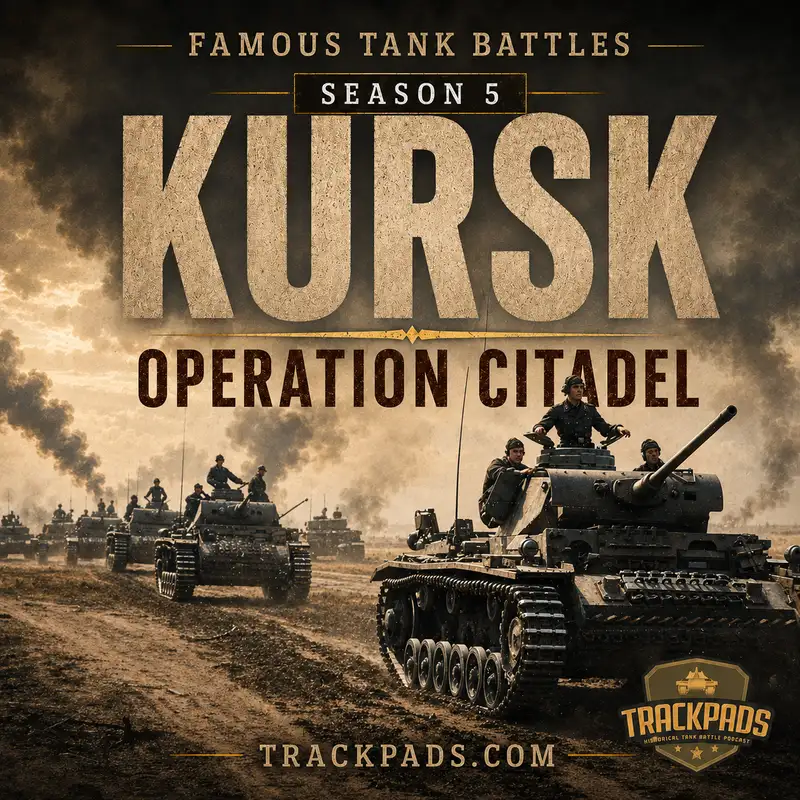
Kursk: Episode 13 — The Southern Face
The southern face of Kursk was where the German offensive came closest to becoming the kind of mobile battle its planners had wanted. North of Belgorod and Kharkov, German armored formations drove into the lower shoulder of the Soviet salient, aiming toward the roads and approaches that could eventually lead behind Kursk. This was the sector that made Soviet commanders most uneasy, because the Germans here had room to concentrate powerful panzer formations and because the terrain offered chances for deeper movement than in the north. Yet the southern battle was not a simple story of German tanks breaking loose across open steppe. It was a contest in which the Soviet defense bent hard, absorbed punishment, and forced every German gain to remain incomplete.
If you would like to move beyond the podcast, you can see my available books at Military Author dot me. And at Trackpads dot com, you will find magazines and galleries with hundreds of thousands of photos and videos to explore.
The German command in the south was under Field Marshal Erich von Manstein, whose reputation rested on operational skill, quick counterstrokes, and the ability to turn movement into decision. Under him, the main armored force included Hermann Hoth’s Fourth Panzer Army, with formations that had been rebuilt and strengthened for Operation Citadel. Army Detachment Kempf attacked on a related axis to the east, meant to protect the flank and help widen the German push. The southern plan depended on driving north through Soviet defenses, opening the way toward Oboyan and, if the situation allowed, toward the deeper rear of the salient. It was the more promising arm of the German pincer, but that promise carried danger. If it advanced without the northern arm matching its progress, success could become isolation inside Soviet depth.
Opposing the southern thrust was Nikolai Vatutin’s Voronezh Front, a major Soviet command responsible for defending the lower shoulder of the salient. Vatutin’s forces had spent weeks building defensive belts, placing mines, preparing artillery zones, and organizing reserves behind the forward troops. The Soviet high command understood that the southern face might be the more dangerous German attack, but it did not intend to meet that danger with a single brittle line. The aim was to make the Germans fight through one belt after another, while deeper Soviet forces watched for the moment when local German momentum could be contained. This was defense as a planned sequence, not defense as mere resistance. The southern face would prove how costly that sequence could be for both sides.
The land itself made the battle more mobile than the northern face, but not truly open. The region was a mixture of fields, low ridges, villages, streams, road junctions, and patches of ground that could be mined or covered by fire. A tank commander might see space ahead and still be forced toward a particular road, a particular bridge, or a particular gap between obstacles. Villages became anchors for defense because they controlled routes and gave infantry places to hold. Ridges mattered because they allowed observation and anti-tank fire. Streams and ravines mattered because heavy armored vehicles could not ignore them. The southern battlefield looked more favorable for maneuver, but the Soviets had worked to make maneuver predictable.
When the German attack opened on 5 July, the southern formations struck with force and skill. Artillery and airpower supported the advance, while engineers worked to clear minefields and infantry moved with the tanks to reduce strongpoints. German armored units could still execute combined-arms attacks with discipline, and in several areas they broke into the Soviet forward defenses. These gains were real and should not be minimized. Soviet troops suffered heavily, positions were overrun, and commanders had to respond quickly to local crises. But the question at Kursk was never whether the Germans could take ground. The question was whether they could take ground fast enough, deeply enough, and coherently enough to break the Soviet defensive system before it absorbed them.
The deeper the Germans pushed, the more the southern face revealed the difference between penetration and breakthrough. Penetration means entering the enemy’s defenses, damaging them, and driving beyond the first positions. Breakthrough means escaping the defensive system entirely, reaching the space where armored formations can move freely, disrupt the rear, and create operational collapse. At Kursk, the Germans achieved penetrations in the south, but they did not easily convert them into breakthrough. Each success led to another belt, another village fight, another minefield, another anti-tank zone, or another Soviet reserve formation. The attack moved forward, but it did not become free. That distinction is one of the most important lessons of the battle.
The Soviet defense bent hardest in this sector because the German blow was powerful and concentrated. In some places, forward Soviet units were badly battered, and the pressure forced commanders to commit local reserves to prevent collapse. The danger was not imaginary. A weaker, thinner, or less prepared defense might have cracked under the southern assault, allowing German armor to widen its penetration and threaten the coherence of the entire salient. Instead, the layered Soviet system turned the battle into a contest over tempo. German units advanced, stopped, reorganized, cleared obstacles, fought again, and then faced new resistance. The defense did not need to remain perfectly intact everywhere. It needed to prevent the Germans from moving faster than the Soviet command could react.
Tanks were central to the southern face, but they did not fight alone. German armor depended on infantry to clear trenches and villages, engineers to open lanes through mines, artillery to suppress anti-tank guns, aircraft to support movement, and supply columns to keep fuel and ammunition close enough to matter. Soviet armor also worked within a larger system, often appearing in counterattacks or as reserves behind the defensive belts rather than simply charging forward at the first alarm. Anti-tank guns, mines, artillery, infantry, and airpower shaped the battlefield before many tank clashes occurred. This is why the southern face cannot be reduced to a duel between German heavy armor and Soviet T-34s. It was a contest between armored systems under pressure.
German commanders faced a growing dilemma as the southern attack advanced. From one perspective, progress encouraged continued effort, because the south was clearly doing better than the north. From another perspective, every mile cost vehicles, fuel, infantry strength, and time, while the encirclement plan depended on both pincers working together. If the northern attack remained stalled, the southern thrust could not complete Citadel on its own. It could threaten Soviet defenses, force reserves into action, and create local crises, but it could not pinch off the salient without the other arm. This made the southern battle feel both promising and ominous. The Germans were moving, but the larger geometry of the operation was already beginning to fail.
Vatutin and the Soviet high command had their own difficult choices. Commit too few reserves, and the German attack might rupture the defensive system before a deeper response could form. Commit too many too early, and the Red Army might waste the forces needed for the later counterstroke. This tension was especially sharp in the south because the German advance created real danger. Soviet commanders had to read the battlefield through delayed reports, broken communications, dust, smoke, and the conflicting claims of units under stress. Holding reserves is easier in theory than under the pressure of a live armored offensive. The southern face shows that Soviet patience was not calm detachment. It was a risky discipline practiced while the front line was being hammered.
The southern fighting also shaped the road toward Prokhorovka, though that famous name should not swallow the earlier battle. Before the armored collision near Prokhorovka, there were days of movement, resistance, loss, and decision across the southern shoulder of the salient. German spearheads pushed through defensive belts and sought routes that might lead toward operational freedom. Soviet commanders shifted forces to block them, reinforce threatened areas, and prepare deeper counterblows. The battlefield became more fluid than in the north, but fluidity did not mean German control. It meant danger, uncertainty, and the possibility that one side’s timing might finally defeat the other’s. The southern face was the campaign’s most alarming stage because, for a time, the German offensive still seemed capable of forcing a major crisis.
In the history of armored warfare, the southern face of Kursk matters because it shows both the power and the limits of a concentrated armored attack against prepared depth. The Germans demonstrated that they could still break into strong defenses, coordinate armor with supporting arms, and create severe danger for a capable opponent. The Soviets demonstrated that a defense could bend without breaking if it had depth, reserves, mines, artillery, and commanders willing to trade space and losses for time. This was not the static trench warfare of an earlier age, and it was not the clean armored maneuver of early blitzkrieg legend. It was modern mechanized battle in its harsher form: mobile enough to terrify, dense enough to slow, and costly enough to decide whether an army still possessed the strength to impose its will.
The southern face did not end the battle by itself, but it carried the campaign toward its decisive crisis. Here the Germans came closest to proving that Operation Citadel still had life, and here the Soviets faced the hardest test of their decision to wait. The defense bent under the weight of German armor, but bending was not failure if the system behind it continued to function. Every German advance had to be measured against the time lost, the vehicles damaged, the infantry worn down, and the reserves still waiting farther east and north. That is why the southern face feels different from the northern one. It was more mobile, more dangerous, and more suspenseful, but it still unfolded inside a battlefield the Soviets had built to deny the one thing Germany needed most: a quick, decisive breakthrough.