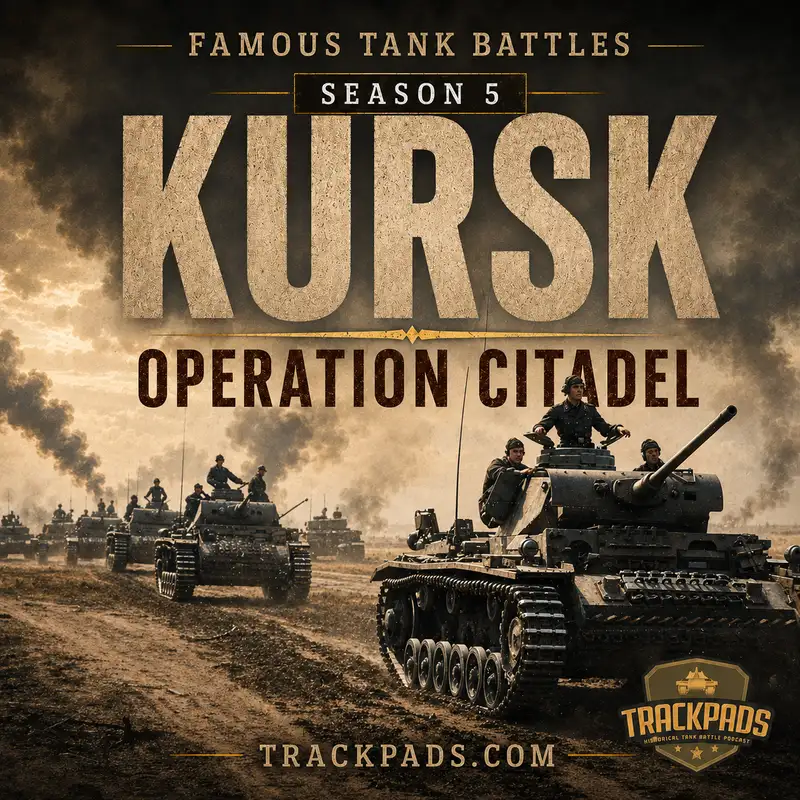
Kursk: Episode 14 — Through the Belts
The phrase through the belts describes the essential experience of the German attack on the southern face of Kursk. The Germans were not trying merely to seize a trench or capture a village. They were trying to pass through an entire defensive system, one layer after another, until their armored formations reached the open space where maneuver could become decisive. The Soviets had designed those belts to prevent exactly that. Mines, anti-tank guns, trenches, strongpoints, artillery zones, and reserves were arranged so that any German success would lead into another problem rather than into freedom. This episode matters in the history of armored warfare because it explains why breaking into a defense is not the same thing as breaking through it.
If you would like to move beyond the podcast, you can see my available books at Military Author dot me. And at Trackpads dot com, you will find magazines and galleries with hundreds of thousands of photos and videos to explore.
A defensive belt is best understood as a connected zone, not a single line. It includes trenches where infantry can hold, minefields that slow vehicles, anti-tank guns positioned to cover likely approaches, artillery registered on roads and open ground, and reserve forces waiting behind the front. At Kursk, the Soviet belts were arranged in depth, so that the attacker could not win the battle by cracking the first crust of resistance. The Germans might overrun a forward position and still face another prepared zone beyond it. They might clear a minefield and still enter a fire pocket. They might capture a village and still find the next road blocked. The point of the belts was to make German progress real but insufficient.
On the southern face, German armored formations entered these belts with considerable skill. They used artillery preparation, air support, engineers, tanks, assault guns, and infantry to open gaps and widen them. Their crews and commanders were not helpless victims of Soviet defenses; they were experienced professionals trying to solve a difficult military problem under fire. In some sectors, they did solve it locally. Soviet forward positions were crushed, guns were destroyed, and German units advanced several miles into the defensive system. But local solutions did not automatically create campaign success. Every solved problem exposed the next unsolved one. The deeper the Germans advanced, the more the battle became a race between their ability to maintain momentum and the Soviet ability to impose another delay.
Mines were the first and most persistent expression of the belts. The southern attack repeatedly encountered mined approaches that forced engineers to work ahead of the armored formations. A mine did not need to kill a crew to have operational effect. It could break a track, block a lane, halt following vehicles, and force the entire column to wait while artillery found the congestion. The psychological effect mattered too. Crews moving through mined ground could not treat the landscape as neutral. Every patch of earth might be safe, or it might disable the vehicle and leave it exposed. This uncertainty slowed decisions, and in an armored offensive, hesitation can spread backward from the lead tank to the whole formation.
Engineers became the men who turned possibility into movement. They had to clear mines, mark lanes, deal with obstacles, and keep routes open under fire. Their work was dangerous because the Soviets had planned to cover obstacles with guns and artillery. If engineers worked too slowly, the armored thrust lost tempo. If they worked too far forward without protection, they could be cut down before opening the path. If a marked lane became blocked by a damaged vehicle, the entire flow of the attack could be disrupted. Kursk reminds us that mechanized warfare depends on people doing exposed, practical tasks in the worst possible conditions. The tank may be the symbol, but often the engineer decides whether the tank moves at all.
Anti-tank zones formed the next layer of resistance. Soviet gunners positioned their weapons where German vehicles were likely to appear after clearing obstacles or moving through gaps. This meant that the belts worked together. Mines slowed the tanks, artillery disrupted the support, infantry held the strongpoints, and anti-tank guns waited for the moments when vehicles exposed themselves. German heavy armor could be difficult to kill from the front, and Soviet gunners often faced terrible danger when firing at such targets. But the system did not require every gun to win a perfect duel. It required many weapons to produce cumulative damage, confusion, and delay. A disabled tank, a forced turn, or a halted column could matter as much as a destroyed vehicle.
Infantry fighting made passage through the belts especially costly. German infantry had to advance with or behind the armor to clear trenches, bunkers, villages, and anti-tank positions. If infantry fell behind, tanks became vulnerable to close assault or flank fire from positions that had not been cleared. Soviet infantry, meanwhile, had to hold long enough for the defensive system to work. They fought from trenches, village edges, and fieldworks under artillery, aircraft, and armored attack. Their role was not simply to stand and die; it was to anchor the belts so that the mines and guns had protection and meaning. Without infantry, the belts would be obstacles. With infantry, they became fighting systems.
Artillery gave the belts depth beyond what the eye could see. Soviet guns could strike German assembly areas before an assault, shell lanes through minefields once they were opened, and fire on villages or ridges as German units attempted to consolidate. German artillery was also essential, suppressing Soviet positions and helping attackers move from one objective to the next. The duel between artillery systems was therefore not background noise. It shaped what tanks and infantry could do. When German fire suppressed a Soviet gun line, the attack might surge forward. When Soviet fire fell on engineers, roads, or exposed infantry, the attack might stall. Through the belts, movement depended on whether fire could be coordinated at the right moment and in the right place.
The belts also tested communications. Commanders needed to know which lanes were open, which units had advanced, which positions still held, where Soviet reserves were appearing, and whether neighboring formations were keeping pace. Under battle conditions, this information was never clean. Dust reduced visibility, artillery cut wires, radios became overloaded or failed, and reports from forward units often described only fragments of the fight. A German commander might believe a gap had opened, only to discover that the route beyond it was mined or covered by fire. A Soviet commander might hear that a sector had collapsed, only to learn that a deeper belt was still holding. Armored warfare at Kursk was a fight against confusion as much as against enemy vehicles.
The German experience through the belts was therefore one of partial success. This is crucial to understanding the southern battle. The Germans were not stopped instantly at the first line, and any account that suggests they simply crashed against an unbreakable wall misses the danger of the campaign. They advanced, broke positions, inflicted heavy losses, and forced the Soviets to respond with urgency. Yet they kept encountering fresh resistance before the previous success could widen into freedom. The Soviet defense accepted that forward troops might be lost or driven back. Its purpose was to make every German gain expensive enough that the offensive would lose the ability to exploit its own achievements.
For Soviet commanders, the belts bought time to judge when and where to commit reserves. A defense without reserves is brittle, because once the front breaks there is nothing left to restore the situation. At Kursk, deeper formations could move toward threatened sectors, counterattack, or prepare for a larger response. This did not make Soviet decisions easy. Reserves committed too early could be worn down before the decisive moment. Reserves held too long might arrive after a sector had been ruptured beyond repair. The belts made that judgment possible by slowing the German advance and forcing it to reveal its direction. They turned space into information, and information into time.
The German plan required the southern thrust to become more than a hard advance. It had to become operational freedom, the kind of movement that would unhinge the Soviet defense and help close the pincer around the salient. The belts prevented that transformation by keeping German units in constant contact with organized resistance. Even when the attackers moved forward, they remained tied to cleared lanes, exposed supply routes, engineer support, and infantry battles over strongpoints. A spearhead can be sharp and still fail if it cannot pull the rest of the force through behind it. Through the belts, the German attack remained powerful but increasingly burdened. Its success was measured not only in ground taken, but in momentum spent.
The lesson of the southern belts reaches beyond Kursk. Modern armored warfare depends on the relationship between breakthrough and exploitation. A tank force can break a position, but unless it can exploit beyond the defensive system, the battle may become attrition instead of decision. The Soviets understood this and built their defense accordingly. They did not need every belt to hold forever. They needed the sequence of belts to slow, damage, disorganize, and reveal the attacker before the Red Army’s deeper strength was committed. In that sense, the southern battle was not a failure of German tactical ability. It was the success of Soviet operational design. The Germans broke into the defense, but the defense had been built so that breaking in was only the beginning of the problem.
Through the belts, Kursk became a schoolhouse in the limits of armored force. German tanks, assault guns, engineers, infantry, artillery, and aircraft achieved real battlefield results, but the Soviet system denied them the clean passage from tactical gain to decisive breakthrough. The belts turned movement into labor, confidence into uncertainty, and every advance into a question of what waited behind the next ridge or village. This is why the episode belongs in a series on armored warfare. It shows that tanks are most dangerous when they enter space the enemy can no longer organize, and least decisive when they are forced to fight inside a defensive machine built to consume them. At Kursk, the Germans went through the belts, but they did not get through them in the way that Operation Citadel required.