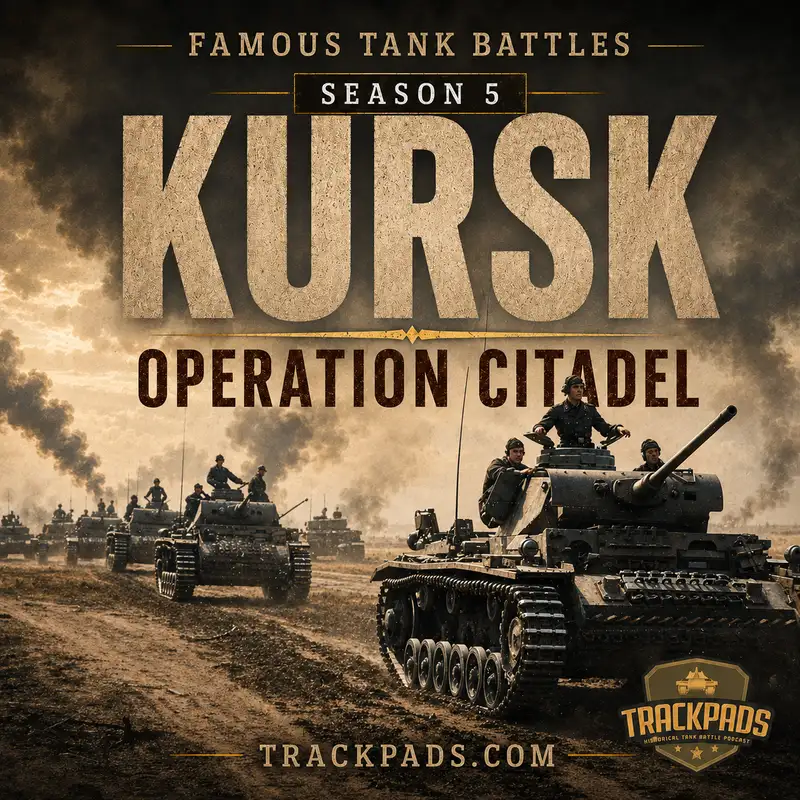
Kursk: Episode 16 — Eyes Over the Steppe
Kursk is remembered as a tank battle, but no army on that battlefield fought only at ground level. Above the steppe, the sky was crowded with reconnaissance aircraft, fighters, bombers, ground-attack planes, smoke, dust, and the urgent need to see before being seen. Airpower mattered at Kursk because armored warfare depends on information as much as armor plate. Commanders had to know where enemy reserves were moving, where artillery was firing, where roads were jammed, where tanks were concentrating, and where a breakthrough might be forming. The battle above the front did not replace the struggle of tanks, infantry, engineers, and guns. It shaped what those forces could see, hit, and survive.
If you would like to move beyond the podcast, you can see my available books at Military Author dot me. And at Trackpads dot com, you will find magazines and galleries with hundreds of thousands of photos and videos to explore.
The German army entered Kursk with long experience in using airpower to support mobile operations. Earlier in the war, the Luftwaffe had helped panzer formations by striking enemy positions, disrupting movement, and providing reconnaissance that allowed commanders to exploit confusion. In 1943, that tradition still mattered. German aircraft could attack Soviet strongpoints, support advances, and hit artillery or reserve concentrations when they were found. Ground-attack aircraft could be especially important when an armored thrust ran into anti-tank defenses or when Soviet troops began moving toward a threatened sector. But the Luftwaffe no longer operated in the same environment it had enjoyed in 1941. The Soviet air forces were stronger, better organized, and better able to contest the sky.
The Red Air Force had suffered terribly in the opening phase of the German invasion, but by Kursk it had recovered in numbers and improved in method. Soviet pilots, ground crews, and commanders had learned through hard experience how to support large land operations more effectively. They still faced problems, including uneven training, command rigidity, and the challenge of coordinating with ground forces under fast-changing conditions. Even so, the Soviet air presence at Kursk was substantial and consequential. Fighters defended important sectors. Attack aircraft struck German troops and vehicles. Reconnaissance aircraft searched for concentrations and movement behind the front. The air war over Kursk was not a sideshow. It was part of the same combined-arms contest that shaped the ground battle.
Reconnaissance was one of the most important air missions because Kursk was too large for any commander to see directly. A general might receive reports from corps and divisions, but those reports were often late, incomplete, or distorted by battle. Aircraft could help reveal where roads were crowded, where tanks were massing, where reserves were moving, and where artillery positions might be located. This did not mean aerial observation was perfect. Dust, smoke, camouflage, cloud cover, anti-aircraft fire, and the speed of events could all limit what pilots saw and what they could report in time. Still, even imperfect information could matter. In armored warfare, knowing that a reserve column is moving toward a flank can change where commanders send aircraft, artillery, or tanks.
The steppe itself made air observation both useful and difficult. Open areas could reveal vehicle movement, especially when dust columns marked traffic on dry roads. A moving armored unit could leave signs visible from above, not just through the vehicles themselves but through the disturbance they created. Yet the same dust could obscure targets, confuse pilots, and make it hard to distinguish friend from enemy near the front. Villages, woods, smoke, and camouflage added to the difficulty. The battlefield was not a clean diagram beneath the aircraft. It was a shifting, dirty, dangerous landscape where pilots had seconds to identify targets while avoiding fighters and ground fire. Seeing from above did not mean seeing clearly.
Close air support had a direct effect on the armored fight. Aircraft could attack anti-tank guns, infantry strongpoints, supply columns, artillery positions, and tanks caught in the open. For German armored formations trying to push through Soviet defensive belts, air support could help suppress resistance at critical points. For Soviet defenders, air attacks could strike German units forming for assault or moving through congested lanes opened in minefields. But close support required coordination, and coordination was never simple. Pilots needed accurate target information, ground commanders needed aircraft at the right time, and both sides had to avoid hitting their own troops in a fluid battle. The closer aircraft worked to the front line, the more valuable and dangerous their support became.
Interdiction was the less dramatic but deeply important air mission of attacking movement behind the front. An armored offensive consumes fuel, ammunition, spare parts, food, and replacement crews. If aircraft can strike columns, bridges, railheads, road junctions, or supply areas, they can weaken the attacker before the next engagement begins. At Kursk, both sides understood that the battle was not only where tanks were firing. It was also on the roads behind them, where fuel trucks moved, ammunition was unloaded, and repair teams tried to return damaged vehicles to service. Air attack could create delay even without destroying large numbers of tanks. A scattered convoy, a blocked road, or a disrupted fuel delivery could slow a spearhead already fighting against time.
Anti-aircraft defenses gave the ground battle another layer. Tanks, artillery, headquarters, supply areas, and bridges all needed protection from the air. German and Soviet formations used anti-aircraft guns not only to defend against aircraft, but sometimes also in ground roles when circumstances demanded. The presence of anti-aircraft fire shaped how pilots approached targets, how low they could fly, and how long they could remain over the battlefield. A pilot attacking a column or gun position had to think not only about enemy fighters, but about tracer fire rising from the ground. The sky over Kursk was not open space. It was contested terrain, as real in its own way as the minefields and ridges below.
The air battle also affected morale. Soldiers under air attack often felt exposed and helpless, especially when caught on roads, in assembly areas, or in vehicles unable to disperse quickly. The sound of aircraft could signal danger before any bomb or cannon shell arrived. At the same time, friendly aircraft overhead could reassure troops that they were not alone and that enemy positions might be struck before the next assault. Morale should not be treated sentimentally, but it matters in battle. A unit that feels abandoned may hesitate. A unit that sees enemy aircraft operating freely may lose confidence in movement by day. Kursk’s air war shaped not only physical destruction, but the mental conditions in which ground troops advanced, held, or waited.
The contest for air superiority at Kursk did not produce a simple story of one side completely owning the sky. The balance varied by sector, time, mission, and local concentration. The Luftwaffe could still be highly effective, especially when supporting German attacks at critical points. The Soviet air forces could mass numbers, defend important areas, and increasingly interfere with German operations. What mattered most was that neither side could ignore the other. Airpower had to be planned into the ground battle, and ground movement had to account for air threat. The result was a battlefield where armored commanders looked upward as well as forward, because a column seen from above could quickly become a column under attack.
Airpower also linked the northern and southern faces of the battle to the wider campaign. Aircraft could be shifted to support threatened sectors, strike at reserves, or answer crises as they developed. But aircraft were not unlimited, and every commitment involved choices. Supporting one attack might leave another sector less protected. Striking front-line defenses might mean fewer aircraft available to attack roads and reserves deeper behind the front. Commanders had to decide whether the immediate need was suppression, reconnaissance, interdiction, or air defense. These choices reveal why Kursk was a modern battle in the fullest sense. The question was not whether tanks or aircraft mattered more. The question was how to coordinate all arms under pressure when every part of the battlefield demanded attention.
The experience of Kursk also shows the limits of airpower. Aircraft could see, strike, and disrupt, but they could not by themselves occupy a trench, clear a minefield, repair a bridge, or hold a village after the tanks passed. Air attacks could slow reserves, but they could not guarantee that the ground offensive would exploit the delay. Reconnaissance could identify movement, but the information had to reach commanders in time and be acted on correctly. This is why the air war should not be separated from the ground battle. It magnified success when combined with effective movement and fire. It lost some of its effect when coordination failed or when the ground situation remained too dense and confused for air strikes to decide the issue.
In the long development of armored warfare, Kursk made clear that mechanized battle had become three-dimensional. Tanks had first appeared as machines to cross fire-swept ground, but by 1943 they operated in an environment shaped constantly by aircraft. To move armor without air awareness was to risk being seen, struck, and delayed. To use aircraft without understanding the ground fight was to waste sorties against targets that did not matter at the decisive moment. Later armored operations, from the late Second World War through the age of jet aircraft and precision weapons, would only deepen this connection between air and ground. Kursk was not the final form of that relationship, but it showed that the tank battle could no longer be understood from the ground alone.
The eyes over the steppe mattered because they influenced tempo, and tempo was the heart of Kursk. The Germans needed speed through the Soviet belts. The Soviets needed warning, delay, and the ability to shift reserves before German movement became decisive. Aircraft helped both sides search for that advantage. They watched roads, attacked columns, supported assaults, defended sectors, and added another layer of danger to an already crowded battlefield. Kursk remains famous for armored vehicles grinding through mines and anti-tank fire, but above those vehicles was another contest over sight and timing. Whoever saw first might strike first. Whoever struck at the right moment might delay the enemy long enough to change the campaign. In a battle where minutes and miles mattered, the sky was not background. It was part of the battlefield itself.