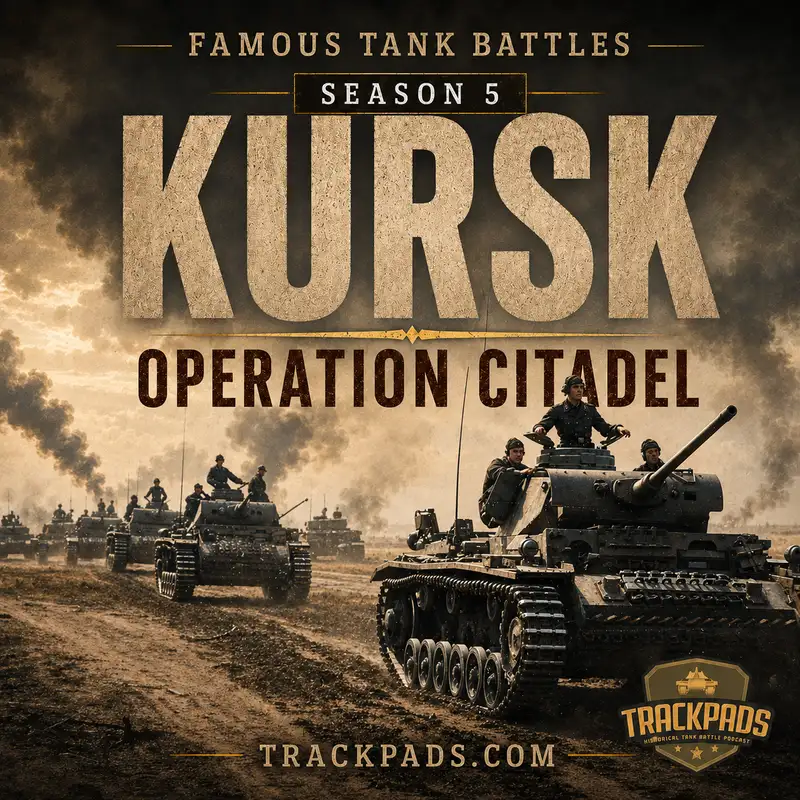
Kursk: Episode 18 — Prokhorovka Eve
On the eve of Prokhorovka, the southern battle at Kursk had become a race between German momentum and Soviet commitment. German armored formations had forced their way through layers of defense, not cleanly and not cheaply, but deeply enough to create one of the most dangerous moments of Operation Citadel. The Soviet command now moved powerful reserves into the path of that advance, hoping to stop the spearhead before it could open the way to greater operational freedom. Prokhorovka matters in armored warfare history because it became the place where days of preparation, delay, penetration, and reserve movement converged. It was not an isolated tank duel waiting to happen. It was the crisis point of a campaign already in motion.
If you would like to move beyond the podcast, you can see my available books at Military Author dot me. And at Trackpads dot com, you will find magazines and galleries with hundreds of thousands of photos and videos to explore.
The geography around Prokhorovka shaped what was coming. The area lay east of the main German push toward Oboyan, near rail lines, fields, low ground, villages, and the Psel River sector to the north. Without a map, the listener should picture a battlefield that was not an endless open plain, but a constricted space shaped by ridges, embankments, ravines, roads, and prepared positions. Movement was possible, but not effortless. Visibility could be limited by terrain, smoke, and dust. Routes mattered because large armored formations needed room to deploy, turn, refuel, and coordinate. The ground around Prokhorovka would not simply host the battle. It would shape how the battle unfolded and how quickly plans began to break apart.
The German force moving toward this area included the II SS Panzer Corps, a powerful Waffen-SS armored formation composed of divisions that had been heavily engaged during the southern advance. Its formations, including Leibstandarte, Das Reich, and Totenkopf, had fought through Soviet defenses and remained dangerous despite losses and fatigue. These units had tanks, assault guns, infantry, artillery, engineers, and close air support available at different moments, but they were not fresh machines rolling into a parade ground. They had spent days fighting through minefields, anti-tank zones, villages, and Soviet counterattacks. Their vehicles needed maintenance, their infantry had been worn down, and their supply lines had to keep pace through damaged and congested routes.
On the Soviet side, the most famous formation moving into the area was Rotmistrov’s 5th Guards Tank Army, part of the deeper reserve system that had been held back for a decisive moment. It was not alone. Soviet rifle armies, artillery, anti-tank units, engineers, and air forces were also part of the response, because stopping the German spearhead required more than sending tanks forward. The 5th Guards Army, under Aleksei Zhadov, also moved into the developing crisis, adding infantry strength to the defensive and counterattacking effort. The Soviet plan was to bring enough force to halt the German advance and seize back the initiative in this sector. That meant coordination under pressure, and coordination was exactly what the coming battle would strain.
The decision to counterattack near Prokhorovka was driven by urgency. The German southern thrust had not achieved a decisive breakthrough, but it had advanced far enough to alarm the Soviet command. If the Germans were allowed to continue, they might widen their penetration, threaten important routes, and force Soviet reserves into an even worse position. The Soviet answer was to strike before the German advance could fully consolidate. This was not simply a desire for a dramatic armored clash. It was an operational decision shaped by fear of what might happen if the Germans were given more time. The Red Army had chosen to absorb the German blow, but now the moment had arrived when absorption had to become action.
Moving the Soviet reserves into place was difficult and dangerous. Tank formations had to travel toward the front over crowded routes while fuel, ammunition, maintenance teams, and headquarters tried to keep pace. Units arriving after long movement could be tired before they even entered combat. Vehicles could break down, commanders could lose track of neighboring units, and last-minute orders could change routes or objectives. Darkness helped conceal movement, but it also complicated control. Dust and traffic added to the strain. A tank army gathering for a counterattack is not just an armored fist. It is a complicated organism trying to arrive, assemble, understand the ground, and strike before the opportunity disappears.
The terrain around Prokhorovka made deployment especially important. Large tank formations need space to spread out, build momentum, and maintain contact with supporting arms. If they are forced into narrow approaches, broken ground, or areas where visibility is poor, their numbers may not translate into clean combat power. The railway embankment, river sector, ravines, and local defensive features helped create a battlefield more cramped and confusing than the later legend often suggests. This mattered because Soviet tank forces preparing to attack needed to close with German armor under conditions that reduced long-range German fire advantages, but those same conditions could also disrupt Soviet formations. Prokhorovka would become famous for mass, yet much of its violence would be shaped by restriction.
The Germans also faced uncertainty on the eve of the clash. Their southern advance had achieved more than the northern attack, but the larger operation was still in trouble. The northern pincer had failed to make corresponding progress, which meant that the southern spearhead could not complete the encirclement by itself. German commanders had to decide whether continued pressure could still produce useful results or whether they were pushing deeper into a Soviet response that was growing stronger by the hour. The II SS Panzer Corps remained capable of inflicting severe losses, but it was operating inside a campaign whose original purpose was becoming harder to fulfill. On the eve of Prokhorovka, German tactical danger and operational uncertainty existed side by side.
The Soviet command faced a different kind of uncertainty. It had reserves moving, but the exact shape of the German position was not perfectly known. Commanders had to interpret reconnaissance, frontline reports, and the shifting location of German units. They had to coordinate artillery, tanks, infantry, and air support while the situation was changing quickly. The pressure to act was intense, because delay might allow the Germans to improve their positions or continue their advance. But action without perfect knowledge could be costly, especially against German formations that remained tactically skilled and well armed. This tension is central to Prokhorovka. The coming battle would be born not from calm certainty, but from urgent decisions made under incomplete information.
Airpower and artillery added to the gathering storm. Both sides understood that the next day’s fighting would depend partly on what could be seen, suppressed, and struck before armored forces collided. Aircraft could attack columns, support advancing troops, and search for reserves or concentrations. Artillery could prepare attacks, disrupt assembly areas, or break up movement along known routes. But as always at Kursk, firepower had to be tied to timing. A bombardment delivered too early might warn the enemy without decisive effect. Air support arriving too late might find the battlefield already confused. The eve of Prokhorovka was therefore not only the movement of tanks toward tanks. It was the positioning of entire systems for a violent test of coordination.
The later myth of Prokhorovka can make the eve seem like the pause before a simple, apocalyptic tank collision. The reality was sharper and more complicated. The Germans were not entering the area with unlimited strength, and the Soviets were not merely preparing a heroic charge across empty ground. Both sides were tired, pressured, and trying to solve operational problems that had developed over the previous week. Prokhorovka would become famous because of the scale and intensity of the fighting, but its meaning cannot be understood if it is separated from the days before it. The battle was not created in one morning. It was assembled through delay, movement, misjudgment, courage, exhaustion, and the narrowing of choices.
By nightfall on 11 July, two moving storms were converging on the same patch of ground. From the west and southwest came German armored formations that had fought their way through the Soviet belts and still hoped to make the southern advance matter. From the east and rear came Soviet reserves that had been held back for the moment when defense would turn into counterattack. Between them lay terrain that would compress movement, confuse observation, and punish imperfect coordination. This was the edge of the Kursk crisis. The next day would be fast, violent, and difficult to describe neatly because real armored combat rarely respects the clean lines of a plan. On Prokhorovka eve, the essential question was no longer whether the Germans could enter the Soviet defense. They had already done that. The question was whether the Soviet reserves could stop them before penetration became freedom.