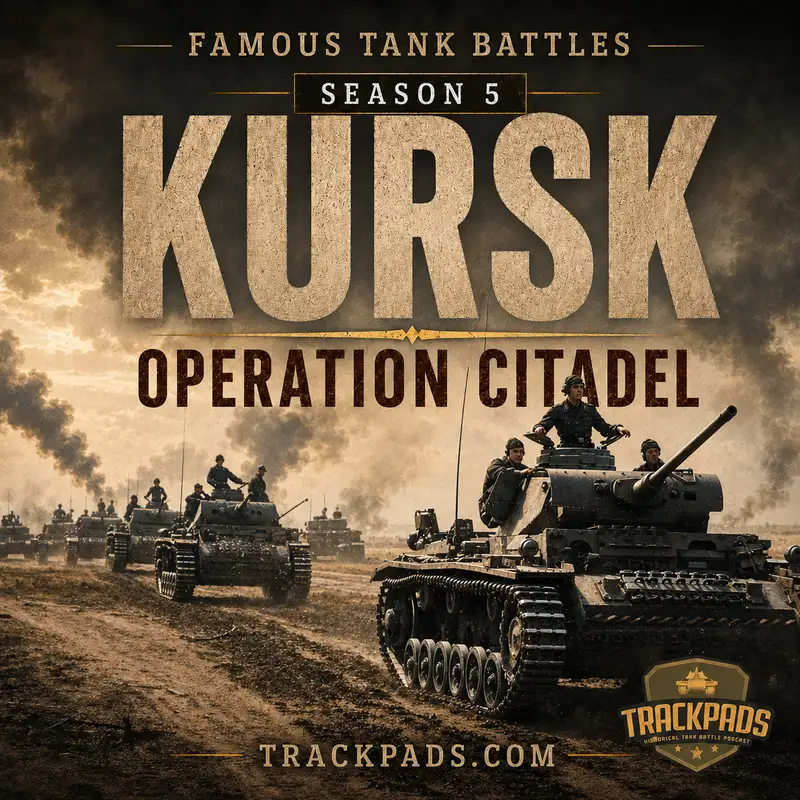
Kursk: Episode 19 — 12 July
The morning of 12 July 1943 became the most famous day of the Battle of Kursk, and with good reason. Near Prokhorovka, on the southern face of the salient, Soviet reserves struck the German armored spearhead that had been grinding northward for a week. The day has often been remembered as a single enormous tank collision, a battlefield of engines, guns, dust, and close-range violence. That image captures some of the terror, but not the full reality. Prokhorovka mattered because careful operational plans on both sides dissolved into a fast, confusing struggle in which tanks, infantry, artillery, aircraft, terrain, communications, and timing all fought for control of a narrowing battlefield.
If you would like to move beyond the podcast, you can see my available books at Military Author dot me. And at Trackpads dot com, you will find magazines and galleries with hundreds of thousands of photos and videos to explore.
The setting had been shaped by the previous week of fighting. German formations had pushed through Soviet defensive belts from the south, paying heavily but still advancing far enough to alarm the Soviet command. They had not broken free into open operational space, but they had created a dangerous penetration that threatened to make the Soviet defensive system bend too far. Prokhorovka lay near rail lines, villages, ridges, ravines, and the Psel River sector, ground that constrained movement more than the legend sometimes suggests. This was not an empty plain built for a clean armored duel. It was a crowded, broken, and pressured battlefield where large forces had to deploy under fire and where small terrain features could decide who moved and who stopped.
The Soviet counterattack centered on Pavel Rotmistrov’s 5th Guards Tank Army, a powerful armored reserve that had been held back for a moment like this. It was intended to strike the German spearhead before it could consolidate, widen its gains, or continue toward deeper objectives. Soviet infantry, including formations of the 5th Guards Army, also played a vital role because tanks alone could not hold ground or clear every obstacle. The plan required speed and violence. Soviet armor would close the distance quickly, reducing the advantage of German long-range fire, and crash into the German forward positions before the enemy could fully prepare. In theory, it was a way to turn defense into attack and seize back the tempo of the southern battle.
The German force facing this blow was not a fresh parade of invincible machines. The II SS Panzer Corps had fought for days through mines, villages, anti-tank zones, and counterattacks. Its divisions, including Leibstandarte, Das Reich, and Totenkopf, remained dangerous, experienced, and tactically skilled, but they were worn by combat and dependent on strained supply and recovery systems. German armor included heavy and medium tanks, assault guns, and supporting infantry, with artillery and aircraft available at key moments. These formations were trying to continue a difficult advance while also protecting their flanks and maintaining contact with the rest of the southern offensive. They were formidable, but they were operating inside a campaign that was already losing time.
When the Soviet attack began, the battlefield did not behave like a drill ground. Artillery fire, air attacks, smoke, dust, and confused reports shaped the first hours. Soviet tank formations moved forward with urgency, but movement under combat conditions was never smooth. Units could lose alignment, bunch near obstacles, or become separated from supporting infantry and artillery. German defenders were not simply waiting helplessly; many were in positions where they could fire on advancing Soviet tanks, while their own infantry and guns tried to hold key ground. The careful Soviet desire for a powerful, coordinated counterstroke quickly met the reality of restricted terrain, imperfect reconnaissance, and an enemy still capable of lethal defensive fire.
The railway embankment, ravines, local slopes, and obstacles near the battlefield mattered intensely. They limited visibility, channeled movement, and created sudden close encounters. In some places, Soviet tanks did close rapidly and fighting became chaotic at short range. In other places, German fire struck Soviet armor before it could bring its numbers fully to bear. This is why Prokhorovka is so difficult to describe honestly in one sweeping image. It was neither a perfectly ordered German defensive victory nor a simple Soviet armored avalanche. It was a series of overlapping fights in which formations entered battle unevenly, commanders struggled to understand what was happening, and individual crews found themselves inside a storm of fire, dust, and noise.
The Soviet intent to close the range made sense in plain battlefield terms. German tanks and anti-tank weapons could be deadly at longer distances, especially when they had good positions and clear fields of fire. Soviet tank crews often needed to get close enough to reduce that advantage and create opportunities against flanks or vulnerable angles. But closing the range came at a terrible cost when the approach was watched, obstructed, or covered by guns. Tanks moving fast can still be hit, and tanks moving fast in restricted ground can lose formation. The result was intense violence without clean control. The Soviet counterattack showed courage and urgency, but it also exposed how difficult it was to use mass armor effectively in compressed terrain against prepared German positions.
Infantry and artillery shaped the day as much as tanks did. Soviet infantry helped hold ground, support the armored attack, and resist German efforts to keep the advance alive. German infantry protected tanks and guns from close assault, defended local positions, and fought for villages and ridges that controlled movement. Artillery from both sides struck assembly areas, likely routes, defensive positions, and concentrations of vehicles. Aircraft added another layer of danger, attacking ground targets and trying to influence moments that were already changing by the minute. Prokhorovka was famous for tanks because the armored clash was dramatic, but the day cannot be understood unless the listener hears the whole combined-arms battlefield working at once.
North of the main collision, the fighting near the Psel River also mattered. German forces there sought positions that could threaten the Soviet flank and widen the danger facing Prokhorovka. Soviet commanders understood that the crisis was not limited to one field or one road. A penetration on the flank could change the meaning of the central counterattack, and a local German gain could create new pressure on reserves that were already committed. This made the day even more confusing. The battle was not one neat line of tanks meeting another. It was a shifting crisis across several connected areas, where pressure on one sector affected decisions in another and where commanders had to act before the full picture was clear.
For the commanders, 12 July was a day of interpretation as much as action. Rotmistrov needed his tank army to stop the German thrust, but he could not control every formation once the battle began. Vatutin and the Soviet high command had to decide whether the counterattack was stabilizing the southern face or consuming precious reserves at an alarming rate. Manstein and the German commanders had to judge whether continued pressure could still turn southern gains into operational success. Reports from the battlefield were fragmentary, late, and often shaped by the chaos of combat. In armored warfare, the difference between success and failure is not always visible at the moment it occurs. Sometimes it becomes clear only when the day’s movement is measured against the campaign’s purpose.
The material results of 12 July were severe, especially for the Soviet tank formations committed into the fight. Soviet losses in armor and crews were heavy, and many vehicles were destroyed or damaged in attacks that did not produce the clean rupture their commanders had hoped for. German losses were real but not the catastrophic destruction described in some older accounts. Yet counting wrecks alone can mislead the listener if the larger purpose is forgotten. The Germans needed the southern attack to keep generating operational momentum, and Prokhorovka helped deny them the freedom and time required for that. The Soviets paid heavily, but the German spearhead did not break open the road to decisive victory.
The climax of Prokhorovka was therefore not a simple story of one side smashing the other in a single heroic blow. It was the violent collision of a German offensive running out of margin and a Soviet reserve commitment that stopped the danger at enormous cost. The day was fast, loud, confusing, and cruel, because plans that had been drawn across maps were suddenly forced through smoke, dust, wrecked vehicles, broken communications, and frightened men trying to survive inside steel hulls and shallow positions. Prokhorovka did not end the Kursk campaign by itself, but it revealed the campaign’s direction. Germany could still inflict punishment. The Soviet Union could still absorb terrible losses. But on 12 July, the German hope of turning southern penetration into decisive freedom began to fade into the larger failure of Operation Citadel.