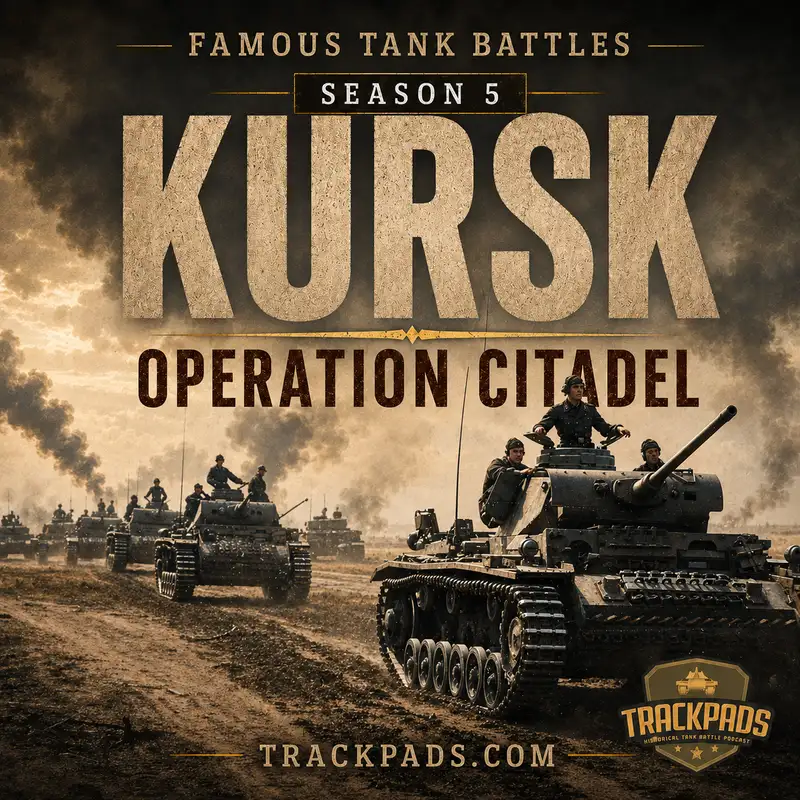
Kursk: Episode 20 — What Prokhorovka Really Was
Prokhorovka is one of those battles where memory can become so large that it blocks the battlefield itself. For decades, it was often presented as the greatest tank clash in history, a vast head-on collision in which Soviet armor threw itself at elite German panzer divisions and destroyed their offensive power in one apocalyptic day. The real Prokhorovka was still enormous, frightening, and important, but it was more complicated than that legend. It was fought on constrained ground near rail lines, ridges, villages, ravines, and the Psel River, inside a campaign already shaped by a week of German advance and Soviet resistance. Understanding what Prokhorovka really was does not make it smaller. It makes it more historically useful.
If you would like to move beyond the podcast, you can see my available books at Military Author dot me. And at Trackpads dot com, you will find magazines and galleries with hundreds of thousands of photos and videos to explore.
The older legend grew for understandable reasons. The Soviet Union needed symbols of endurance, sacrifice, and victory, especially in a war whose human cost was almost beyond description. Prokhorovka offered a powerful image: Soviet tank crews closing with German armor, stopping the invader, and proving that the Red Army could defeat the best formations Germany had left. Wartime reporting, postwar commemorations, memoirs, and Cold War military history all helped strengthen that image. It was also emotionally satisfying because it turned a confused day into a clear moral drama. But history has to do more than preserve powerful images. It has to ask what actually happened, what was exaggerated, and why the exaggeration mattered.
Later research using wartime records from both sides has changed the picture. It shows that German armored losses on 12 July were much lower than the most dramatic older accounts claimed, while Soviet losses were very heavy. It also shows that the II SS Panzer Corps was not annihilated at Prokhorovka and did not simply vanish as an offensive force that afternoon. That correction matters, but it should not be handled with a smirk. The point is not to replace one myth with another by pretending the day was insignificant. The point is to separate tactical destruction from operational effect. A battle can be tactically costly for one side and still contribute to stopping the enemy’s larger plan.
What Prokhorovka really was, first of all, was a series of connected battles rather than one clean armored meeting engagement. Fighting took place across a battlefield shaped by terrain and by the positions reached during the German advance. The Soviet counterattack struck into a German force that was partly attacking, partly defending, and partly trying to maintain its southern momentum. Some clashes were close and chaotic, while others involved German tanks and anti-tank weapons firing from more favorable positions at Soviet armor moving forward under pressure. The battlefield was not a flat tournament ground. It was a restricted and confused combat zone where units entered the fight unevenly and where local conditions mattered enormously.
It was also not a simple Soviet tactical victory in the narrow sense. Rotmistrov’s 5th Guards Tank Army suffered severe losses and did not smash through the German corps in the way Soviet accounts later suggested. Many Soviet tank crews were committed into difficult terrain against a skilled enemy that still had strong firepower, defensive positions, and supporting arms. The attack achieved the vital purpose of stopping or disrupting the immediate German danger near Prokhorovka, but it did so at a price that shocked even Soviet commanders. This is an important distinction. Courage and sacrifice were real. So were mistakes, confusion, and the brutal cost of ordering mass armor forward under urgent conditions.
At the same time, Prokhorovka was not a meaningful German victory if victory is measured by the purpose of Operation Citadel. The German southern spearhead needed more than favorable kill ratios or local tactical success. It needed to break through Soviet depth, regain mobile freedom, and help create the encirclement that had justified the entire offensive. By 12 July, the northern pincer had already been contained, and the southern advance was running into deeper Soviet reserves. A German force that could still destroy Soviet tanks was not the same thing as a force able to decide the campaign. Prokhorovka mattered because it came at the moment when German tactical power no longer had enough time and space to become operational decision.
The battle should therefore be understood as an operational interruption within the larger Kursk campaign. The Soviets did not win the day by cleanly destroying the German armored corps. They won something more complicated: they denied the Germans the continuation of momentum on terms that could still rescue Citadel. The German advance had already been slowed by mines, anti-tank belts, artillery, infantry strongpoints, and constant delay. Prokhorovka added the weight of major Soviet reserves at the crisis point. The result was not a neat battlefield annihilation, but a further narrowing of German possibility. After days of fighting through prepared depth, the Germans were still dangerous, but the operation they were trying to save was becoming strategically hollow.
This interpretation also helps explain why the myth lasted so long. A story about the largest tank battle in history is easier to remember than a story about tempo, reserves, terrain, archival loss reports, and operational purpose. Machines make memory vivid. Tigers, Panthers, T-34s, and burning fields are easier to picture than the slow failure of a campaign design. German postwar accounts sometimes encouraged their own distortions by emphasizing tactical skill, Soviet numbers, or Hitler’s interference while downplaying the larger strategic exhaustion of the Wehrmacht. Soviet accounts emphasized heroic counterattack and German destruction while minimizing Soviet losses and command problems. Both kinds of memory simplified the battle in ways that made it more dramatic but less accurate.
The real teaching value of Prokhorovka lies in how it reveals the difference between a tank battle and armored warfare. A tank battle is what the eye notices: armored vehicles firing, moving, burning, and colliding in the dust. Armored warfare is the entire system that produces or prevents decision: reconnaissance, artillery, engineers, infantry, air support, fuel, maintenance, radios, reserves, terrain, and command timing. At Prokhorovka, Soviet armor did not operate in a vacuum, and neither did German armor. The day was shaped by the week before it, by the defensive belts, by the failure of the northern attack, by the commitment of reserves, and by the limits of moving large mechanized forces through restricted ground.
Terrain is especially important to the revised understanding. The old image of endless open steppe encourages the idea of two armored waves charging directly into one another. The actual battlefield was more restrictive. Embankments, ravines, settlements, river approaches, and narrow movement corridors shaped how tanks could deploy and how quickly they could support one another. These features could reduce long-range visibility in some areas, but they could also disrupt attacking formations and create deadly congestion. That meant numbers alone did not automatically translate into combat power. A tank army committed into cramped ground could lose its cohesion, and once cohesion faltered, experienced defenders could punish the confusion. Prokhorovka was violent partly because so much force was being forced through imperfect space.
The human reality is also sharpened, not weakened, by correcting the myth. If Soviet losses were heavier than older heroic accounts admitted, then the courage of the crews becomes more tragic, not less. Men advanced in tanks that were vulnerable to guns they could not always see, across ground that did not allow the clean maneuver their commanders wanted. German soldiers, too, fought inside a collapsing strategic situation that tactical skill could not repair. Infantrymen on both sides endured artillery, aircraft, smoke, and the fear of being overrun or burned out of position. Myth can turn suffering into spectacle. History should return weight to it by showing that these were not symbols moving across a board, but human beings caught inside decisions made at levels far above them.
The wider date matters as well. On 12 July, while Prokhorovka raged in the south, the Soviet Union also launched Operation Kutuzov against the German-held Orel salient in the north. That meant Kursk was no longer simply a German offensive being resisted. It was becoming a widening Soviet counteroffensive across the front. This is crucial to judging Prokhorovka. Even if German units near Prokhorovka remained tactically capable, the strategic environment was shifting against them. The battle in the south cannot be separated from the northern counteroffensive, the failure of the northern pincer, the growing Soviet reserves, and the wider Allied pressure on Germany. Prokhorovka was one violent node in a campaign whose balance was moving decisively away from German initiative.
What Prokhorovka really was, then, was not the neat legend of an apocalyptic tank smash-up that single-handedly destroyed German armored power. It was a costly, chaotic, operationally decisive interruption at the crisis point of the southern face of Kursk. It showed that Soviet commanders could commit deep reserves to halt a dangerous armored penetration, even if the immediate tactical price was terrible. It showed that German armored forces could still fight with great effectiveness, but no longer had the strategic margin to turn battlefield skill into campaign victory. That is why correcting the myth does not deflate Prokhorovka. It sharpens the lesson. The battle matters not because the simplest story is true, but because the real story shows armored warfare as it is: powerful machines embedded in systems, constrained by terrain, driven by command decisions, and judged finally by whether they change the course of a campaign.