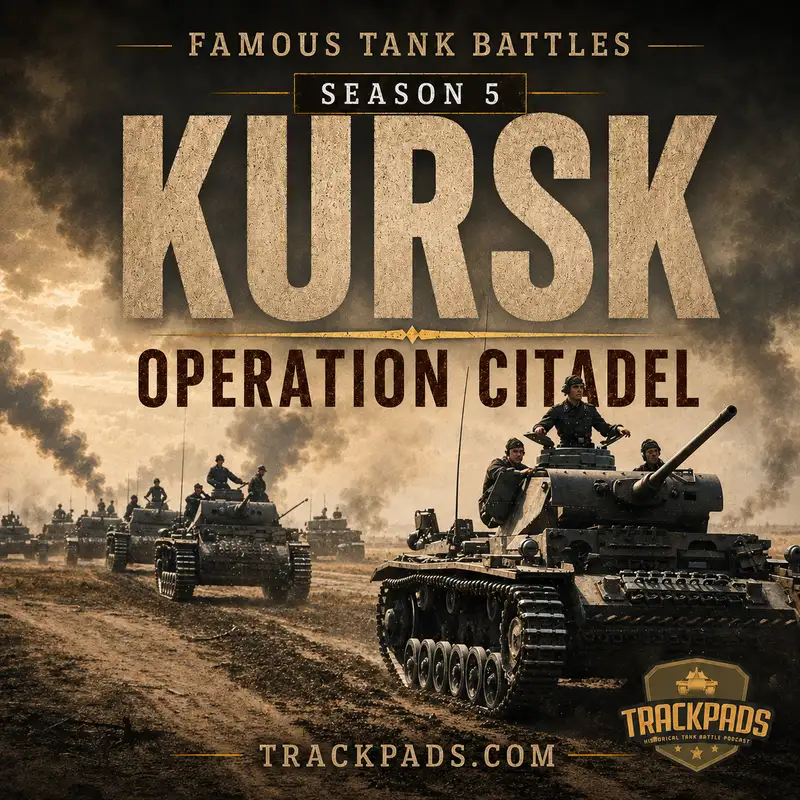
Kursk: Episode 23 — The Last Southern Push
After Prokhorovka, the southern face of Kursk did not simply fall silent. The great Soviet counterattack of 12 July had stopped the German drive from becoming a clean operational breakthrough, but the German formations in the south were not destroyed, and their commanders did not immediately accept that the battle had lost its purpose. For a short time, the southern struggle continued as an attempt to recover meaning from a failing operation. This last push matters because it shows a difficult truth about armored warfare: a force can remain tactically dangerous after the campaign it is fighting has already turned against it. Tanks can still advance, guns can still destroy, and commanders can still see opportunities, even when the larger offensive no longer has a road back to victory.
If you would like to move beyond the podcast, you can see my available books at Military Author dot me. And at Trackpads dot com, you will find magazines and galleries with hundreds of thousands of photos and videos to explore.
Field Marshal Erich von Manstein believed that the southern battle still held possibilities. His formations had advanced farther than the northern attack and had inflicted heavy losses on Soviet forces. From his perspective, stopping too soon risked wasting the effort already spent and allowing Soviet reserves to escape after being committed into battle. He argued that continued pressure might damage the Red Army more severely, improve the German position, or produce a limited operational success even if the original plan of encircling the Kursk salient had become impossible. This was not pure fantasy. German units in the south still had skill, firepower, and local offensive capacity. The problem was that local capacity was no longer the same thing as strategic opportunity.
The original purpose of Operation Citadel had been a double envelopment. The northern arm was supposed to drive south, the southern arm north, and the two were supposed to meet behind Soviet forces inside the salient. By the time of the last southern push, that structure had collapsed. Model’s northern attack had been stopped, and Soviet Operation Kutuzov was striking the German-held Orel salient to the north. The pincer could no longer close. That changed the meaning of every German move in the south. An advance that might once have been part of a trap now risked becoming only a costly protrusion into Soviet depth. The map had not changed as dramatically as the logic had.
The brief continuation of fighting in the south is sometimes associated with efforts to link German forces and improve the tactical situation east of the earlier advance. One limited operation, often referred to as Operation Roland, tried to bring German formations into better contact and exploit what remained of the southern momentum. It involved armored and infantry forces still trying to coordinate under the strain of fatigue, losses, supply problems, and Soviet pressure. The goal was no longer the grand encirclement promised by Citadel. It was more modest: destroy Soviet forces where possible, straighten lines, and prevent the southern effort from ending as a complete waste. That reduction of ambition tells the story by itself.
For the German armored formations, the last push was fought with machines and men already worn by days of combat. Tanks needed repair, crews needed rest, infantry units had suffered, and supply routes had become crowded and vulnerable. Heavy vehicles that looked formidable in battle also demanded fuel, spare parts, recovery equipment, and time that Germany increasingly lacked. A panzer unit could still assemble enough strength for a local attack, but sustaining that attack was another matter. Every damaged vehicle had to be recovered or abandoned. Every mile forward lengthened the chain back to fuel and ammunition. The southern push took place inside an offensive system that had not collapsed all at once, but was losing its ability to renew itself.
The Soviet side was also battered. Prokhorovka had cost the Red Army heavily, especially in tank losses, and the southern defensive forces had endured days of intense pressure. But the Soviets had achieved the central purpose of their defensive design: they had kept the German attack from breaking free before deeper reserves and wider counteroffensives could take effect. Soviet commanders now had to contain the remaining German pressure while preparing for the larger offensive phase to come. This required discipline after sacrifice. They could not assume the Germans were finished simply because Citadel had failed to achieve its original aim. A dangerous enemy remained in contact, and the next stage of the campaign would have to be built on exhausted ground.
The last southern push therefore became a contest between tactical opportunity and operational exhaustion. German units could still seize ground, hit Soviet formations, and create local crises. Soviet units could still be surprised, damaged, or forced back. But the larger question was whether any of that could restore the initiative to Germany. By mid-July, the answer was becoming increasingly clear. The northern pincer was gone. The Soviets were attacking elsewhere. The Allied landing in Sicily had created a strategic emergency in the Mediterranean. The German high command could not treat the southern face of Kursk as if it existed in isolation. Armored warfare may happen in fields and villages, but campaigns are judged across theaters, reserves, and time.
Command decisions in these days were especially difficult because the battlefield did not present a clean signal. Manstein could point to German tactical success and argue that more might be gained. Other commanders and Hitler himself had to weigh that against the wider collapse of Citadel’s purpose. The tension reveals a recurring problem in military history. A commander close to the fighting often sees the enemy immediately in front of him and the possibility of another blow. Higher command must ask whether that blow still serves the war. At Kursk, continued southern pressure could hurt the Red Army, but it could not easily recreate the lost northern arm, erase Soviet counteroffensives, or restore the strategic balance that had made Citadel worth attempting.
The role of combined arms remained essential, even in this diminished phase. German tanks still needed infantry to clear and hold ground, engineers to handle mines and obstacles, artillery to suppress Soviet positions, and aircraft to strike or observe where possible. The Soviets still relied on anti-tank guns, mines, artillery, infantry, tanks, and reserves to prevent German movement from becoming dangerous again. The battle had moved beyond the dramatic image of Prokhorovka, but it remained a mechanized struggle in which every branch depended on the others. If engineers failed, tanks stalled. If infantry lagged, armor became exposed. If artillery could not keep pace, an attack lost weight. If fuel did not arrive, the most powerful tank became a stationary object.
The human experience of the last push was bitter because the outcome was already narrowing, but the danger was still immediate. Soldiers did not fight abstractions like failed operational purpose. They fought for ridges, villages, road junctions, and survival. German troops attacking after days of exhaustion still faced mines, guns, air attack, and Soviet counterpressure. Soviet troops holding or counterattacking still faced German armor and artillery that could kill as effectively as before. The knowledge that a campaign is failing does not make shells less deadly or withdrawal less hazardous. These late actions remind us that the end of an offensive is often one of its cruelest phases, because men continue to die while commanders decide what can still be salvaged.
In the wider Kursk campaign, the last southern push marks the moment when German offensive ambition shrank into damage control. Citadel had begun as an attempt to cut off a massive salient and recover the initiative in the east. By its final southern efforts, it had become an attempt to inflict losses, improve positions, and justify the cost of a failed gamble. That transformation is central to understanding why Kursk mattered. The German army had not suddenly lost all tactical ability. It had lost the relationship between tactical action and strategic decision. Its tanks could still fight, but they could no longer make the campaign mean what it was supposed to mean.
The last southern push deserves attention because it prevents the Kursk story from ending too neatly at Prokhorovka or at Hitler’s decision to call off Citadel. Battles rarely end in one symbolic moment. They fade through continued attacks, withdrawals, local gains, abandoned plans, and commanders trying to impose order on a situation that has already changed. In the south, Germany tried briefly to keep the battle alive, but what remained was not a true road back to victory. It was the afterlife of an offensive whose conditions had disappeared. Kursk’s lesson is sharpened here: armored warfare depends not only on the power to attack, but on the chance to make attack decisive. Once that chance is gone, even a dangerous armored force may be fighting only to delay the consequences of failure.