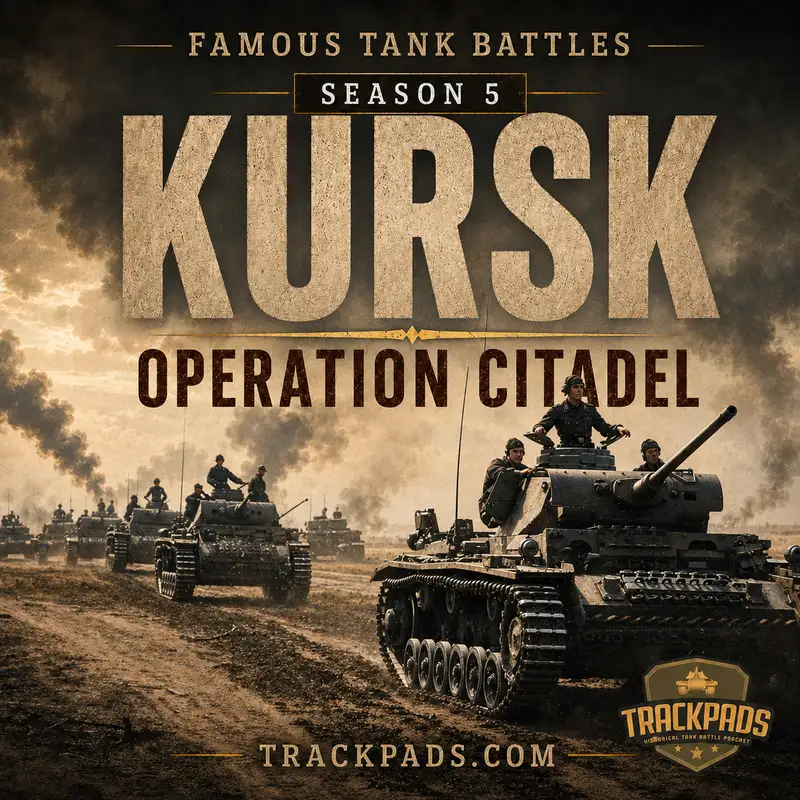
Kursk: Episode 25 — Belgorod and Kharkov
Belgorod and Kharkov were the visible payoff of the Kursk campaign, the moment when a defensive victory fully turned into strategic pursuit. By early August 1943, Operation Citadel had failed, the German northern attack had been stopped, the southern thrust had been contained, and Soviet counteroffensives were widening the front. Now the Red Army drove toward the cities that anchored Germany’s southern position after Kursk. Belgorod fell on 5 August, and Kharkov was finally retaken on 23 August after hard fighting. These victories mattered not simply because cities changed hands, but because they showed that Germany’s last great offensive in the east had ended with the Soviet Union choosing the direction and tempo of the next campaign.
If you would like to move beyond the podcast, you can see my available books at Military Author dot me. And at Trackpads dot com, you will find magazines and galleries with hundreds of thousands of photos and videos to explore.
The road to Belgorod and Kharkov began with Operation Rumyantsev, the Soviet offensive launched in early August by the Voronezh Front under Nikolai Vatutin and the Steppe Front under Ivan Konev. These were large army-group-level commands, controlling infantry armies, tank armies, artillery, engineers, air support, and the supply services needed to keep all of them moving. The operation aimed to break through German positions south of Kursk, recover Belgorod, and then press toward Kharkov, a city that had already changed hands more than once in the war. In plain terms, the Soviets were no longer waiting for German armor to come at them. They were now pushing into the German defense and forcing the Wehrmacht to react.
Belgorod mattered because of where it sat and what it represented. It was a southern counterpart to the Orel struggle in the north, part of the broader collapse of the German positions around the Kursk battlefield. When Soviet troops recovered Orel and Belgorod on the same day, the campaign’s shape became unmistakable. The Germans had attacked to cut off a Soviet salient; instead, they were losing major anchors on both sides of the battlefield. Moscow marked the victories with public celebration, but the military meaning was deeper than ceremony. The Red Army had shown that it could absorb a modern armored offensive, hold enough strength in reserve, and then launch major attacks of its own before the Germans could regain balance.
The fighting for Belgorod was not effortless, and it should not be remembered as a simple Soviet parade after German failure. German forces remained disciplined, experienced, and dangerous on defense. They used anti-tank guns, mines, artillery, villages, ridges, and counterattacks to slow Soviet movement and punish exposed formations. The Red Army’s offensive power was growing, but its methods could still be costly and blunt. Infantry had to advance into fire. Engineers had to clear obstacles and repair routes. Tank formations had to move forward without outrunning the artillery and supply columns that made their advance sustainable. Belgorod fell quickly in comparison with Kharkov, but even quick success depended on an entire combined-arms system working under pressure.
Kharkov was a larger and harder prize. It had rail connections, roads, factories, and political symbolism, and both sides understood its value. The city had already become a recurring battlefield, taken, lost, and retaken in earlier campaigns. For Germany, holding Kharkov helped stabilize the southern front after the failure at Kursk and preserved a major position in eastern Ukraine. For the Soviet Union, recovering it would show that the post-Kursk offensive was not a local success but a strategic shift. The battle for Kharkov therefore carried the weight of accumulated history. It was not just another urban objective. It was a test of whether Soviet momentum could survive German defensive skill and counterattack.
As Soviet forces pressed beyond Belgorod, the operation became more difficult. The farther an army advances, the more its own success creates new problems. Roads become crowded with tanks, trucks, guns, wounded men, prisoners, repair teams, and command vehicles. Fuel and ammunition have to move forward over routes damaged by battle or blocked by traffic. Artillery must displace to new firing positions, and engineers must clear mines or repair bridges before heavy vehicles can pass. In armored warfare, pursuit is not simply the act of moving after a retreating enemy. It is the difficult art of keeping combat power organized while the front line moves, the enemy resists, and every mile lengthens the supply chain.
German commanders under Field Marshal Erich von Manstein still had the ability to strike back. Their position was worse than it had been before Kursk, but they were not helpless. German mobile formations could counterattack Soviet spearheads that pushed ahead too quickly or became separated from supporting infantry and artillery. Around the approaches to Kharkov, German forces used local counterstrokes to slow the Soviet advance and inflict losses. This is important because the Soviet victory after Kursk was not a sudden collapse of German military effectiveness. It was the defeat of German strategic initiative. The Wehrmacht could still fight extremely well at the tactical and operational level, but it was increasingly fighting to contain Soviet movement rather than to dictate events itself.
The Soviet tank armies in this phase faced the attacker’s version of the problem Germany had faced at Kursk. During Citadel, German armor had tried to move through Soviet defensive belts and discovered that breaking in was not the same as breaking through. During the advance on Kharkov, Soviet armor now had to pass through German defenses, avoid anti-tank traps, and exploit gaps without becoming isolated. Tank formations were powerful only when supported by infantry, artillery, engineers, reconnaissance, and supply. If tanks ran too far ahead, they could be hit from flanks, cut off from fuel, or forced to halt while German defenses reorganized. Kharkov showed that successful pursuit still required discipline.
The urban and semi-urban fighting around Kharkov placed additional demands on armored forces. Tanks could support infantry, fire on strongpoints, and help break through outer defenses, but they could not by themselves secure a large city or clear every street, building, and rail area. Infantry remained essential, as did artillery and engineers. Cities restrict visibility, channel movement, and give defenders places to hide guns or attack vehicles at close range. That meant Soviet commanders had to combine pressure from outside the city with careful fighting near and within its approaches. The final recovery of Kharkov was therefore not simply a tank advance reaching a destination. It was the result of sustained pressure across a complex battlefield.
Airpower also mattered in the drive to Kharkov, though it did not make victory automatic. Soviet aircraft could support attacks, strike German road traffic, and search for reserves moving to contain breakthroughs. German aircraft could still hit Soviet concentrations and interfere with movement. But by this stage of the war, the Soviet air effort had grown stronger, and the German ability to dominate the air over key battlefields was not what it had been in 1941. The sky shaped what could be seen, what could move by day, and how quickly reserves could be detected. As with tanks, aircraft mattered most when tied to the ground battle’s timing. A strike at the right road or reserve column could influence an entire sector.
The fall of Kharkov on 23 August closed the Kursk campaign in a meaningful way. The city’s recovery did not end the war in the east, and it did not destroy the German army. But it marked the completion of a dramatic reversal. In July, Germany had attacked to restore initiative. By late August, the Soviet Union had regained major ground, forced German withdrawals, and proved that it could carry the campaign forward after absorbing the German blow. The Red Army had not merely survived. It had turned defense into advance, advance into pursuit, and pursuit into a strategic change that could be seen on the map. Kharkov was the announcement that the direction of movement had changed.
The cost of that movement was severe. Soviet victories were won with heavy casualties, exhausted units, lost tanks, destroyed guns, and immense strain on supply systems. German defenders and civilians caught in the path of battle also suffered badly as cities and villages were fought over yet again. Military history should not turn the recapture of cities into a clean line of triumphant arrows. Each movement on the map meant men advancing under fire, wounded carried back through dust and smoke, crews trapped in burning vehicles, and civilians living amid bombardment, evacuation, occupation, and return. The importance of Belgorod and Kharkov is not reduced by acknowledging that suffering. It is made more honest.
Belgorod and Kharkov deserve their place in the Kursk story because they show what made the battle decisive. Kursk was not decided only by the failure of German tanks in minefields, nor only by the violence near Prokhorovka. It became decisive because the Soviet Union could exploit German failure and push the front westward afterward. Belgorod showed the quick payoff of the post-Citadel reversal. Kharkov showed the harder, larger payoff, where Soviet momentum endured despite German resistance and counterattack. Together, they turned Kursk from a defensive success into a strategic turning point. The Germans had come to Kursk hoping to restore control of the Eastern Front. By the time Kharkov fell, it was clear that control had passed to the army advancing west.