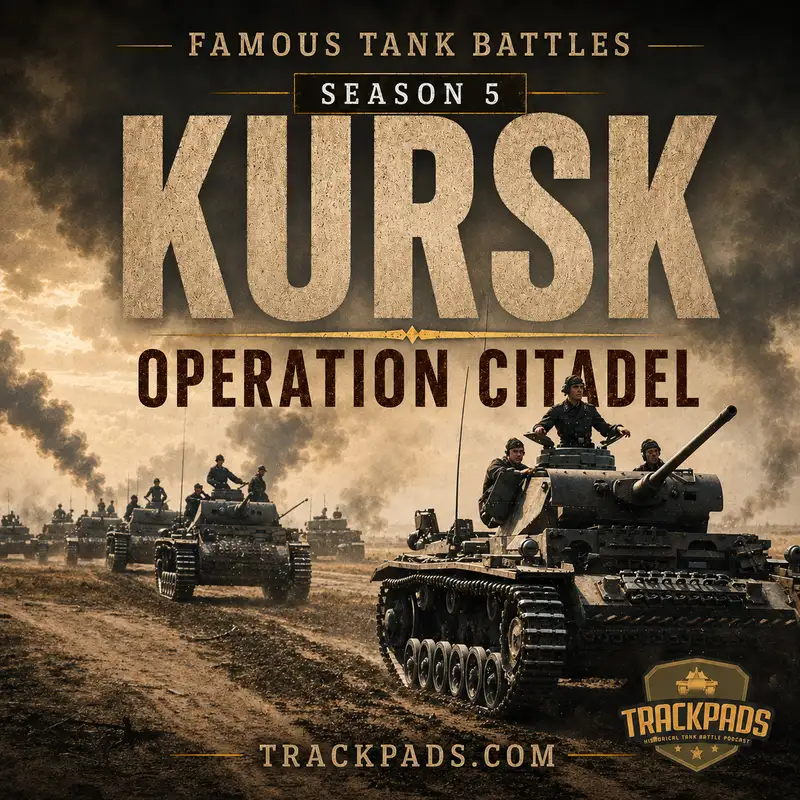
Kursk: Episode 26 — After Kursk
After Kursk, the war on the Eastern Front did not suddenly become easy for the Soviet Union, and Germany did not stop being dangerous. But the direction of the war had changed in a way that could no longer be hidden. Kursk was Germany’s last serious attempt to regain the strategic initiative in the east through a major armored offensive. It failed against a Soviet defense built not merely to survive, but to absorb, delay, exhaust, and then counterattack. The campaign began as Hitler’s gamble to cut off a salient and restore German momentum. It ended with Soviet armies advancing through Orel, Belgorod, and Kharkov, proving that the Wehrmacht could still resist, but could no longer command the rhythm of the war.
If you would like to move beyond the podcast, you can see my available books at Military Author dot me. And at Trackpads dot com, you will find magazines and galleries with hundreds of thousands of photos and videos to explore.
The meaning of Kursk is often compressed into one image: masses of tanks colliding near Prokhorovka on 12 July 1943. That image is powerful, but it is too small for the campaign. Kursk was not one day, one field, or one tank duel. It was a sequence that began after Stalingrad, passed through German planning and delay, Soviet defensive preparation, the opening attacks on 5 July, the grinding northern face, the more dangerous southern thrust, the commitment of reserves, Prokhorovka, and then Soviet counteroffensives that widened the struggle. To understand Kursk properly, the listener has to see the whole arc. The decisive fact was not that tanks fought in great numbers. It was that German offensive design failed and Soviet operational design took over.
For Germany, Kursk revealed the limits of tactical excellence under worsening strategic conditions. German units still fought with skill. Their armored crews, infantry, artillerymen, engineers, and commanders could inflict severe losses and solve difficult local problems. In the south especially, they made real progress and created real danger. Yet that danger did not become decision. The northern pincer stalled. The southern pincer advanced but could not close the trap alone. Soviet defenses consumed time, and time was the one resource Operation Citadel could not afford to lose. Kursk showed that an army may remain deadly at the point of contact while losing the larger ability to impose its will on a theater of war.
For the Soviet Union, Kursk showed a different kind of maturation. The Red Army had already proved at Stalingrad that it could surround and destroy a major German force. At Kursk, it proved something else: that it could anticipate a modern armored offensive, prepare in depth, hold reserves, absorb tremendous punishment, and then move into large counteroffensives. This was not perfection. Soviet command could still be rigid, reconnaissance could be incomplete, and armored counterattacks could be costly and poorly coordinated. Prokhorovka itself showed how expensive urgency could become. But the Red Army’s system had improved enormously since 1941. It could now combine mass, preparation, artillery, engineers, tanks, airpower, and logistics in ways that changed campaigns.
Kursk also changed the way armored warfare should be understood. Tanks were central, but they were never alone. Mines broke tracks and stopped columns. Engineers opened lanes or failed to open them under fire. Infantry held trenches, villages, and ridges that tanks could not ignore. Artillery shaped movement before vehicles saw each other. Aircraft searched roads, struck concentrations, and added danger from above. Radios and staff work determined whether commanders understood the battle quickly enough to act. Fuel, ammunition, maintenance, and recovery determined how many tanks could keep fighting after the first day. Kursk was a tank battle only if tank battle means a whole mechanized system struggling to move, see, supply, and survive.
The campaign’s defensive lessons were especially important. The Soviets did not defeat the German armored attack by building one unbreakable wall. They built depth. The German advance was meant to break through, widen, and exploit into open space. The Soviet defense answered by making each success lead to another obstacle, another gun line, another minefield, another reserve position, another delay. That is why breaking into the Kursk defenses did not mean breaking through them. This lesson would echo through later armored warfare. Modern defenders learned that tanks could be slowed by layers, channeled by terrain, struck from prepared positions, and defeated by systems rather than by a single wonder weapon.
The campaign’s offensive lessons were just as important. Soviet success did not end when the German attack stopped. It became decisive when the Red Army launched Operation Kutuzov against Orel and Operation Rumyantsev toward Belgorod and Kharkov. That transition from defense to offense was the real signature of Kursk. A defender who merely survives may postpone defeat. A defender who survives and then attacks can change the war. The Red Army had planned for that sequence. It accepted the first blow, forced Germany to spend strength, then struck German-held salients and pushed the front westward. Kursk was not only about stopping German tanks. It was about turning stopped tanks into a strategic opportunity.
The battle also marked a shift in the relationship between technology and operational reality. German Tigers, Panthers, and Ferdinands were powerful machines, and some performed with great tactical effect. Soviet T-34s were rugged, numerous, and central to Red Army armored operations. But Kursk punishes any simple answer to the question of which tank was better. A tank’s battlefield value depends on reliability, crew training, recovery, fuel, communications, terrain, supporting infantry, artillery preparation, and the purpose for which it is used. German heavy armor could win local fights and still fail to rescue Citadel. Soviet armor could suffer terrible losses and still help halt the German thrust or support later advances. Machines mattered, but systems decided what machines could mean.
Kursk should also be treated carefully because its memory has been shaped by myth. Older accounts often turned Prokhorovka into an apocalyptic tank smash-up that destroyed German armored power in a single day. Later research has shown a more complicated picture, including heavy Soviet losses and lower German tank losses than some traditional narratives claimed. But correcting the myth does not make Kursk less important. It makes it more important in the right way. The battle was not decisive because of one simplified heroic image. It was decisive because German armored warfare failed to achieve operational decision against a prepared enemy, and because the Soviet Union then converted that failure into sustained strategic advance.
In the longer story from Cambrai to late twentieth-century armored warfare, Kursk sits at a crucial midpoint. Cambrai in 1917 showed that tanks could help crack trench defenses, but it also revealed how hard exploitation was without a mature combined-arms system. The German campaigns of 1939 to 1941 showed how tanks, radios, aircraft, infantry, and operational planning could produce rapid collapse when the defender was surprised or poorly coordinated. Kursk showed the mature counterargument. A defender who understands armored warfare can prepare depth, coordinate fire, preserve reserves, and deny the attacker tempo. Later mechanized battles would keep returning to this problem: tanks are powerful when they create movement faster than the enemy can organize, and vulnerable when the enemy forces them into predictable, unsupported, or delayed action.
The strategic consequences were profound. After Kursk, Germany still launched local counterattacks and conducted skillful defensive operations, but it no longer had the strength for a major eastern offensive that could transform the war. The Wehrmacht increasingly fought to slow Soviet advances, shorten lines, rescue threatened formations, and hold key positions long enough to prevent collapse. The Soviet Union, by contrast, increasingly fought campaigns built around its own timing and objectives. The front did not move west in one smooth line, and there would be many more terrible battles ahead. But the pattern had changed. Germany reacted. The Soviet Union pressed. Kursk did not end the Eastern Front. It changed who set its terms.
The human cost behind that change was immense. Kursk involved vast numbers of soldiers, machines, guns, aircraft, and civilians caught in the path of battle. Exact loss figures vary across sources and categories, and false precision can give a misleading sense of control over suffering. What can be said plainly is that the campaign consumed men and equipment on a staggering scale. Soviet victory came at heavy cost. German failure came with severe losses and the further weakening of forces that Germany could not easily replace. The battlefield was not a proving ground for machines in isolation. It was a place where human beings endured bombardment, fire, fear, injury, exhaustion, and death inside decisions made by states and commanders pursuing strategic aims.
After Kursk, the Eastern Front became a story of Soviet advance and German reaction, though that phrase should not make the remaining war sound simple. The Red Army still had to fight through Ukraine, Belarus, Poland, and into Germany. The Wehrmacht still resisted with skill and brutality. But Kursk marked the moment when Germany’s hope of regaining the initiative through armored decision in the east was broken. That is why the campaign deserves more than the memory of one famous clash. It was a battle of planning, patience, machines, mines, guns, reserves, airpower, roads, fuel, and time. It showed that armored warfare had evolved from the dream of breakthrough into a contest between entire systems. At Kursk, the German system could still strike hard, but the Soviet system could absorb the blow, break its rhythm, and move forward afterward. That was the turning point.