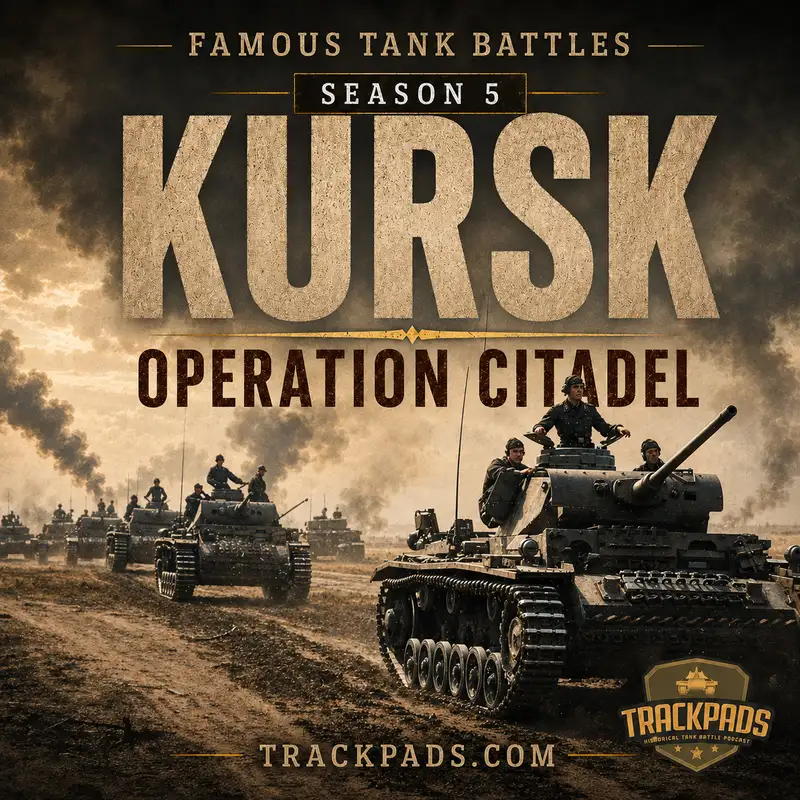
Kursk: Episode 3 — Hitler’s Gamble
Operation Citadel was the name Germany gave to the offensive against the Kursk salient in July 1943, but the word operation can make it sound more controlled than it really was. By the time the plan took shape, Germany was no longer fighting from the position of confidence that had defined the early blitzkrieg years. Stalingrad had exposed the limits of German reach, and the Red Army was growing stronger in both equipment and operational skill. Yet Adolf Hitler and the German high command still hoped that a concentrated armored blow could cut off the Kursk bulge, destroy a large Soviet force, and restore momentum on the Eastern Front. Kursk became Hitler’s gamble because the plan required speed, surprise, and decisive exploitation, even as Germany was losing the very conditions that made those things possible.
If you would like to move beyond the podcast, you can see my available books at Military Author dot me. And at Trackpads dot com, you will find magazines and galleries with hundreds of thousands of photos and videos to explore.
The basic idea behind Citadel was simple enough to explain and dangerous enough to believe in. German forces would attack the Kursk salient from two directions, one thrust driving southward from the Orel region and another driving northward from the Belgorod and Kharkov area. If the two spearheads met behind the Soviet armies inside the bulge, the Red Army formations there could be trapped and destroyed. This was not a wild idea in the abstract. German armored warfare had achieved some of its greatest victories by concentrating force, breaking through, and encircling enemies before they could organize a stable defense. The trouble was that Kursk in 1943 was not France in 1940, and the Red Army facing the Germans was not the stunned, disorganized force of the early invasion.
Citadel was limited in geography, but enormous in implication. Germany was not trying to conquer Moscow or seize the Caucasus oilfields in one sweeping campaign. It was trying to win a controlled victory, one that would shorten the front, damage Soviet reserves, and prove that the Wehrmacht could still dictate the terms of battle. That limited aim made the plan look realistic to many German officers. It also made it politically attractive to Hitler, who needed a success after the catastrophe at Stalingrad and the loss of prestige that came with it. But a limited offensive can still be strategically reckless if it consumes irreplaceable strength. At Kursk, Germany was preparing to spend some of its best remaining armored formations in a battle the enemy had every reason to expect.
Hitler’s role in the gamble was shaped by hesitation as much as aggression. He wanted a victory, but he also feared committing his forces before they were ready. German commanders disagreed about timing, with some arguing that the attack should be launched quickly before Soviet defenses grew too strong, while others worried that the available armored forces needed rebuilding after the winter fighting. Hitler’s attention increasingly fixed on new weapons, especially heavier and more powerful armored vehicles that seemed to promise a technological edge. Waiting for these machines became part of the logic of Citadel. Yet the delay carried a hidden cost. Every day that gave Germany more time to assemble tanks also gave the Soviet Union more time to build minefields, dig positions, register artillery, and move reserves into depth.
This is one of the central lessons of the campaign: technology cannot rescue an operational plan from bad timing. The German army could field impressive vehicles, experienced panzer crews, and commanders who understood mobile warfare at a high level. But tanks are not magic instruments that erase prepared defenses. They need room to maneuver, engineers to open lanes through obstacles, infantry to clear strongpoints, artillery to suppress guns, and supply columns to keep fuel and ammunition moving forward. A tank that cannot move is a pillbox. A tank that moves without infantry can be isolated. A tank formation that breaks into a defensive belt but cannot break out the other side may be strong tactically and still fail operationally. Citadel demanded operational success, not just local battlefield victories.
Many German officers understood the danger. Some believed the attack should be abandoned once surprise was clearly gone. Others thought a shorter, earlier strike might have had a better chance. Field Marshal Erich von Manstein, commanding in the south, continued to believe that offensive action could regain the initiative if German forces were used skillfully. General Walter Model, commanding the northern attack, was more cautious and recognized the strength of the Soviet defenses facing him. These commanders were not all thinking in the same way, but they were trapped inside the same strategic problem. Germany needed a victory large enough to matter, but it no longer possessed the freedom to choose an ideal time, place, and method. The plan survived partly because no alternative looked more promising.
The German army that prepared for Citadel was still formidable, and that point matters. It would be wrong to describe the offensive as doomed because the Germans had suddenly become incompetent or weak. German units still had excellent tactical discipline in many sectors, skilled junior leaders, effective gunnery, and a deep culture of battlefield improvisation. Their panzer formations could still concentrate violence at a chosen point and punish defenders severely. The danger was that tactical excellence might conceal strategic exhaustion. A unit can win its immediate fight and still contribute to a losing campaign if the broader operation has no room for delay, attrition, or unexpected resistance. At Kursk, the Germans were planning an offensive in which every hour lost to mines, anti-tank fire, and traffic congestion would weaken the entire design.
The Soviet preparation turned Hitler’s gamble into something close to a test of German predictability. Soviet intelligence, reconnaissance, partisan reports, prisoner interrogations, and careful analysis all pointed toward the likelihood of an attack on the salient. Soviet commanders did not know every detail perfectly, but they understood the main problem well enough. Instead of rushing into a premature offensive, they accepted the risk of receiving the German blow on prepared ground. This was a major development in Soviet operational thinking. The Red Army was not merely waiting behind trenches; it was shaping a battlefield designed to slow the German attack, force it into channels, separate tanks from support, and then strike back once the attacking force had lost its momentum. Patience became an active weapon.
The terrain and defenses around Kursk turned the offensive into a contest over tempo. Tempo means more than speed; it means the ability to keep actions unfolding faster than the enemy can respond. German armored warfare had often succeeded by generating tempo, cracking a front and then driving so deeply that enemy headquarters lost control of events. At Kursk, the Soviet defense was meant to break that rhythm. Minefields forced engineers to work under fire. Anti-tank guns covered likely approaches. Artillery disrupted assembly areas and roads. Infantry strongpoints held villages and ridges that tanks could not simply ignore. Even when the Germans advanced, they had to stop, regroup, clear obstacles, bring up support, and attack again. Each pause gave the defenders more time to react.
Hitler’s gamble also depended on a belief that a major victory at Kursk could still have strategic consequences beyond the battlefield itself. Destroying Soviet forces inside the salient might shorten the German line and free reserves for other threatened sectors. It might delay Soviet offensives and reassure Germany’s allies. It might show that the Eastern Front had not passed permanently out of German control. But the gamble contained a darker possibility. If Citadel failed, Germany would have committed elite armored strength into a prepared defensive system and gained little in return. Worse, the Red Army might then launch its own offensives while German formations were tired, damaged, and short of reserves. In that case, the attack meant to restore initiative would accelerate its loss.
The wider war made the decision even more dangerous. Germany in 1943 was not fighting only at Kursk. It had to defend occupied Europe, guard against Allied moves in the Mediterranean, sustain the air war over Germany, and hold a vast Eastern Front. Every tank, aircraft, trained crewman, mechanic, and fuel shipment sent to Citadel existed in a world of competing demands. Armored warfare is often described through the drama of the front line, but modern mechanized war is also a struggle of allocation. A high command must decide where scarce mobile forces can achieve the most. At Kursk, Germany chose to concentrate many of its best resources in a predictable attack against a well-prepared enemy. That choice reflected ambition, but also the narrowing of German options.
The offensive plan therefore carried a contradiction at its heart. It was designed as a decisive armored operation, but it had been delayed until the defender had made decisiveness unlikely. It depended on powerful tank formations, but it forced them into a battlefield where mines, guns, trenches, and artillery could slow them before they reached open space. It aimed to restore the initiative, but it was launched partly because Germany had already lost the strategic initiative and needed some visible way to recover it. This contradiction is what makes Citadel so important in the history of armored warfare. It shows that tanks cannot be understood apart from timing, intelligence, enemy preparation, logistics, and the wider strategic situation. The best machines and crews can be squandered if the operational setting is wrong.
When the German attack finally began, it would still be terrifying. Soviet soldiers in the defensive belts would face heavy bombardment, advancing armor, close combat, and the strain of holding positions under enormous pressure. German tank crews and infantry would enter minefields and anti-tank zones knowing that every yard forward could bring another ambush, another disabled vehicle, another delay. The gamble was not abstract to the men ordered to carry it out. It was paid for in burned vehicles, wrecked guns, shattered villages, and lives cut short in fields that had been studied on maps for months. The tragedy of Citadel is that many of those sacrifices were made in pursuit of a decision that the structure of the battle had already made extraordinarily difficult to achieve.
Hitler’s gamble at Kursk deserves attention because it marks a turning point in the relationship between armored ambition and operational reality. Earlier in the war, German armored forces had often made the battlefield seem fluid, unstable, and vulnerable to sudden collapse. At Kursk, the Soviet Union showed that a prepared defender could deny that fluidity, forcing tanks to fight through depth instead of racing through a rupture. Citadel was not foolish because Germany lacked brave soldiers or capable commanders. It was dangerous because it asked a strained army to win quickly against an enemy that had prepared precisely to make quick victory impossible. Once that happened, the offensive ceased to be a path back to initiative and became a costly test of whether German armored warfare could still impose its will. Kursk would answer that question with increasing clarity, and the answer would not favor Germany.