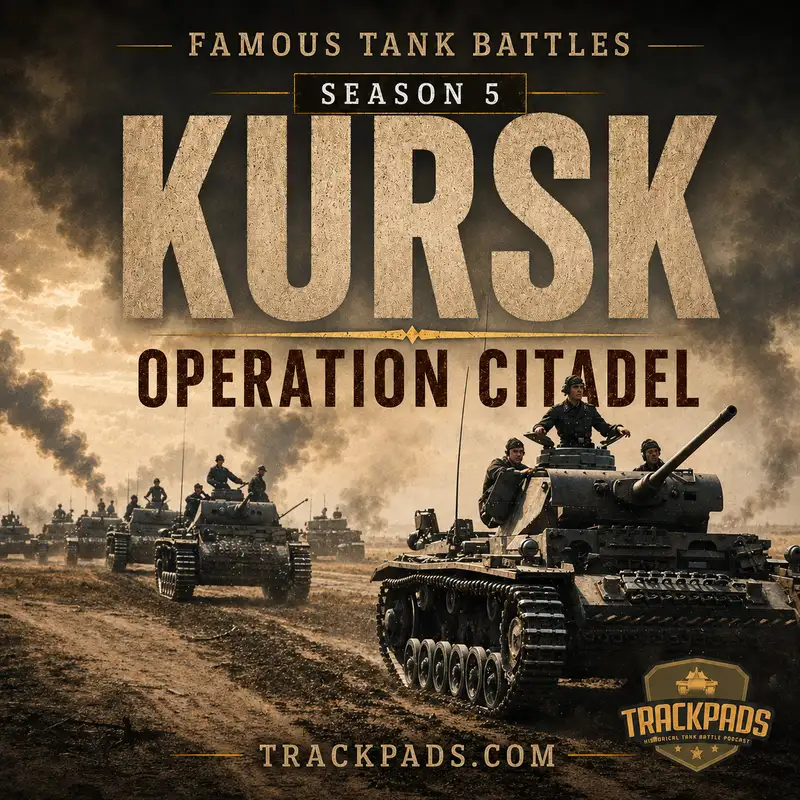
Kursk: Episode 5 — Building the Deep Defense
The Soviet defense at Kursk was not simply a matter of digging trenches and hoping German tanks would stop. It was a deliberate attempt to construct an entire battlefield, one that would receive the force of Operation Citadel, slow it, break its rhythm, and prepare the ground for counterattack. Around the Kursk salient, Soviet soldiers, engineers, laborers, gunners, tank crews, and commanders turned ordinary fields, villages, ridges, and roads into a defensive system in depth. That phrase can sound abstract, but at Kursk it meant something brutally practical: the Germans would not be allowed one clean breakthrough. Kursk matters in armored warfare history because it showed that a modern tank offensive could be defeated not by one heroic line, but by layers of obstacles, fire, reserves, and time.
If you would like to move beyond the podcast, you can see my available books at Military Author dot me. And at Trackpads dot com, you will find magazines and galleries with hundreds of thousands of photos and videos to explore.
The idea behind the Soviet defense began with a clear reading of the German method. German panzer forces were most dangerous when they could concentrate at a narrow point, smash through the front, and then move fast enough to disrupt command posts, artillery, supply columns, and reserves in the rear. The Soviet answer was to deny them that sequence. If the first line broke, the second line would still be there. If the second line bent, artillery and anti-tank guns farther back would still have prepared targets. If the Germans found a road, it might be mined, blocked, or covered by fire. The goal was not to make every yard impossible, because no defensive system can do that. The goal was to make every yard expensive and slow.
The scale of the preparation was immense, but the important point is not just how much earth was moved. It is why the earth was moved in that particular pattern. Soviet defensive belts were arranged one behind another, so that attacking units would be forced to fight repeatedly rather than once. Forward trenches and strongpoints were meant to absorb the first impact and identify the main German effort. Behind them lay anti-tank zones, artillery positions, reserve lines, and additional defenses around villages and road junctions. This meant that a German tactical success could be real without becoming operationally decisive. A panzer unit might break into the first belt, destroy guns, and take prisoners, yet still find itself far from the open movement it needed.
Mines were among the most important weapons in this defensive design. They did not have to destroy every tank to change the battle. A mine that blew off a track could halt a vehicle in the open, block a lane, force engineers forward, and create a traffic jam behind it. Once columns slowed or bunched together, artillery and anti-tank guns gained time to fire. Minefields also created uncertainty, and uncertainty is poison to tempo. A tank commander who cannot trust the next patch of ground has to pause, probe, wait for engineers, or risk immobilizing the vehicle. At Kursk, mines turned movement itself into a problem, and movement was the thing German armored warfare most needed to preserve.
The engineers who built and maintained these obstacles were central to the battle, though they are often less remembered than tank crews. They laid mines, dug anti-tank ditches, prepared roadblocks, improved field fortifications, and helped create lanes through Soviet positions for friendly movement. Their work connected tactical details to operational purpose. A trench in the wrong place could be bypassed, and a minefield uncovered by fire might only delay an attacker briefly. But obstacles placed where tanks were likely to move, and covered by artillery, machine guns, and anti-tank weapons, became part of a larger trap. Engineers made the terrain less neutral. They turned it into an active participant in the defense, shaping where German armor could go and how quickly it could get there.
Anti-tank guns gave the defensive belts their killing power. Soviet gunners were positioned to cover likely approaches, road exits, slopes, and gaps between villages. Some guns were hidden until German vehicles came within more favorable range, while others fired earlier to disrupt movement and draw attention. These weapons varied in size and effectiveness, and German heavy tanks could be difficult targets from the front. But the Soviet defense did not depend on every gun defeating every tank in a fair duel. It depended on many weapons, from different angles, working inside a system that included mines, artillery, infantry, and reserves. Even an armored vehicle that survived one gun position might be forced to turn its flank, slow down, or expose itself to another.
Infantry made the defense hold together. Tanks could pass over ground, but infantry had to occupy it, contest it, and keep it from becoming safe for the attacker. Soviet riflemen held trenches, villages, woods, and strongpoints that German armor could not simply ignore if German infantry and engineers were to follow. They fought in dust, smoke, shellfire, and confusion, often under pressure from artillery and close assault. Their role was not glamorous, and it was frequently costly, but it was essential. A defensive belt without infantry could be penetrated and cleared. A minefield without infantry could be breached. An anti-tank gun without nearby protection could be overrun. Kursk was a tank battle only if the word tank is understood as shorthand for a much larger combined-arms struggle.
Artillery gave the Soviet defense reach and weight. Guns and rocket launchers could strike assembly areas, road columns, suspected command posts, and concentrations forming for attack. Soviet artillery fire was often planned in advance against likely routes and known sectors, because the expected German attack gave defenders time to register targets. This mattered in a mapless sense that any listener can follow. If the Germans had to advance through predictable corridors, and if those corridors had already been measured by Soviet observers, then the German attack began under a shadow before it reached the forward trenches. Artillery could not stop everything, and bombardments did not always land where needed. But when combined with mines and anti-tank positions, artillery helped turn delay into destruction.
Defense in depth also depended on communication and command discipline. Soviet commanders needed to understand where the German attack was real, where it was secondary, and where reserves should be held rather than wasted. This was difficult under battle conditions. Telephone lines were cut, radios failed or were overloaded, smoke obscured observation, and reports from the front could be late, exaggerated, or contradictory. Yet the defensive design helped reduce the danger of a single local surprise. Because there were multiple belts and reserves behind them, the Red Army did not have to solve every crisis instantly. It could absorb shock, watch the pattern of the German advance, and then decide where the deeper forces should move. The structure of the battlefield bought time for judgment.
The Soviet reserve system was the hidden strength behind the visible defenses. Not every tank and gun was placed at the forward edge, because the purpose of the battle was not merely to survive the first day. Stronger formations waited behind the defensive zones, ready either to seal a penetration or to join a counteroffensive once the German blow had lost momentum. Holding them back required discipline. The pressure to reinforce a hard-hit sector is always strong, especially when forward troops are suffering. But if all reserves are committed too early, the defender may stop one crisis and lose the larger campaign. At Kursk, the Red Army tried to make the Germans spend strength first, then meet them with forces that had not yet been exhausted.
Logistics were part of the defense as much as trenches or guns. Ammunition had to be stockpiled, fuel had to be positioned for counterattacking formations, medical services had to prepare for heavy casualties, and roads behind the front had to carry troops, shells, food, replacement weapons, and repair teams. A defensive battle of this size could not be improvised once the attack began. Soviet preparations included the less dramatic work of moving supplies forward and creating enough depth behind the lines to keep fighting after the first shocks. This mattered because the German plan depended on exhausting or bypassing the forward defense quickly. If the Soviets could keep feeding the defense without committing everything at once, then German progress became more costly with each mile.
The human experience of this constructed battlefield should not be lost behind operational language. Thousands of Soviet soldiers waited in prepared positions knowing that the strongest German armored forces might strike them directly. Engineers worked near exposed ground where their minefields and obstacles would soon be tested. Gun crews understood that firing too early might reveal them, while waiting too long might mean being crushed. Infantrymen in trenches faced not only tanks, but artillery, aircraft, machine-gun fire, and the fear of being isolated. The Soviet plan was effective because it was organized, but it was not bloodless. Defense in depth used time and space intelligently, yet the time was bought by men holding under pressure, and the space was marked by shattered equipment and bodies.
For the Germans, this deep defense attacked the heart of armored momentum. A panzer commander wanted to break through, keep moving, and find the enemy’s rear before the defender could regain balance. Kursk forced something different. German forces had to clear lanes, reduce strongpoints, bring forward engineers, call artillery, repair vehicles, reorganize under fire, and attack again into yet another belt. Even success became fatiguing. Every disabled tank required recovery, every minefield required time, every village fight drew in infantry, and every pause gave Soviet commanders more information. This is why the Soviet defenses were not passive walls. They were machines for slowing a machine, designed to turn the German offensive from a fast operation into an attritional contest.
The deep defense at Kursk deserves its place in the history of armored warfare because it proved that the answer to tanks was not simply another tank. The answer was a battlefield system that combined intelligence, engineering, infantry, artillery, anti-tank weapons, reserves, logistics, and command patience. Earlier tank warfare had often been imagined as the story of breakthrough, from the first armored experiments at Cambrai to the sweeping German operations of 1940 and 1941. Kursk showed the mature counterargument: a defender who knows the blow is coming can build depth that denies the attacker the quick decision he needs. The Soviets were not just digging in around Kursk. They were preparing to change the tempo of the war, and once German momentum was broken, the ground itself would help turn defense into attack.