Kursk: Episode 6 — Tigers, Panthers, and Ferdinands
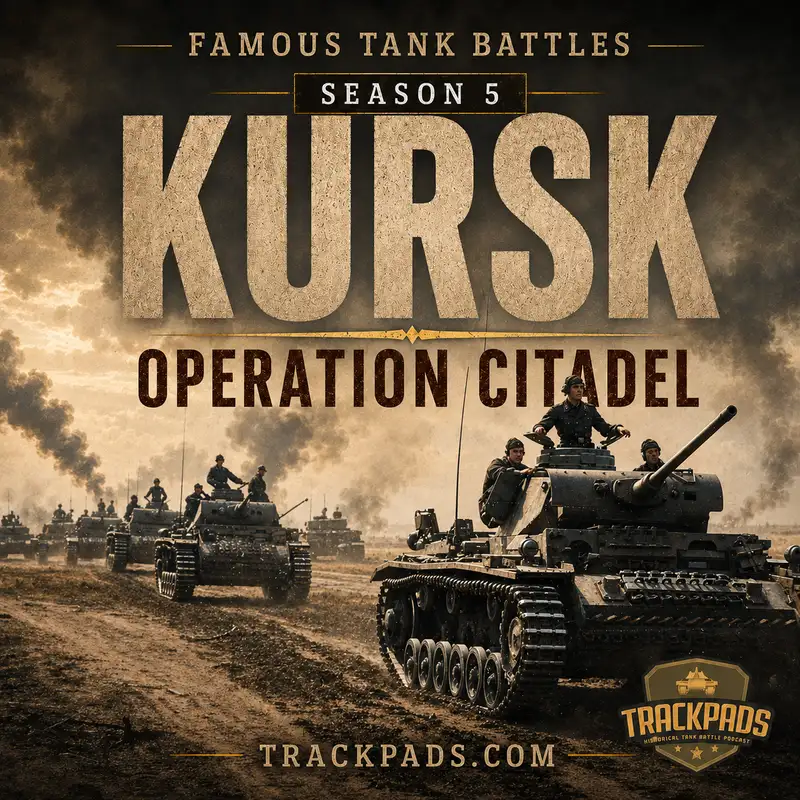
The names Tiger, Panther, and Ferdinand have become part of the legend of Kursk, and it is easy to understand why. These were German armored vehicles with an aura of power, built around heavy protection, strong guns, and the hope that technological superiority might restore battlefield advantage. To listeners coming to Kursk through popular memory, the battle can seem like a contest between famous machines, with German heavy armor on one side and masses of Soviet tanks on the other. But that picture is too narrow. Kursk matters because it shows that even impressive armored vehicles could not guarantee operational success when they were pushed into a battlefield shaped by mines, artillery, anti-tank belts, logistics, and prepared reserves.
If you would like to move beyond the podcast, you can see my available books at Military Author dot me. And at Trackpads dot com, you will find magazines and galleries with hundreds of thousands of photos and videos to explore.
German faith in new armor grew from real pressures. By 1943, the Wehrmacht faced a Red Army that was larger, better organized, and increasingly capable of replacing losses. Germany could not easily win a production race, so it placed increasing emphasis on quality, firepower, and protection. Heavy and advanced tanks seemed to offer a way to offset Soviet numerical strength. If German crews could hit harder at longer ranges and survive return fire more often, perhaps concentrated armored formations could still break through. This logic was not foolish in a simple tactical sense. A better gun, thicker armor, and trained crews could matter enormously in a local fight. The danger came when tactical advantages were expected to solve operational problems that were much larger.
The Tiger was the most feared of the German heavy tanks at Kursk. It was heavily armored, carried a powerful gun, and could dominate many engagements when it fought from favorable positions with skilled crews and proper support. Soviet tank crews and anti-tank gunners had reason to respect it. Yet the Tiger was not a battlefield miracle. It was heavy, mechanically demanding, fuel-hungry, and dependent on recovery and maintenance systems that had to function under fire. A Tiger that broke down, hit a mine, or became isolated from infantry and engineers could lose much of its value. Its strength was real, but it worked best as part of a coordinated system, not as an independent solution to a deeply prepared defense.
The Panther was newer, more ambitious, and in some ways more revealing. It had sloped armor and a high-velocity gun that pointed toward the future of tank design. On paper, it seemed like exactly the kind of vehicle Germany needed: powerful enough to fight Soviet armor effectively, yet more suited to armored formations than the heavier Tiger. At Kursk, however, the Panther suffered from the consequences of being rushed into combat before it had fully matured. Mechanical problems, fires, drivetrain failures, and recovery difficulties reduced its battlefield effect, especially in the opening phase. Some Panthers fought effectively, and the design would become more formidable later, but Kursk exposed the difference between promising engineering and a reliable weapon system ready for sustained operations.
The Ferdinand heavy tank destroyer was another example of German faith in firepower. It carried a very powerful gun and had heavy frontal protection, making it dangerous against tanks and guns at range. But it also revealed the limits of designing a vehicle around one impressive strength. At Kursk, Ferdinands could be deadly when they found the right engagement, but they were vulnerable when forced into close terrain, mines, infantry attacks, or situations requiring flexible support. Early Ferdinands lacked a hull machine gun, which made them especially dependent on nearby infantry protection against close assault. That detail matters not as trivia, but as a lesson. A vehicle built to kill tanks still had to survive on a battlefield filled with infantry, engineers, mines, artillery, and confusion.
The German armored force at Kursk was therefore both formidable and fragile. It contained experienced crews and powerful vehicles, but those vehicles imposed heavy demands. They needed fuel, ammunition, spare parts, trained mechanics, recovery vehicles, and routes strong enough to carry them forward. A damaged medium tank might sometimes be recovered more easily than a heavy vehicle stuck under fire or immobilized in a minefield. Mechanical losses could be as important as enemy fire, because an offensive depends on how many vehicles can keep moving, not just how many exist on morning strength reports. At Kursk, the Germans could assemble impressive armor, but the Soviet battlefield was designed to convert weight and complexity into delay.
The Soviet side is often described through the T-34, and that tank deserves its place in the story. It was mobile, rugged by comparison with many more complex vehicles, and available in large numbers. By 1943, however, many German tanks and anti-tank guns could kill it, and Soviet crews often faced severe danger when attacking well-positioned German armor. The T-34 was not a magic machine any more than the Tiger was. Its importance came from the system around it: production, repair, replacement, crew training that was improving though still uneven, and the ability to use tanks in combination with artillery, infantry, and reserves. Soviet armored warfare at Kursk was not simply about having more tanks. It was about having enough tanks, guns, mines, and men to keep the campaign going after losses.
Soviet anti-tank defense also did much of the work that popular memory assigns to tank duels. Mines stopped or slowed vehicles. Anti-tank guns covered likely approaches. Artillery struck concentrations and support units. Infantry protected positions and attacked isolated vehicles at close range when conditions allowed. Tank brigades and corps were held for counterattacks, but they were only one part of the larger defensive design. This is essential to understanding Kursk. The Germans did not drive into an open field and lose only because Soviet tanks appeared in greater numbers. They drove into a layered environment where every branch of the Red Army had a role in damaging, confusing, and slowing the armored attack before the largest counterblows were launched.
The famous hardware also shaped the psychology of the battle. German heavy tanks could encourage confidence among attackers and fear among defenders, especially where their guns outranged Soviet weapons in open engagements. Soviet soldiers learned to attack them through flank shots, close-range fire, mines, artillery, and coordinated anti-tank zones rather than relying on fair frontal exchanges. That was not always successful, and Soviet losses could be severe. But the defensive system reduced the number of situations in which German technical strengths could operate freely. A powerful gun matters most when it can see, aim, and fire before the enemy can respond. Dust, smoke, mines, broken ground, artillery, and pressure from multiple directions all made that clean engagement harder to achieve.
Crew training and communication were just as important as steel. German armored units generally benefited from experienced leaders, good tactical coordination, and radio use that had long been central to panzer warfare. These advantages helped them react quickly, shift fire, exploit local openings, and recover from confusion. Soviet forces had improved greatly, but many units still struggled with uneven training, command rigidity, and communication problems under stress. Yet Kursk shows that tactical skill does not operate in a vacuum. A well-handled German tank platoon could win its immediate fight and still be delayed by mines, halted by artillery, or drawn into a defense too deep for local success to decide. Skill mattered, but the battlefield framework mattered too.
Maintenance and recovery formed a hidden battle behind the armored clash. A tank army is never made only of tanks. It includes workshops, spare parts, fuel trucks, ammunition carriers, recovery tractors, mechanics, drivers, road-control troops, and commanders trying to keep routes open. Heavy German vehicles could be difficult to recover when disabled, especially under fire or in congested lanes. Soviet vehicles also broke down and were destroyed in large numbers, but Soviet planning increasingly accepted losses as part of a campaign of depth and replacement. The crucial measure was not whether a tank type was impressive in isolation. It was whether enough armored strength could be kept in the fight long enough to serve the operational plan.
The comparison between German and Soviet armor at Kursk is therefore not a simple story of quality against quantity. The Germans had vehicles that could be tactically superior in important situations, but they also had a plan that required those vehicles to achieve rapid operational effects against prepared defenses. The Soviets had large numbers of tanks, but they did not rely on numbers alone. They used a defensive system that made German advantages harder to exploit and Soviet losses easier, though never easy, to absorb. This is why Kursk is such a valuable teaching battle. It forces the listener to move beyond the question of which tank was better and ask the more important question: which army built the better system for the battle it expected to fight?
The story of Tigers, Panthers, and Ferdinands also connects Kursk to the broader evolution of armored warfare. From the First World War onward, armies repeatedly hoped that machines could solve the problem of fire, movement, and survival on the modern battlefield. Sometimes technology changed everything, but only when doctrine, training, logistics, and combined arms made that technology usable. At Cambrai, tanks showed promise but lacked the full system needed for lasting exploitation. In the early blitzkrieg campaigns, German armored forces showed how radios, aircraft, infantry, and operational planning could make tanks decisive. At Kursk, the lesson shifted again. Advanced vehicles could win firefights and still fail to produce decision if the enemy had prepared the battlefield to consume momentum.
The machines of Kursk deserve attention because they were real, dangerous, and influential. German Tigers, Panthers, and Ferdinands shaped the fighting and left a deep mark on memory, just as Soviet T-34s and anti-tank weapons shaped the defense that met them. But the battle’s deeper lesson is that armored warfare is never just a showroom of vehicles. It is a contest between systems under pressure: engineering against movement, logistics against distance, communications against confusion, doctrine against reality, and human endurance against fire and fear. The Germans brought some of the most powerful armored machines yet seen on the Eastern Front. The Soviets answered not with one better machine, but with a battlefield designed to make machines insufficient by themselves. That is why the hardware episode of Kursk ends not with a winner in a tank comparison, but with a harder truth: technology matters, but it only becomes decisive when the whole army can turn it into operational success.