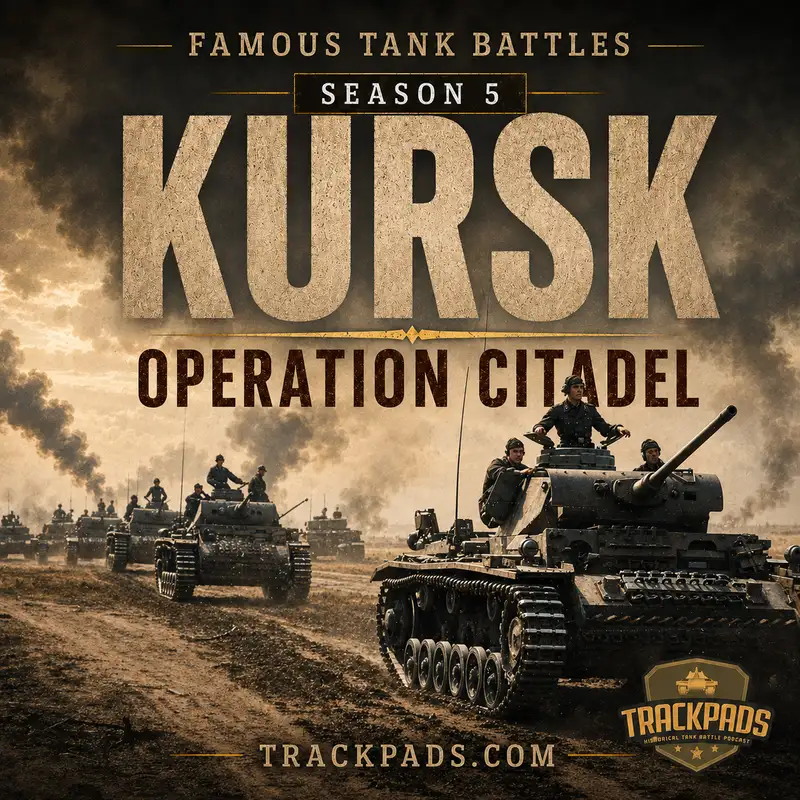
Kursk: Episode 8 — Night Before Citadel
On the night before Operation Citadel began, the Kursk salient was not quiet in any simple sense. Even when guns were not firing, the landscape held the pressure of months of preparation. German formations waited north and south of the Soviet bulge, assembled for an offensive that was meant to restore momentum on the Eastern Front. Soviet troops waited inside the salient, dug into belts of defenses that had been built precisely because they expected this attack to come. Kursk’s eve matters in the history of armored warfare because it shows the strange stillness before a mechanized storm, when tanks, guns, aircraft, mines, maps, fuel dumps, and human fear had already been arranged into a battle long before the first official assault.
If you would like to move beyond the podcast, you can see my available books at Military Author dot me. And at Trackpads dot com, you will find magazines and galleries with hundreds of thousands of photos and videos to explore.
For German soldiers, the night carried the burden of expectation and uncertainty. They knew they were preparing for a major attack, and many understood that this was no ordinary local operation. Units had rehearsed routes, studied objectives, checked vehicles, moved ammunition, and waited through delays while the high command argued over timing and new equipment. Tank crews inspected tracks, engines, radios, sights, and weapons, because a mechanical failure in the opening hours could remove a vehicle from the battle as surely as enemy fire. Infantrymen prepared to follow armor into minefields and fortified villages. Engineers knew their work would be among the most dangerous of all, because the attack could not move unless lanes were opened through obstacles covered by Soviet guns.
On the Soviet side, waiting had a different meaning. The Red Army had chosen to receive the blow, but that choice did not make the final hours easy. Soldiers in the forward defenses understood that they might face the first impact of German armor, artillery, and air attack. Gun crews waited in dug-in positions, knowing that firing too soon could expose them and firing too late could be fatal. Engineers checked minefields and obstacles that might soon decide whether German tanks kept moving or stopped in confusion. Commanders watched for signs of the attack while trying to hold reserves in readiness. The Soviet defense was prepared, but preparation is not the same as safety. It meant that danger had been studied, not removed.
The last night before Citadel also belonged to staffs and signalers, the people who made large-scale mechanized warfare possible without becoming famous in the memory of it. Orders had to move from headquarters to corps, divisions, regiments, and battalions. Timetables had to coordinate artillery preparation, engineer work, armored movement, infantry advances, air support, and supply routes. Radios had to function, telephone lines had to be checked, and liaison officers had to understand where neighboring units were supposed to be. In an operation built around two converging attacks, coordination was not decorative. It was the difference between pressure and confusion. A pincer offensive depends on timing, and timing depends on communication that survives the first shock of battle.
The Soviet command system was also alert to the possibility of preempting the German assault with artillery fire. The Red Army had gathered enough information to expect the attack, though not every detail could be known with certainty. In the hours before dawn, Soviet artillery would strike German assembly areas in some sectors, an attempt to disrupt the attacker at the moment of greatest concentration. The effect of such fire has been debated and should not be exaggerated into a simple story of the German offensive being stopped before it started. But its significance is clear. The Germans were not attacking an unaware enemy. They were entering a battle in which the defender had been waiting, listening, measuring, and preparing to interfere before the first tanks crossed the start line.
The night was also full of machines at rest, which in armored warfare is never a simple condition. A tank park before an offensive is a place of maintenance, fueling, loading, and last-minute repair. Crews depended on mechanics and supply troops as much as on bravery. Fuel had to be in the right place. Ammunition had to be distributed. Recovery vehicles had to be ready to pull disabled tanks from lanes that would soon be crowded and dangerous. Heavy German vehicles such as Tigers, Panthers, and Ferdinands promised formidable combat power, but they also placed great demands on the support system around them. Soviet tanks held deeper in reserve faced the same reality in their own way. A tank that cannot be fueled, repaired, or guided into battle is only potential strength.
The human imagination naturally looks for drama in the moment before combat, but historical responsibility requires restraint. We do not need invented conversations or theatrical speeches to understand the tension. The situation itself was dramatic enough. Men on both sides were waiting in darkness for an event that had been discussed for months and would be decided in violence over days and weeks. Some were veterans who had survived earlier campaigns and knew how quickly plans could dissolve. Others were replacements or younger soldiers whose understanding of what was coming was shaped by rumor, training, and the visible mass of weapons around them. Fear, exhaustion, confidence, fatalism, and duty could coexist in the same unit without leaving neat evidence behind.
The landscape itself had been altered in ways that mattered for the coming dawn. Soviet trenches cut through fields. Minefields lay along likely approaches. Anti-tank guns were dug in where they could cover roads, slopes, and gaps between settlements. German routes forward had been selected, studied, and assigned, but those routes would soon be tested by obstacles, fire, dust, and traffic. Without a map, the listener can picture two great pressures aimed toward one another across the shoulders of a bulge. From the north, German units prepared to move down into the salient. From the south, German armored forces prepared to drive upward into deeper Soviet defenses. Inside the salient, Soviet formations waited not in a single line, but in layers.
Air forces prepared for their own opening role. Kursk was not only a ground battle, and both sides knew that reconnaissance and close support could shape the first day. Aircraft could strike assembly areas, attack columns, support ground troops, and attempt to blind the enemy by disrupting command and observation. Pilots and ground crews were part of the same pre-battle tension as tank crews and infantry. Engines had to be maintained, aircraft armed, targets assigned, and airfields protected. The Luftwaffe still possessed skill and striking power, while the Soviet air forces had grown stronger and more capable than in the early disasters of the war. The coming battle would crowd the sky as well as the roads and fields.
The final hours also reveal the difference between strategic ambition and tactical experience. At the highest level, Hitler and the German command hoped Citadel could cut off the salient and reassert German initiative. At the level of a platoon or company, that ambition translated into immediate tasks: cross a start line, follow a lane, clear a minefield, hold formation, keep radio contact, survive artillery fire, and reach the next piece of ground. The Soviet high command intended to absorb the blow and then counterattack from depth. At the level of a trench or gun pit, that intention meant staying in place while bombardment arrived, waiting for targets, and trusting that the defensive system behind them would not collapse. Great campaigns are lived in small, dangerous increments.
By this point, the battle had already become a contest over tempo. The Germans needed the first day to produce momentum, because Citadel depended on quick penetration and exploitation. The Soviets needed the first day to deny that rhythm, to turn forward motion into delay, and to make the German attack reveal its strength and direction. This is why the night before Citadel carries such importance. It was not merely a pause before battle. It was the last moment before two different theories of armored warfare collided. One theory still sought decision through concentrated mechanized attack. The other used intelligence, engineering, depth, and reserves to break that attack before answering with its own offensive force.
The stillness before dawn did not mean peace, and it did not mean uncertainty in the ordinary sense. Both sides knew a great battle was coming, even if no one could know exactly how it would unfold. The Germans had assembled armored strength and planned a double envelopment that looked clear from headquarters. The Soviets had built a prepared defense meant to make that clarity dissolve in minefields, artillery fire, and successive belts of resistance. Between those two preparations lay thousands of soldiers waiting for the night to end. Kursk would soon become noise, dust, smoke, confusion, and movement, but its meaning was already present in the darkness. The battle had been building for months, and the final night showed that modern armored warfare begins long before tanks move. It begins when armies decide what kind of battlefield they intend to create, and what price they are willing to pay when dawn arrives.