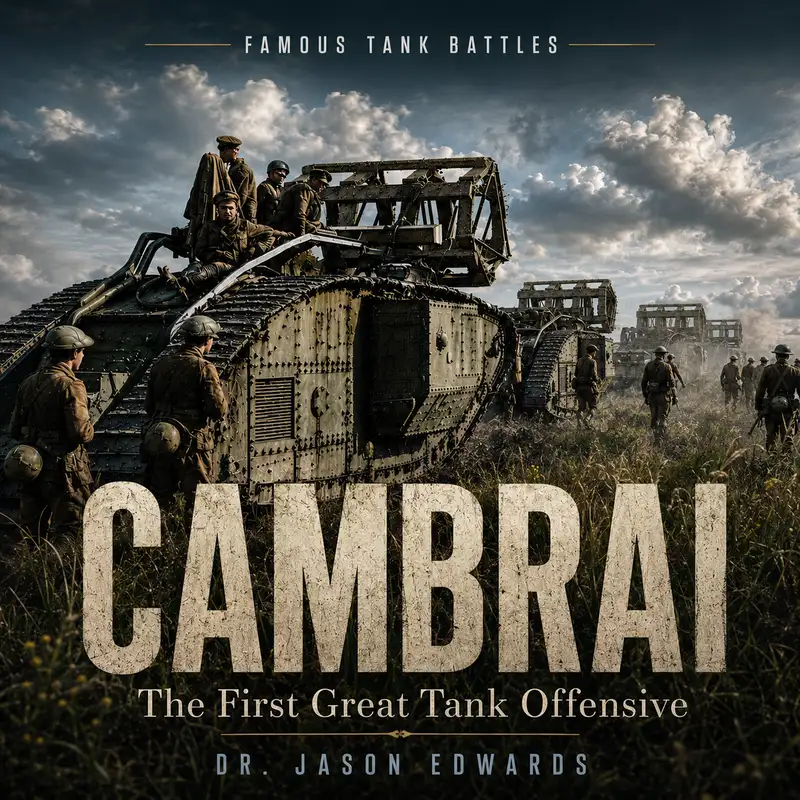
Cambrai: Episode 24 — Draw, Legend, and the Future of Armor
When the Battle of Cambrai finally wound down in the first week of December, Nineteen Seventeen, it left behind two very different truths that have lived together ever since. One truth was military and immediate. The British had not achieved a decisive strategic victory, had not taken Cambrai, and had not turned their dramatic opening breach into a lasting collapse of the German front. The other truth was larger and longer-lived. Cambrai had changed how soldiers, politicians, and the public thought about tanks, surprise, and combined-arms battle, and that change survived even though the battlefield result itself remained painfully incomplete. That is why the ending of Cambrai is so important. It was both a near draw in ground and casualties, and a genuine turning point in military imagination.
This podcast is accompanied by a companion book that expands the story of the Battle of Cambrai, with additional historical context, maps, and dozens of enhanced colorized photographs from the battle. Your purchase helps support our mission to keep these podcasts free. You can find the book at Military Author dot me or at track pads dot com
Measured in straightforward battlefield terms, the end state was disappointing when set against the hopes of the twentieth of November. The British had burst through the Hindenburg Line, advanced several miles on the first day, and briefly made it seem possible that the old trench deadlock was finally cracking under a new method. Then the battle narrowed around Bourlon, the German counterstroke tore through the southern side of the salient, and much of the spectacular gain was clawed back. By the time the fighting ended, the British retained only a smaller wedge of ground around places such as Havrincourt, Ribécourt, and Flesquières, while the larger dream of using Cambrai as the opening of something decisive had vanished. Casualty figures vary depending on exactly how they are counted, but the broad impression remains consistent: both sides paid heavily, and neither side emerged with the kind of strategic decision that could settle the campaign.
That military ambiguity created an immediate political and institutional problem. Cambrai had first been presented in Britain as a striking success, so much so that church bells rang in celebration after the opening blow. Then the German counterattack and the loss of much of the newly won ground turned triumph into controversy. This was not just a matter of disappointed headlines. It raised uncomfortable questions inside the British state and the army about whether the battle had been mishandled after its initial success, whether intelligence had failed, whether troops had been left too exposed, and whether senior commanders had properly understood the risks of the salient they had created. When a battle begins like a breakthrough and ends like an unfinished argument, people do not leave it alone. They demand inquiry, they search for blame, and they build stories that make the confusion easier to bear.
The inquiry that followed reflected exactly that mood. No single explanation could carry the whole burden of what had gone wrong after the opening days, because too many failures had intersected. There had been poor warning of the scale and method of the German counterattack. British doctrine for defending a newly won salient was underdeveloped. Units on the line had been exhausted by the offensive fighting around Bourlon and were not in ideal condition to absorb a sophisticated counterstroke. Higher commanders had also made choices that exposed the position to danger, especially by continuing to deepen the salient without fully securing it. This is why Cambrai remains such an important study in command. It was not lost or limited by one error alone. It was shaped by the interaction of intelligence, training, fatigue, battlefield geometry, and the pressure senior commanders placed on tired troops to keep pressing after the easy opportunities had already narrowed.
Naturally, many people still wanted simpler answers than that. Simpler answers are emotionally satisfying in war because they turn painful complexity into something that can be pointed at. One version blamed particular commanders, especially in the disputes over Flesquières and later over the southern collapse. Another version blamed intelligence officers for failing to appreciate the danger building on the German side. Still another pointed to the alleged poor training of some troops in defensive methods. Each of these explanations contains part of the truth, but none is large enough on its own. Cambrai produced myths because myths are what armies and nations often build when a battle offers both pride and embarrassment at once. The famous story of the lone gunner at Flesquières, the tendency to load too much blame onto one divisional commander, or the urge to turn the whole inquiry into one villain’s failure all belong to that larger human habit of simplifying what was, in reality, a deeply entangled military event.
And yet if Cambrai ended only as an argument about blame, it would not still matter as much as it does. The reason it stayed alive in memory is that its opening success had been real enough to change belief. Tanks had already appeared in the war before Cambrai, but here they were used in a concentrated, operationally meaningful way that the public and the army could not ignore. The image of British tanks crossing wire and trenches in large numbers, working alongside carefully planned artillery and advancing infantry, had an effect far beyond the final line on the map. To civilians back home, the tank looked like a distinctly British answer to the deadlock, a weapon that seemed to promise movement, ingenuity, and industrial power. To soldiers, even skeptical ones, it became much harder after Cambrai to dismiss the tank as a theatrical curiosity. The battle’s opening had given the machine a public legend, and legends can survive outcomes that are otherwise mixed.
Still, the most serious legacy of Cambrai was not legend by itself. It was the fact that the battle showed tanks as part of a system rather than as independent heroes. The real achievement of the twentieth of November was not that one new machine suddenly conquered the battlefield on its own. It was that predicted artillery fire, sound-ranging, surprise, concentrated tanks, specialized engineer work, infantry tactics, and air support were all beginning to converge into a recognizable combined-arms method. That method was still imperfect, and the later fighting around Bourlon, Fontaine, and the salient showed exactly how imperfect it remained. But the central lesson had been taught. The future of armored warfare would not lie in tanks alone. It would lie in tanks working within a coordinated battle design that protected movement with fire, used surprise intelligently, and understood that logistics and timing mattered as much as armor plate.
That lesson was enough to secure the tank’s institutional future in the British Army. Before Cambrai, the Tank Corps still had to prove that it was more than an expensive experiment. After Cambrai, even though many tanks had been lost or abandoned and even though the battle had not yielded a decisive strategic result, the argument about whether tanks belonged at all had been transformed. Now the debate was not over existence, but over use, doctrine, maintenance, and scale. That is an enormous change. Military institutions can survive disappointment if they have shown genuine potential, and at Cambrai the tank had shown exactly that. It had helped produce a first-day result the army could not have ignored even if it had wanted to. In that sense, the future of armor was secured not by an unbroken victory, but by a flawed demonstration powerful enough to make retreat from the idea impossible.
The Germans learned from Cambrai just as seriously, which is one more reason the battle matters. They had already answered the British opening with their own counterstroke, but the lesson did not end there. The shock created by tanks in large numbers forced German commanders to think harder about anti-tank artillery, battlefield obstacles, and the use of captured British machines. In fact, dozens of abandoned Mark Fours fell into German hands after the fighting, and after repair a significant number were used by Germany in Nineteen Eighteen. That detail is revealing in two ways. It shows how costly Cambrai had been for the British armored force, and it shows that even the side that had checked the new method felt compelled to adopt part of it. The future of armor was therefore not only British. Cambrai helped push both armies toward a new military world, even if they entered it from different directions.
Its deepest practical importance lay in what came next. Cambrai did not offer a finished model of successful armored warfare. It offered an incomplete draft. The British could later look back and see what had been missing. They needed better ways to sustain momentum after the breach. They needed clearer doctrine for stopping an attack before it turned into attritional waste. They needed more resources and more organizational confidence to launch a successful blow and then shift the effort elsewhere rather than continuing to batter at the same point. Those are among the reasons later operations in Nineteen Eighteen, especially Amiens, looked more mature. At Amiens, many of the parts that had been present but incomplete at Cambrai came together more successfully: combined arms, surprise, tanks in force, artillery coordination, and a clearer appreciation of when success was enough and when continued assault would simply consume the attacking strength.
This is why Cambrai should be remembered neither as a simple triumph nor as a simple disappointment. If someone calls it the battle that proved tanks would dominate the future, that says too much. If someone calls it an overhyped battle that changed little because the map moved back toward its starting point, that says too little. The more accurate judgment is harder and therefore more useful. Cambrai was a battle in which the future became visible before it became reliable. It revealed that trench systems could be broken into by a carefully designed all-arms assault. It also revealed that breaking in was easier than breaking through, that exploitation required more than shock, and that a salient created by success could become a dangerous burden if the attacker lacked the means to secure its shoulders and protect its communications.
Memory, of course, has never been content with that balanced version. Public memory prefers the first day, the bells, the tanks, and the sense of invention. Professional military memory often prefers the lessons: how not to overextend, how not to fight for too long in the wrong terrain, how to combine weapons more intelligently, and how to protect the gains of an offensive before chasing more. Political memory prefers the inquiry and the blame, because those are the forms in which disappointment becomes manageable. All of those memories contain part of Cambrai, but none contains all of it. The battle became a legend because it satisfied different needs at once. It offered heroism, caution, innovation, and controversy. That is exactly the kind of battle that survives, not because its result was simple, but because its meaning was so difficult to settle.