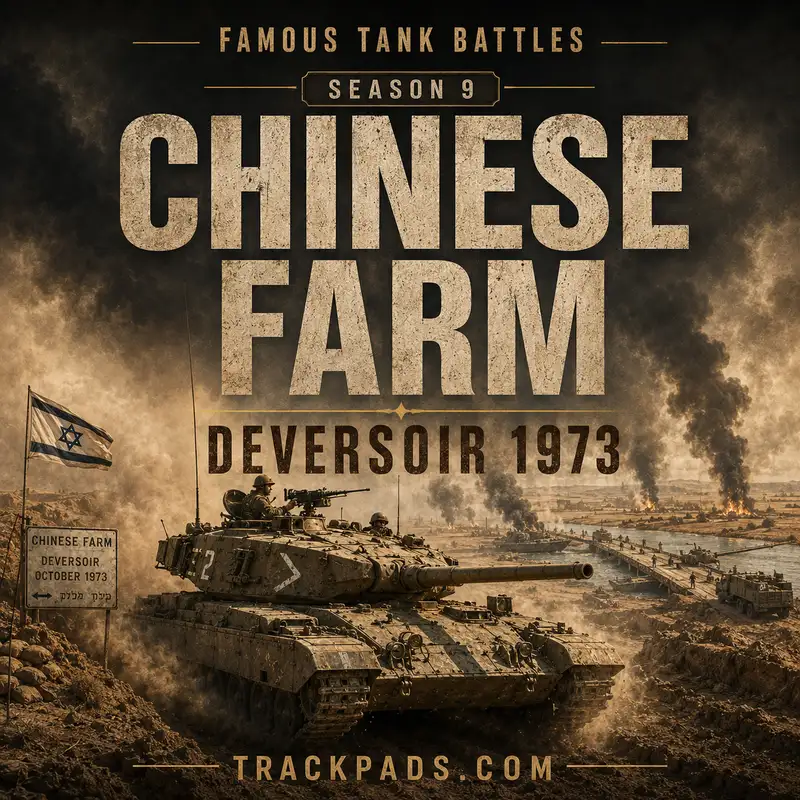
Chinese Farm: Episode 13 — Night of 15 October
The night of 15 October began with the kind of darkness that makes armies feel both hidden and lost. Somewhere ahead lay the Suez Canal, the same strip of water Egypt had crossed in triumph nine days earlier, now waiting for Israel’s counterstroke. Behind the Israeli columns stretched a battlefield already crowded with burned tanks, exhausted crews, shouted orders, and roads that mattered more than anyone had imagined before the war. The plan was bold enough to sound simple: push through the gap near Deversoir, reach the water, put a first force across, and open the way for bridges and armor. But night does not respect neat plans. It turns tracks into guesses, units into shadows, and minutes into things men can lose without noticing until the entire operation is in danger.
If you would like to move beyond the podcast, you can see my available books at Military Author dot me. And at Trackpads dot com, you will find magazines and galleries with hundreds of thousands of photos and videos to explore.
Israel entered that night carrying two memories at once. One was the shock of 6 October, when Egypt had crossed the canal and made the old Israeli answers fail. The other was the victory of 14 October, when Egyptian armor had pushed eastward and been badly beaten in the open desert. Those memories pulled in opposite directions. The first warned against arrogance; the second invited action. Israeli commanders knew that the opportunity near Deversoir might not remain open for long. If Egypt recognized the danger and sealed the seam between its Second and Third Armies, the crossing plan could die before it began. So the army moved not with the calm confidence of a force certain of success, but with the strained urgency of men who believed the war had given them one narrow door and might close it at any hour.
For Ariel Sharon’s division, the first task was to reach and hold the approaches to the canal. That meant controlling a confusing network of desert roads and tracks whose code names would soon become part of the war’s grim vocabulary. Akavish and Tirtur led westward toward the crossing area. Lexicon ran closer to the canal. To a planner, these were lines on a map, ways to move tanks, infantry, and bridging equipment toward Deversoir. To the soldiers that night, they were darker and more treacherous things: dust-choked routes where vehicles bunched up, where commanders argued over location, where a wrong turn could push a unit toward Egyptian fire or leave a bridge convoy stranded behind a traffic jam. The whole counteroffensive depended on passage through corridors that were not yet truly secure.
The battlefield east of the canal was not empty, and that was the danger hidden inside the word gap. Operationally, there was a seam between the Egyptian armies. Tactically, men still occupied trenches, strongpoints, ditches, and fields near the route. Egyptian soldiers did not need to understand the full Israeli crossing plan to endanger it. A platoon holding firm, an anti-tank team firing from concealment, or artillery falling at the wrong junction could slow the flow long enough to unravel the sequence. The area around the agricultural research complex later called the Chinese Farm was especially dangerous because it broke the illusion of open desert. Irrigated plots, embankments, canals, and prepared positions made movement confusing and cover plentiful. The Israelis were trying to create a corridor through ground that could swallow units whole.
The night movement had to balance secrecy against speed. Move with too much caution, and surprise would evaporate before the crossing force reached the water. Move too fast, and tanks, half-tracks, engineers, paratroopers, and bridging vehicles could collide with one another in darkness and dust. This is one of the least cinematic truths of armored warfare: great operations can be delayed by traffic. A tank that halts in the wrong place can block vehicles behind it. A bridge section that cannot pass through a jam is as useless as a bridge destroyed by enemy fire. A column that loses its route may carry enormous combat power in the wrong direction. On the night of 15 October, Israel’s bold operational idea had to pass through the very ordinary problem of getting men and machines to the same place at the same time.
The first force meant to cross the canal was not a heavy armored column but a paratroop force under Danny Matt. These men had to reach the bank, launch rubber boats and rafts, and slip across to the west side before the Egyptians fully grasped what was happening. The contrast is striking. Around them, tanks and armored vehicles roared, radios crackled, and commanders tried to force order onto roads packed with machines. Yet the crossing itself, at its first and most vulnerable moment, depended on small craft moving across dark water. There is something almost intimate about that kind of danger. A tank battle can feel vast from a distance, but a boat crossing at night reduces war to breathing, paddling, waiting for fire, and staring at a bank that may or may not be held by the enemy.
Israeli deception and confusion worked together in ways no headquarters could fully control. The Israelis hoped the Egyptians would not immediately recognize the crossing as the main effort. Some Egyptian attention remained fixed on the east-bank fighting and on the aftermath of the failed offensive the day before. Yet the same confusion that helped hide Israeli intentions also threatened Israeli coordination. Units moving toward Deversoir did not always know exactly where neighboring units were. Commanders received reports that were incomplete or already outdated. A formation might be told a route was open only to discover that Egyptian resistance still covered it. The operation needed surprise, but it also needed clarity. War has a cruel habit of giving one at the expense of the other.
As Israeli armor pushed through the approaches, the fighting grew sharper. Tanks were needed not simply as breakthrough machines but as guards for the whole crossing apparatus. They had to seize junctions, suppress Egyptian positions, shield the movement of infantry, and keep routes open for vehicles that could not defend themselves well. That included the bridging equipment waiting behind the forward units. Without bridges, the first troops on the west bank would remain a fragile foothold. With bridges, the foothold could become a true lodgment and then a threat to the Egyptian rear. This made every fight east of the canal feel larger than its immediate size. A trench cleared near a road might decide whether a bridge convoy moved. A delayed convoy might decide whether the paratroopers across the water lived or died.
The Egyptian defenders fought inside a fog of their own. Some knew only that Israeli forces were pressing hard in their sector. Others may have understood that something larger was underway but not exactly where or how far it had gone. The Egyptian army had spent years preparing to cross eastward and defend its bridgeheads against Israeli counterattack. Now, on the night of 15 October, the direction of danger began to bend. Israeli forces were not merely trying to push Egyptian infantry back from the canal line. They were trying to reach the canal at a weak point and reverse the war’s geography. For Egyptian soldiers in the trenches, that larger truth may have been invisible. What was visible was the immediate fight: headlights cut off, engines in the dark, tank fire, flares, shouting, and the order to hold.
The Israeli high command watched the night with hope sharpened by anxiety. If the first crossing succeeded, Israel could place troops west of the canal and force Egypt into a crisis it had not planned for. If it failed, Israel might lose precious men and machines in a narrow corridor while the Egyptians sealed the gap. The operation’s structure left little room for half-success. A few men across the canal would not be enough. A few tanks near the bank would not be enough. The roads had to stay open, the boats had to cross, the bridges had to arrive, and follow-on forces had to widen the breach before Egyptian counteraction became overwhelming. The plan was not one event. It was a chain, and every link was under strain.
This night also shows why armored warfare cannot be understood as movement alone. The Israeli army was moving boldly, but movement had meaning only if it connected to infantry, engineers, bridges, communications, and command judgment. Tanks could seize space, but they could not turn water into a crossing site by themselves. Paratroopers could establish a foothold, but they could not exploit it without armor and supplies behind them. Engineers could bring bridging equipment forward, but only if the roads were cleared and traffic controlled. Commanders could imagine a maneuver, but imagination had to survive dust, darkness, Egyptian resistance, mechanical delay, and human exhaustion. The night of 15 October was not a clean armored dash. It was a moving argument between a plan and everything the battlefield did to resist it.
By the time the first Israelis began to reach the canal area, the war had entered its most delicate phase. Egypt’s opening success had not been erased. The bridgeheads east of the canal still existed, Egyptian troops still fought hard, and the missile umbrella still shaped the wider battlefield. But the initiative was beginning to tilt. For the first time since Operation Badr, Israel was not merely reacting to Egypt’s design. It was attempting to impose a new design of its own, one that would make the Egyptians defend their rear and protect the west bank. That shift began not with a triumphant parade of tanks but with exhausted men forcing their way through darkness toward a crossing site that might still vanish as an opportunity if they arrived too late.
The night of 15 October deserves its place in this story because it was the breath before the plunge. It was the moment when the Israeli counteroffensive stopped being an idea and became a dangerous physical fact moving through narrow roads, enemy positions, and black water. Nothing was secure yet. The Chinese Farm still waited as a bloodier struggle for the corridor. The bridges had not yet solved the crossing problem. Danny Matt’s paratroopers still had to establish themselves on the far bank, and Egyptian commanders still had time to react. But the hinge of the campaign had begun to turn. In the darkness near Deversoir, amid confusion that no plan could fully master, Israel reached for the canal and for the chance to turn Egypt’s great crossing into the opening of an Israeli countercrossing.